Begin of page section:
Page sections:

  • Go to contents (Accesskey 1)
  • Go to position marker (Accesskey 2)
  • Go to main navigation (Accesskey 3)
  • Go to sub navigation (Accesskey 4)
  • Go to additional information (Accesskey 5)
  • Go to page settings (user/language) (Accesskey 8)
  • Go to search (Accesskey 9)

End of this page section. Go to overview of page sections

Begin of page section:
Page settings:

English en
Deutsch de
Search
Login

End of this page section. Go to overview of page sections

Begin of page section:
Search:

Search for details about Uni Graz
Close

End of this page section. Go to overview of page sections


Search

Begin of page section:
Main navigation:

Page navigation:

  • University

    University
    • About the University
    • Organisation
    • Faculties
    • Library
    • Working at University of Graz
    • Campus
    Developing solutions for the world of tomorrow - that is our mission. Our students and our researchers take on the great challenges of society and carry the knowledge out.
  • Research Profile

    Research Profile
    • Our Expertise
    • Research Questions
    • Research Portal
    • Promoting Research
    • Research Transfer
    • Ethics in Research
    • Commission for Scientific Integrity
    Scientific excellence and the courage to break new ground. Research at the University of Graz creates the foundations for making the future worth living.
  • Studies

    Studies
    • Prospective Students
    • Students
  • Community

    Community
    • International
    • Location
    • Research and Business
    • Alumni
    The University of Graz is a hub for international research and brings together scientists and business experts. Moreover, it fosters the exchange and cooperation in study and teaching.
  • Spotlight
Topics
  • Sustainable University
  • Researchers answer
  • Work for us
Close menu

End of this page section. Go to overview of page sections

Begin of page section:
You are here:

University of Graz Natural sciences Institute of Physics News Druckwelle (German only)
  • About the institute
  • Our research
  • Personalities
  • Student Services
  • News
  • Events

End of this page section. Go to overview of page sections

Monday, 17 January 2022

Druckwelle (German only)

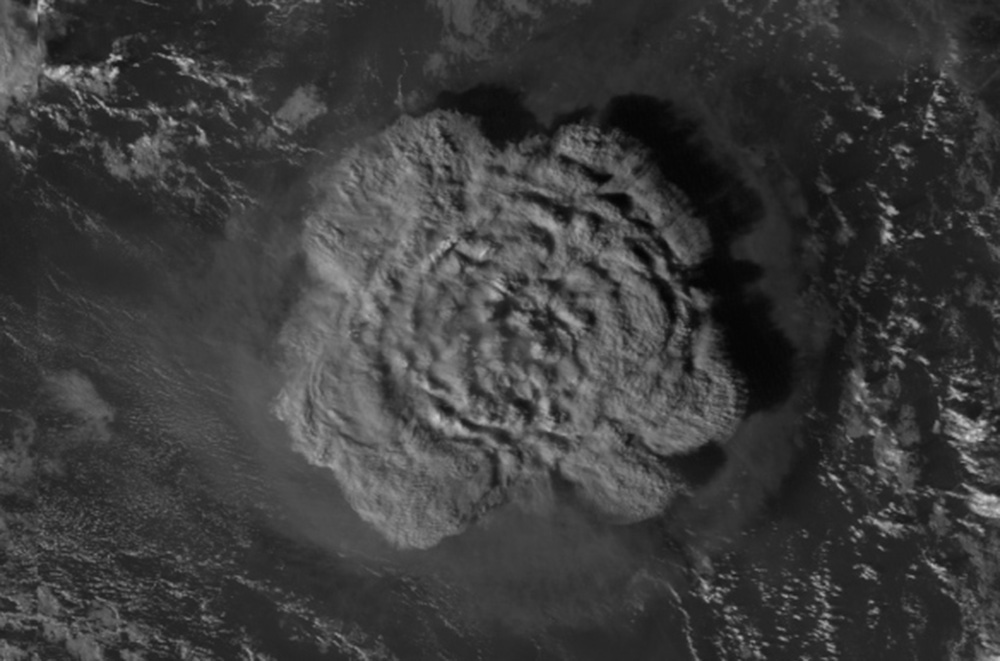
Ausbruch des Unterwasservulkans vor Tonga am 15. Jänner 2022. Foto: NASA

Ausbruch des Unterwasservulkans vor Tonga am 15. Jänner 2022. Foto: NASA

Der Vulkanausbruch vor Tonga im Südpazifik wurde an der Universität Graz gemessen

Der gewaltige Ausbruch des Unterwasservulkan vor Tonga im Südpazifik passierte am Samstag auf der anderen Seite der Erdkugel. Sichtbar war er aber sogar an der Wetterstation der Universität Graz. „Wir sehen die Druckwelle deutlich in den Aufzeichnungen unserer Messgeräte sowohl am Campus als auch auf der Kanzelhöhe“, schildert Ulrich Foelsche vom Institut für Physik. Denn eine Explosion breitet sich ähnlich einem Steinwurf ins Wasser in der Atmosphäre aus. Die aktuellen Daten hat Foelsche, der von der Stärke der Explosion überrascht war, gemeinsam mit seinen Wissenschaftskollegen Dietmar Baumgartner, Christoph Bichler und Klaus Huber ausgewertet. "An der Uni Graz ist die Druckwelle um 19:40 UTC Weltzeit angekommen, auf der Kanzelhöhe gerade einmal fünf Minuten später“, erklärt der Physiker.

Ob sich das Naturereignis nun aufs globale Klima auswirken wird, ließe sich derzeit noch nicht beantworten. „Das hängt davon ab, wie viel Schwefel in die Stratosphäre gelangt“, erklärt Foelsche. „Dort entsteht durch die Verbindung mit Wasser Schwefelsäure, die das Klima beeinflussen kann. Denn diese Schwefelsäure-Aerosole reflektieren einen Teil der Sonnenstrahlung und kühlen damit die Erde ab.“ Dieses Phänomen konnten ForscherInnen zuletzt vor 30 Jahren dokumentieren, als der philippinische Vulkan Pinatubo ausgebrochen war.
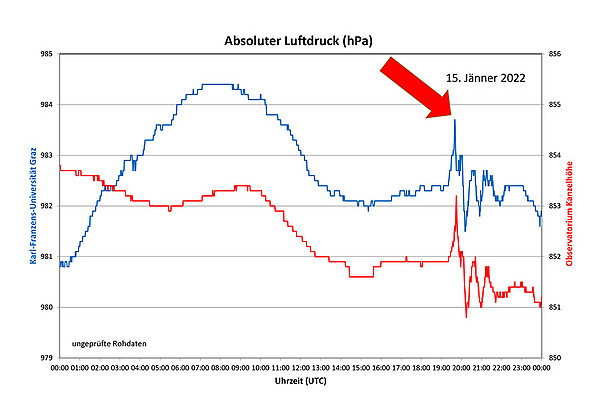
Die gewaltige Druckwelle, verursacht durch den Vulkanausbruch im Südpazifik, wurde am 15. Jänner 2022 ca. um 20 Uhr an den Wetterstationen Uni Graz (blau) und Kanzelhöhe (rot) gemessen.
Explosives Ereignis: Die gewaltige Druckwelle, verursacht durch den Vulkanausbruch im Südpazifik, wurde am 15. Jänner 2022 ca. um 20 Uhr an den Wetterstationen Uni Graz (blau) und Kanzelhöhe (rot) gemessen.
created by Andreas Schweiger

Related news

Committed to the highest standards

Three young researchers from the OpNaQ group gain insight into the world of standardization.

And the winner is ...

The winner of this year's indoor soccer tournament for employees of Styrian universities, universities of applied sciences and teacher education comes from our Institute! We congratulate our team with the prestigious name ‘We All have Potential!’ on this great success!

Research on the International Stage

Visiting Award 2025 Takes Marko Šimić to Stanford University The Dean’s Office of the Faculty of Natural Sciences at the University of Graz has awarded Marko Šimić the Visiting Award 2025. This mobility fellowship is granted annually to outstanding early-career researchers. Its aim is to promote research at the highest level at internationally renowned research institutions, providing financial and organizational support from the University of Graz and its research management services.

Happy birthday Schrödinger equation!

One of the most important equations of physics celebrates a round birthday.

Begin of page section:
Additional information:

University of Graz
Universitaetsplatz 3
8010 Graz
Austria
  • Contact
  • Web Editors
  • Moodle
  • UNIGRAZonline
  • Imprint
  • Data Protection Declaration
  • Accessibility Declaration
Weatherstation
Uni Graz

End of this page section. Go to overview of page sections

End of this page section. Go to overview of page sections

Begin of page section:

End of this page section. Go to overview of page sections