Begin of page section:
Page sections:

  • Go to contents (Accesskey 1)
  • Go to position marker (Accesskey 2)
  • Go to main navigation (Accesskey 3)
  • Go to sub navigation (Accesskey 4)
  • Go to additional information (Accesskey 5)
  • Go to page settings (user/language) (Accesskey 8)
  • Go to search (Accesskey 9)

End of this page section. Go to overview of page sections

Begin of page section:
Page settings:

English en
Deutsch de
Search
Login

End of this page section. Go to overview of page sections

Begin of page section:
Search:

Search for details about Uni Graz
Close

End of this page section. Go to overview of page sections


Search

Begin of page section:
Main navigation:

Page navigation:

  • University

    University
    • About the University
    • Organisation
    • Faculties
    • Library
    • Working at University of Graz
    • Campus
    Developing solutions for the world of tomorrow - that is our mission. Our students and our researchers take on the great challenges of society and carry the knowledge out.
  • Research Profile

    Research Profile
    • Our Expertise
    • Research Questions
    • Research Portal
    • Promoting Research
    • Research Transfer
    • Ethics in Research
    Scientific excellence and the courage to break new ground. Research at the University of Graz creates the foundations for making the future worth living.
  • Studies

    Studies
    • Prospective Students
    • Students
  • Community

    Community
    • International
    • Location
    • Research and Business
    • Alumni
    The University of Graz is a hub for international research and brings together scientists and business experts. Moreover, it fosters the exchange and cooperation in study and teaching.
  • Spotlight
Topics
  • Our digital Advent calendar
  • Sustainable University
  • Researchers answer
  • Work for us
Close menu

End of this page section. Go to overview of page sections

Begin of page section:
You are here:

University of Graz Natural sciences Institute of Physics News Ein Leben für Sonne, Mond und Planeten
  • About the institute
  • Our research
  • Personalities
  • Student Services
  • News
  • Events

End of this page section. Go to overview of page sections

Wednesday, 03 February 2016

Ein Leben für Sonne, Mond und Planeten

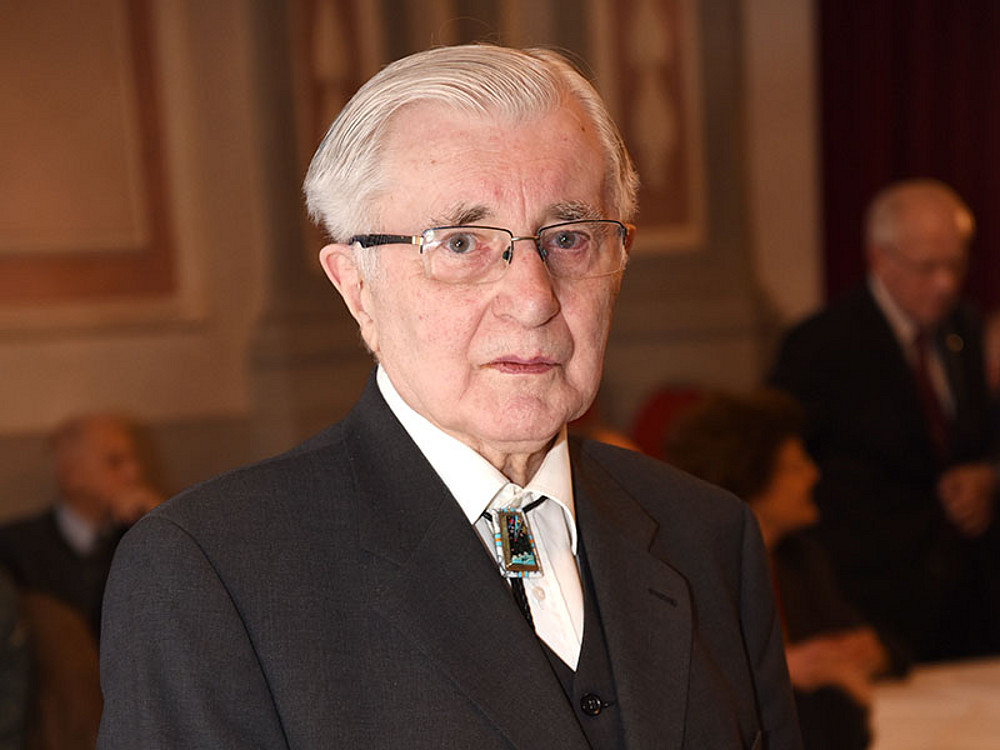
Hermann Haupt war von 1970 bis zu seiner Emeritierung 1994 Professor am Institut für Astronomie der Uni Graz. Fotos: Uni Graz/Pichler ©Uni Graz/Pichler

Hermann Haupt war von 1970 bis zu seiner Emeritierung 1994 Professor am Institut für Astronomie der Uni Graz. Fotos: Uni Graz/Pichler

Unter den GratulantInnen: Vizerektorin Renate Dworczak ... ©Uni Graz/Pichler

Unter den GratulantInnen: Vizerektorin Renate Dworczak und ...

... Arnold Hanslmeier vom Bereich Geophysik, Astrophysik und Meteorologie am Institut für Physik der Uni Graz. ©Uni Graz/Pichler

... Arnold Hanslmeier vom Bereich Geophysik, Astrophysik und Meteorologie am Institut für Physik der Uni Graz.

Astronom Hermann Haupt wurde anlässlich seines 90. Geburtstags an der Uni Graz geehrt

24 Jahre lang leitete Em.O.Univ.-Prof. Dr. Hermann Haupt das Institut für Astronomie der Karl-Franzens-Universität Graz, bis er 1994 emeritierte. Am 2. Februar 2016 feierte die Uni Graz den Sonnen- und Planetenforscher anlässlich seines 90. Geburtstags im Meerscheinschlössl.

Der gebürtige Niederösterreicher hatte an der Universität Wien Astronomie studiert und dort an der Sternwarte gearbeitet. Nach seiner Dissertation verbrachte Hermann Haupt ein Jahr an einer Sternwarte in Kalifornien. 1960 wechselte er von Wien an das Sonnenobservatorium Kanzelhöhe in Kärnten, wo er sich habilitierte. 1970 wurde er an die Karl-Franzens-Universität Graz berufen und befasste sich in den folgenden Jahren als Forscher und Lehrer vor allem mit Kleinplaneten, Sonnenphysik, Mond und Finsternissen.

Unter den GratulantInnen, die sich zur Geburtstagsfeier einfanden, waren Vizerektorin Ao.Univ.-Prof. Dr. Renate Dworczak, Dekan Univ.-Prof. Dr. Christof Gattringer, der Leiter des Instituts für Physik, Univ.-Prof. Dr. Walter Pötz, Em.O.Univ.-Prof. Dr. Helmut Denk in Vertretung des Präsidiums der Österreichischen Akademie der Wissenschaften und Univ.-Prof. Dr. Christian Köberl vom Naturhistorischen Museum und der Uni Wien.
Tit.Ao.Univ.-Prof. Dr. Ronald Weinberger von der Universität Innsbruck teilte als Schüler Haupts „Erinnerungsschnipsel“ mit den Gästen. Univ.-Prof. Dr. Arnold Hanslmeier vom Bereich Geophysik, Astrophysik und Meteorologie der Uni Graz moderierte die Feier und hielt einen Kurzvortrag über „das unsichtbare Universum“.
Als Überraschung überreichte Dr. Werner Pötzi vom Observatorium Kanzelhöhe dem Jubilar eine Sonnenfleckenzeichnung, die Hermann Haupt einst selbst angefertigt hatte.

created by Gudrun Pichler

Related news

New FWF – WEAVE Project "Longer Acenes: Synthesis, Interfaces, and Thin Films"

Unlocking the Potential of Longer Acenes: A New Era in Organic Electronics

Two Awards for an Outstanding Dissertation

Andreas Windischbacher received two prestigious awards for his outstanding doctoral dissertation. On March 17th, 2025, he was presented with the golden ring of honour of the Republic of Austria by our Federal President as part of the Promotio sub auspiciis Praesidentis rei publicae. On the same day, he was also selected for the Josef Krainer Förderungspreis, whose ceremonial presentation, however, took place later on November 12th, 2025.

NanoGraz Careers & Ideas Days 2025: Career paths after the doctorate

On October 13 and 14, the consortium NanoGraz of the Research Career Campus at the University of Graz organized a two-day event to inform the consortium's doctoral students about their career options after completing their doctorate. In addition to exciting lectures by early-career researchers as well as representatives from industry, the Austrian Science Fund (FWF), and the research management of the University of Graz, a brainstorming competition took place on the second day, in which the participants had the opportunity to develop their own joint mini-projects.

Seed-Funding Grant: Bringing Ideas to Life Together

With the new OpNaQ Seed-Funding Grant, the OpNaQ Group, part of the Institute of Physics, lifts collaboration within the research group to a whole new level, and supports sub-groups in turning their ideas into concrete projects.

Begin of page section:
Additional information:

University of Graz
Universitaetsplatz 3
8010 Graz
Austria
  • Contact
  • Web Editors
  • Moodle
  • UNIGRAZonline
  • Imprint
  • Data Protection Declaration
  • Accessibility Declaration
Weatherstation
Uni Graz

End of this page section. Go to overview of page sections

End of this page section. Go to overview of page sections

Begin of page section:

End of this page section. Go to overview of page sections