Begin of page section:
Page sections:

  • Go to contents (Accesskey 1)
  • Go to position marker (Accesskey 2)
  • Go to main navigation (Accesskey 3)
  • Go to sub navigation (Accesskey 4)
  • Go to additional information (Accesskey 5)
  • Go to page settings (user/language) (Accesskey 8)
  • Go to search (Accesskey 9)

End of this page section. Go to overview of page sections

Begin of page section:
Page settings:

English en
Deutsch de
Search
Login

End of this page section. Go to overview of page sections

Begin of page section:
Search:

Search for details about Uni Graz
Close

End of this page section. Go to overview of page sections


Search

Begin of page section:
Main navigation:

Page navigation:

  • University

    University
    • About the University
    • Organisation
    • Faculties
    • Library
    • Working at University of Graz
    • Campus
    Developing solutions for the world of tomorrow - that is our mission. Our students and our researchers take on the great challenges of society and carry the knowledge out.
  • Research Profile

    Research Profile
    • Our Expertise
    • Research Questions
    • Research Portal
    • Promoting Research
    • Research Transfer
    • Ethics in Research
    Scientific excellence and the courage to break new ground. Research at the University of Graz creates the foundations for making the future worth living.
  • Studies

    Studies
    • Prospective Students
    • Students
  • Community

    Community
    • International
    • Location
    • Research and Business
    • Alumni
    The University of Graz is a hub for international research and brings together scientists and business experts. Moreover, it fosters the exchange and cooperation in study and teaching.
  • Spotlight
Topics
  • Our digital Advent calendar
  • Sustainable University
  • Researchers answer
  • Work for us
Close menu

End of this page section. Go to overview of page sections

Begin of page section:
You are here:

University of Graz Natural sciences Institute of Physics News Erhellende Forschung
  • About the institute
  • Our research
  • Personalities
  • Student Services
  • News
  • Events

End of this page section. Go to overview of page sections

Friday, 03 June 2016

Erhellende Forschung

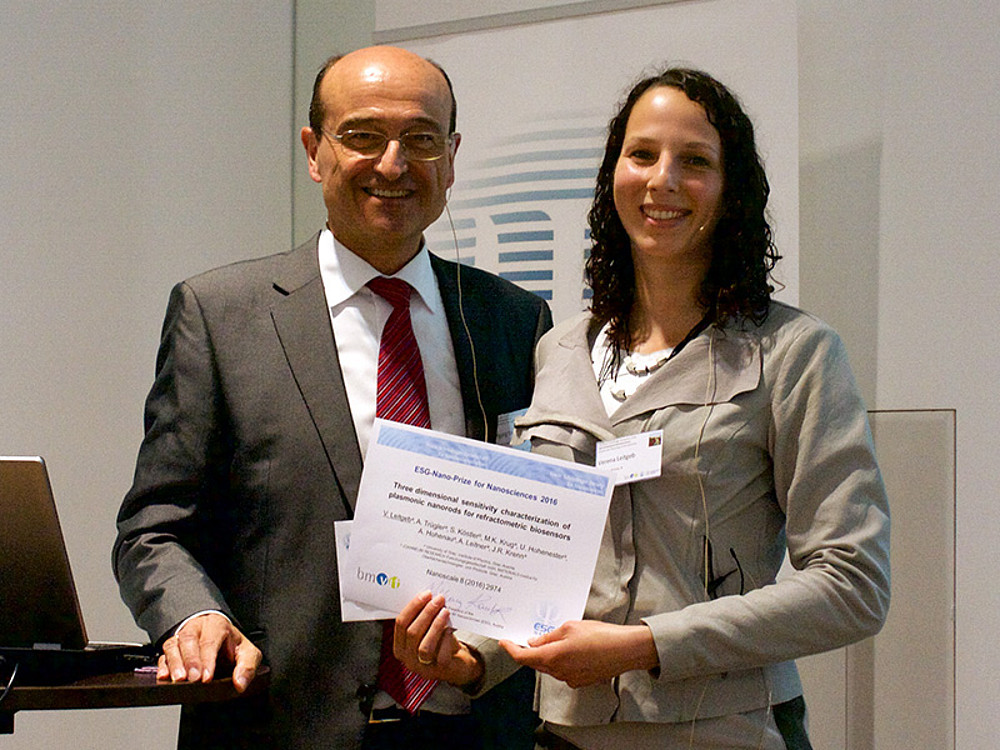
Preisträgerin Verena Leitgeb mit Wolfgang Kautek, Präsident der ESG. Fotos: ESG

Preisträgerin Verena Leitgeb mit Wolfgang Kautek, Präsident der ESG. Fotos: ESG

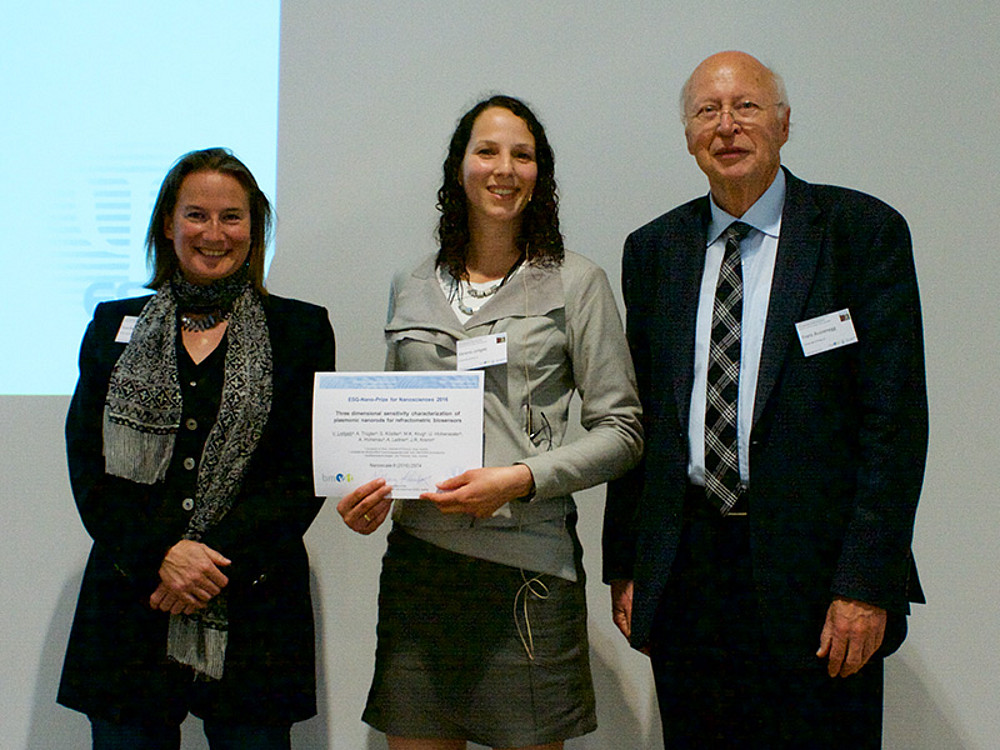
V.l.: Eva-Kathrin Sinner, ESG-Vizepräsidentin, Verena Leitgeb, Franz Aussenegg, ehrenamtlicher Leiter des Erwin Schrödinger Instituts für Nanostrukturforschung an der Uni Graz

V.l.: Eva-Kathrin Sinner, Vizepräsidentin der ESG, Verena Leitgeb und Franz Aussenegg, ESG-Vorstandsmitglied und ehrenamtlicher Leiter des Erwin Schrödinger Instituts für Nanostrukturforschung, das seit 1991 an der Uni Graz angesiedelt ist.

Die Physikerin Verena Leitgeb wurde von der Erwin Schrödinger Gesellschaft für Nanowissenschaften ausgezeichnet

Optische Biosensoren, die auf plasmonischen Partikeln – das sind Elektronenschwingungen auf winzigen Metallteilchen – beruhen, zeigen ein hohes Potenzial zum Nachweis von Molekülen, weil sie bereits auf kleinste Mengen einer Substanz reagieren. Damit sind sie prädestiniert für den Einsatz zur hochpräzisen Analyse verschiedenster Stoffe. Dr. Verena Leitgeb, die im Februar 2016 ihr Doktoratsstudium an der Uni Graz abschloss, forschte in der Arbeitsgruppe Nano-Optik unter der Leitung von Ao.Univ.-Prof. Dr. Joachim Krenn an der Entwicklung und Optimierung neuer optischer Sensoren. Ihre Dissertation betreute Ao.Univ.-Prof. Dr. Alfred Leitner. Als Erstautorin einer bedeutenden Publikation im Fachjournal „Nanoscale” wurde Leitgeb von der Erwin Schrödinger Gesellschaft (ESG) für Nanowissenschaften ausgezeichnet. Die Verleihung des ESG-Nano-Preises 2016 fand am 25. Mai in Wien im Rahmen des Symposiums „Zero Dimensional Nanostructures: Science and Technology of Nanoparticles“ statt.

In der Publikation „Three dimensional sensitivity characterization of plasmonic nanorods for refractometric biosensors“ hat Leitgeb ein räumlich aufgelöstes Profil der Sensitivität plasmonischer Goldstäbchen erstellt, indem sie gezielt Biomolekül-Modelle an verschiedenen Stellen der Sensorpartikeloberfläche positionierte. Das Ergebnis ihrer Untersuchungen schafft grundlegende Voraussetzungen für die weitere Erforschung des Potenzials plasmonischer Sensorpartikel.

Der ESG-Nano-Preis wird für herausragende innovative Arbeiten aus dem Bereich der Nanowissenschaft und -technologie zur Förderung des wissenschaftlichen Nachwuchses vergeben. Das Preisgeld wird vom Bundesministerium für Verkehr, Innovation und Technologie zur Verfügung gestellt. Verena Leitgeb teilt sich die mit insgesamt 4.400 Euro dotierte Auszeichnung, verliehen in den Kategorien „Naturwissenschaften“ und „Lebenswissenschaften“, mit vier weiteren jungen ForscherInnen.

Publikation
“Three dimensional sensitivity characterization of plasmonic nanorods for refractometric biosensors“, Nanoscale 8 (2016) 2974; DOI: 10.1039/C5NR06401E
V. Leitgeba, A. Trüglera, S. Köstlerb, M.K. Kruga, U. Hohenestera, A. Hohenaua, A. Leitnera, J.R. Krenna
a University of Graz, Institute of Physics, Graz, Austria
b JOANNEUM RESEARCH Forschungsgesellschaft mbH, MATERIALS-Institut für Oberflächentechnologien und Photonik, Graz, Austria

created by Gudrun Pichler

Related news

New FWF – WEAVE Project "Longer Acenes: Synthesis, Interfaces, and Thin Films"

Unlocking the Potential of Longer Acenes: A New Era in Organic Electronics

Two Awards for an Outstanding Dissertation

Andreas Windischbacher received two prestigious awards for his outstanding doctoral dissertation. On March 17th, 2025, he was presented with the golden ring of honour of the Republic of Austria by our Federal President as part of the Promotio sub auspiciis Praesidentis rei publicae. On the same day, he was also selected for the Josef Krainer Förderungspreis, whose ceremonial presentation, however, took place later on November 12th, 2025.

NanoGraz Careers & Ideas Days 2025: Career paths after the doctorate

On October 13 and 14, the consortium NanoGraz of the Research Career Campus at the University of Graz organized a two-day event to inform the consortium's doctoral students about their career options after completing their doctorate. In addition to exciting lectures by early-career researchers as well as representatives from industry, the Austrian Science Fund (FWF), and the research management of the University of Graz, a brainstorming competition took place on the second day, in which the participants had the opportunity to develop their own joint mini-projects.

Seed-Funding Grant: Bringing Ideas to Life Together

With the new OpNaQ Seed-Funding Grant, the OpNaQ Group, part of the Institute of Physics, lifts collaboration within the research group to a whole new level, and supports sub-groups in turning their ideas into concrete projects.

Begin of page section:
Additional information:

University of Graz
Universitaetsplatz 3
8010 Graz
Austria
  • Contact
  • Web Editors
  • Moodle
  • UNIGRAZonline
  • Imprint
  • Data Protection Declaration
  • Accessibility Declaration
Weatherstation
Uni Graz

End of this page section. Go to overview of page sections

End of this page section. Go to overview of page sections

Begin of page section:

End of this page section. Go to overview of page sections