Begin of page section:
Page sections:

  • Go to contents (Accesskey 1)
  • Go to position marker (Accesskey 2)
  • Go to main navigation (Accesskey 3)
  • Go to sub navigation (Accesskey 4)
  • Go to additional information (Accesskey 5)
  • Go to page settings (user/language) (Accesskey 8)
  • Go to search (Accesskey 9)

End of this page section. Go to overview of page sections

Begin of page section:
Page settings:

English en
Deutsch de
Search
Login

End of this page section. Go to overview of page sections

Begin of page section:
Search:

Search for details about Uni Graz
Close

End of this page section. Go to overview of page sections


Search

Begin of page section:
Main navigation:

Page navigation:

  • University

    University
    • About the University
    • Organisation
    • Faculties
    • Library
    • Working at University of Graz
    • Campus
    Developing solutions for the world of tomorrow - that is our mission. Our students and our researchers take on the great challenges of society and carry the knowledge out.
  • Research Profile

    Research Profile
    • Our Expertise
    • Research Questions
    • Research Portal
    • Promoting Research
    • Research Transfer
    • Ethics in Research
    Scientific excellence and the courage to break new ground. Research at the University of Graz creates the foundations for making the future worth living.
  • Studies

    Studies
    • Prospective Students
    • Students
  • Community

    Community
    • International
    • Location
    • Research and Business
    • Alumni
    The University of Graz is a hub for international research and brings together scientists and business experts. Moreover, it fosters the exchange and cooperation in study and teaching.
  • Spotlight
Topics
  • Our digital Advent calendar
  • Sustainable University
  • Researchers answer
  • Work for us
Close menu

End of this page section. Go to overview of page sections

Begin of page section:
You are here:

University of Graz Natural sciences Institute of Physics News Es werde Licht ...
  • About the institute
  • Our research
  • Personalities
  • Student Services
  • News
  • Events

End of this page section. Go to overview of page sections

Tuesday, 11 November 2014

Es werde Licht ...
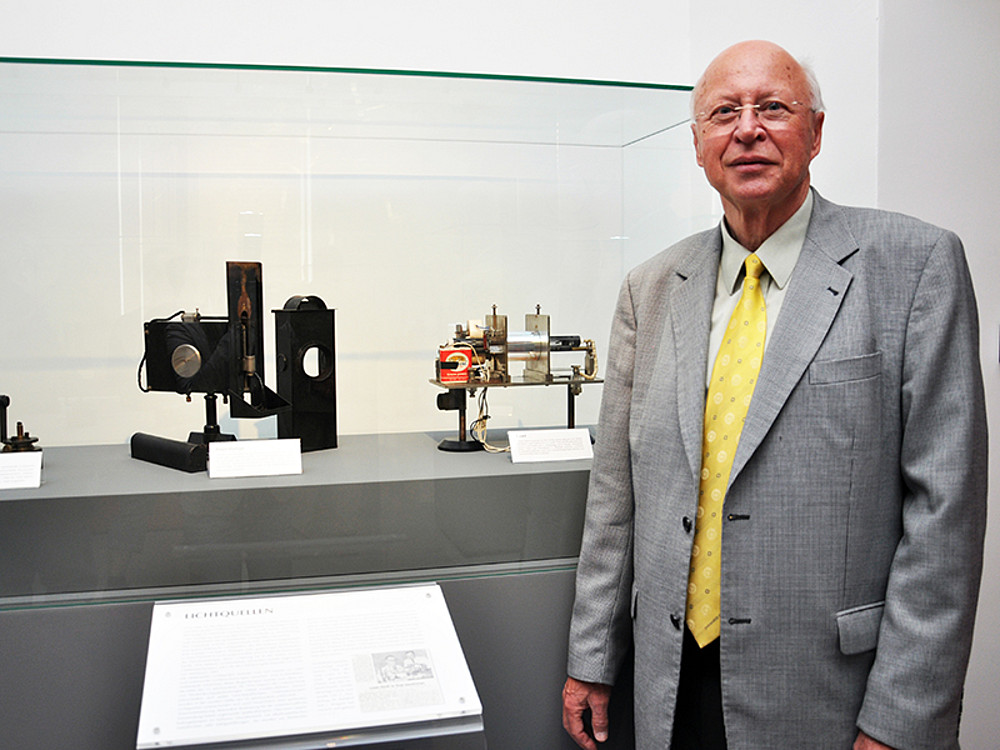
Physiker Franz Aussenegg baute 1964 den ersten Laser in der Steiermark. Die Pionierleistung ist UniGraz@Museum zu bestaunen. im Foto: Uni Graz/Schweiger

Physiker Franz Aussenegg baute 1964 den ersten Laser in der Steiermark. Die Pionierleistung ist UniGraz@Museum zu bestaunen. im Foto: Uni Graz/Schweiger

Pionierleistung der Physik an der Uni Graz: Der erste steirische Laser feiert 50. Geburtstag

DVD, Drucker sowie die Behandlung beim Augen- oder Hautarzt – die Laser-Technologie gehört längst zum Alltag. Im Herbst 1964 war es jedoch eine Sensation: Der erste steirische Laser erblickte das Rampenlicht. 50 Jahre später erinnert sich der Erbauer, Univ.-Prof.i.R. Dr. Franz Aussenegg, an die bahnbrechende Leistung, die als mittlerweile ältester österreichischer Laser im UniGraz@Museum zu bestaunen ist.

„Die Entwicklung und heutigen Anwendungen waren nicht vorhersehbar“, denkt Franz Aussenegg an die Präsentation des ersten steirischen Lasers vor genau fünf Jahrzehnten zurück.
Die Maschine zur Erzeugung von gebündeltem Licht hatte kurz davor in den USA für Furore gesorgt, aber nur langsam den Weg über den Atlantik genommen. Als damals 26-jähriger Assistent am Institut für Physik der Karl-Franzens-Universität Graz hatte Aussenegg die Spur aufgenommen und als Erster in der Steiermark diesen Apparat gebaut. „Der wissenschaftliche Austausch war aufgrund fehlender Kommunikationsinstrumente nicht so stark ausgeprägt. Der Bau des Lasers war vielfach eine Bastelei“, schmunzelt der Physiker. „Ich habe mit einer einfachen Batterie und Isolierband gearbeitet, aber auch mit Rubinstäben mit besonderer optischer Qualität.“
Das Gerät, das zugleich den Ausgangspunkt für moderne Forschung etwa im Bereich der Nanooptik an der Uni Graz bildet, existiert noch immer und ist in Österreich eine echte Rarität.

Anlässlich des Geburtstages wird am 19. November 2014, um 17 Uhr im UniGraz@Museum im Hauptgebäude, wo die Maschine ausgestellt ist, an die steirische Pionierleistung erinnert.
Ein Zwiegespräch zwischen Franz Aussenegg und Museumskustos Mag. Franz Stangl erklärt das Phänomen Laser für LaiInnen. Das historische Original kann natürlich besichtigt werden, Experimente mit modernen CO2- und Luftlasern zeigen den technologischen Fortschritt.

WANN: Mittwoch, 19. November 2014, 17 Uhr
WO: UniGraz@Museum, Universitätsplatz 3, Tiefparterre, 8010 Graz

Der Eintritt ist kostenlos, um Anmeldung wird gebeten:
Mag. Franz Stangl
Tel. 0316 380-7444
E-Mail: franz.stangl(at)uni-graz.at

created by Andreas Schweiger

Related news

New FWF – WEAVE Project "Longer Acenes: Synthesis, Interfaces, and Thin Films"

Unlocking the Potential of Longer Acenes: A New Era in Organic Electronics

Two Awards for an Outstanding Dissertation

Andreas Windischbacher received two prestigious awards for his outstanding doctoral dissertation. On March 17th, 2025, he was presented with the golden ring of honour of the Republic of Austria by our Federal President as part of the Promotio sub auspiciis Praesidentis rei publicae. On the same day, he was also selected for the Josef Krainer Förderungspreis, whose ceremonial presentation, however, took place later on November 12th, 2025.

NanoGraz Careers & Ideas Days 2025: Career paths after the doctorate

On October 13 and 14, the consortium NanoGraz of the Research Career Campus at the University of Graz organized a two-day event to inform the consortium's doctoral students about their career options after completing their doctorate. In addition to exciting lectures by early-career researchers as well as representatives from industry, the Austrian Science Fund (FWF), and the research management of the University of Graz, a brainstorming competition took place on the second day, in which the participants had the opportunity to develop their own joint mini-projects.

Seed-Funding Grant: Bringing Ideas to Life Together

With the new OpNaQ Seed-Funding Grant, the OpNaQ Group, part of the Institute of Physics, lifts collaboration within the research group to a whole new level, and supports sub-groups in turning their ideas into concrete projects.

Begin of page section:
Additional information:

University of Graz
Universitaetsplatz 3
8010 Graz
Austria
  • Contact
  • Web Editors
  • Moodle
  • UNIGRAZonline
  • Imprint
  • Data Protection Declaration
  • Accessibility Declaration
Weatherstation
Uni Graz

End of this page section. Go to overview of page sections

End of this page section. Go to overview of page sections

Begin of page section:

End of this page section. Go to overview of page sections