Begin of page section:
Page sections:

  • Go to contents (Accesskey 1)
  • Go to position marker (Accesskey 2)
  • Go to main navigation (Accesskey 3)
  • Go to sub navigation (Accesskey 4)
  • Go to additional information (Accesskey 5)
  • Go to page settings (user/language) (Accesskey 8)
  • Go to search (Accesskey 9)

End of this page section. Go to overview of page sections

Begin of page section:
Page settings:

English en
Deutsch de
Search
Login

End of this page section. Go to overview of page sections

Begin of page section:
Search:

Search for details about Uni Graz
Close

End of this page section. Go to overview of page sections


Search

Begin of page section:
Main navigation:

Page navigation:

  • University

    University
    • About the University
    • Organisation
    • Faculties
    • Library
    • Working at University of Graz
    • Campus
    Developing solutions for the world of tomorrow - that is our mission. Our students and our researchers take on the great challenges of society and carry the knowledge out.
  • Research Profile

    Research Profile
    • Our Expertise
    • Research Questions
    • Research Portal
    • Promoting Research
    • Research Transfer
    • Ethics in Research
    Scientific excellence and the courage to break new ground. Research at the University of Graz creates the foundations for making the future worth living.
  • Studies

    Studies
    • Prospective Students
    • Students
  • Community

    Community
    • International
    • Location
    • Research and Business
    • Alumni
    The University of Graz is a hub for international research and brings together scientists and business experts. Moreover, it fosters the exchange and cooperation in study and teaching.
  • Spotlight
Topics
  • Our digital Advent calendar
  • Sustainable University
  • Researchers answer
  • Work for us
Close menu

End of this page section. Go to overview of page sections

Begin of page section:
You are here:

University of Graz Natural sciences Institute of Physics News Kelvin reloaded
  • About the institute
  • Our research
  • Personalities
  • Student Services
  • News
  • Events

End of this page section. Go to overview of page sections

Monday, 29 March 2021

Kelvin reloaded

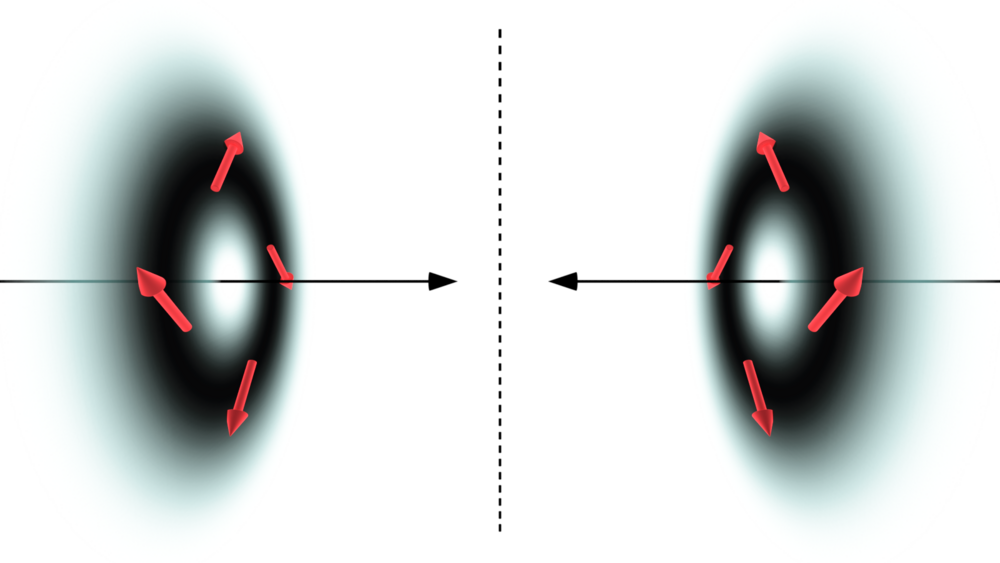
Novel type of light’s handedness originating from its spatial polarization structure. Image: Uni Graz/Eismann/Banzer

Novel type of light’s handedness originating from its spatial polarization structure. Image: Uni Graz/Eismann/Banzer

An international collaboration between research groups from Austria, Germany and Canada – all members of the Max Planck - University of Ottawa Centre for Extreme and Quantum Photonics – has recently shown that Lord Kelvin’s description of geometrical chirality also finds its direct counterpart in bespoke light fields. These novel findings were now published in Physical Review A [1] and highlight the importance of this new type of chirality in light-matter interactions and applications.

Chirality is of utmost importance in a variety of scientific disciplines, ranging from chemistry, biology and medicine all the way to physics and math. Even more importantly, it plays the key role in the evolution of life on earth. Not only DNA strands but also a variety of molecules are chiral. Formally, chirality is a geometrical property first defined by Lord Kelvin more than a century ago. He wrote: “I call any geometrical figure, or group of points, chiral, and say that it has chirality, if its image in a plane mirror, ideally realized, cannot be brought to coincide with itself” [2]. A helix, which is by definition a three-dimensional object, might be considered as the most stereotypical and archetypal chiral structure.

Interestingly, light can also be chiral or, equivalently, it may feature a well-defined handedness. The most prominent type of this optical chirality is intimately connected with the polarization of a light field or beam, i.e., the spinning sense of the field. More generally speaking, optical chirality relates to the local properties of a field, while completely ignoring its spatial structure. This is in striking contrast to the three-dimensional spatial property of a conventional geometrically chiral object like a helix. However, optical chirality plays a crucial role in light-matter interactions. Thus, it is often employed to probe the chirality of matter.

In their study, the researchers now show that the geometrical chirality of a light beam’s spatial polarization structure can also engage in light-matter interactions. They call this type of geometrical chirality of structured electromagnetic fields Kelvin’s chirality of optical beams, and demonstrate it experimentally. Furthermore, they also show that it may even couple to conventional optical chirality in rather simple and common achiral systems. The reported phenomenon and its features shed new light on the fundamentals of chiral light-matter interactions and chiral symmetry breaking, which may lead to novel intriguing research directions.

[1] S.  Nechayev, J.  S. Eismann, R. Alaee, E. Karimi, R. W. Boyd, and P. Banzer, “Kelvin's chirality of optical beams”, Phys. Rev. A 103, L031501 (2021); Editors’ suggestion
https://doi.org/10.1103/PhysRevA.103.L031501

[2] Sir William Johnson Lord Kelvin, “The Molecular Tactics of a Crystal”, Clarendon Press (1894)

Contact: Peter Banzer; Optics of Nano and Quantum Materials (website)

Related news

How Fast Is Ultrafast?

In a recent episode of the podcast Bridge the Gap, Tommaso Mazzocchi and Daniel Werner, two graduate physics students, interviewed Peter Puschnig about ultrafast spectroscopy and his current research. The conversation spans fundamental quantum-mechanical concepts and leads up to state-of-the-art methods for observing electronic dynamics in real time. The episode is titled “How fast is ultrafast spectroscopy?” and is aimed at students and anyone interested in modern physics research.

Accelerated communication with the Kanzelhöhe: solar observatory moves closer to the university

From mid-December, the train journey from Graz to Villach will be reduced to just over an hour. This faster railway connection through the Koralm Tunnel will also bring the Kanzelhöhe Observatory for Solar and Environmental Research closer. Although this unique research station at 1500 metres above sea level is located on the Carinthian Gerlitzen, it has been part of the University of Graz for more than 75 years.

New FWF – WEAVE Project "Longer Acenes: Synthesis, Interfaces, and Thin Films"

Unlocking the Potential of Longer Acenes: A New Era in Organic Electronics

Two Awards for an Outstanding Dissertation

Andreas Windischbacher received two prestigious awards for his outstanding doctoral dissertation. On March 17th, 2025, he was presented with the golden ring of honour of the Republic of Austria by our Federal President as part of the Promotio sub auspiciis Praesidentis rei publicae. On the same day, he was also selected for the Josef Krainer Förderungspreis, whose ceremonial presentation, however, took place later on November 12th, 2025.

Begin of page section:
Additional information:

University of Graz
Universitaetsplatz 3
8010 Graz
Austria
  • Contact
  • Web Editors
  • Moodle
  • UNIGRAZonline
  • Imprint
  • Data Protection Declaration
  • Accessibility Declaration
Weatherstation
Uni Graz

End of this page section. Go to overview of page sections

End of this page section. Go to overview of page sections

Begin of page section:

End of this page section. Go to overview of page sections