Begin of page section:
Page sections:

  • Go to contents (Accesskey 1)
  • Go to position marker (Accesskey 2)
  • Go to main navigation (Accesskey 3)
  • Go to sub navigation (Accesskey 4)
  • Go to additional information (Accesskey 5)
  • Go to page settings (user/language) (Accesskey 8)
  • Go to search (Accesskey 9)

End of this page section. Go to overview of page sections

Begin of page section:
Page settings:

English en
Deutsch de
Search
Login

End of this page section. Go to overview of page sections

Begin of page section:
Search:

Search for details about Uni Graz
Close

End of this page section. Go to overview of page sections


Search

Begin of page section:
Main navigation:

Page navigation:

  • University

    University
    • About the University
    • Organisation
    • Faculties
    • Library
    • Working at University of Graz
    • Campus
    Developing solutions for the world of tomorrow - that is our mission. Our students and our researchers take on the great challenges of society and carry the knowledge out.
  • Research Profile

    Research Profile
    • Our Expertise
    • Research Questions
    • Research Portal
    • Promoting Research
    • Research Transfer
    • Ethics in Research
    Scientific excellence and the courage to break new ground. Research at the University of Graz creates the foundations for making the future worth living.
  • Studies

    Studies
    • Prospective Students
    • Students
  • Community

    Community
    • International
    • Location
    • Research and Business
    • Alumni
    The University of Graz is a hub for international research and brings together scientists and business experts. Moreover, it fosters the exchange and cooperation in study and teaching.
  • Spotlight
Topics
  • Our digital Advent calendar
  • Sustainable University
  • Researchers answer
  • Work for us
Close menu

End of this page section. Go to overview of page sections

Begin of page section:
You are here:

University of Graz Natural sciences Institute of Physics News Mie in a cylinder
  • About the institute
  • Our research
  • Personalities
  • Student Services
  • News
  • Events

End of this page section. Go to overview of page sections

Monday, 29 January 2024

Mie in a cylinder

image: Uni Graz / Hohenester ©Uni Graz / Hohenester

image: Uni Graz / Hohenester

Special functions beat ray-tracing: a problem in optics that can be (just barely) solved analytically

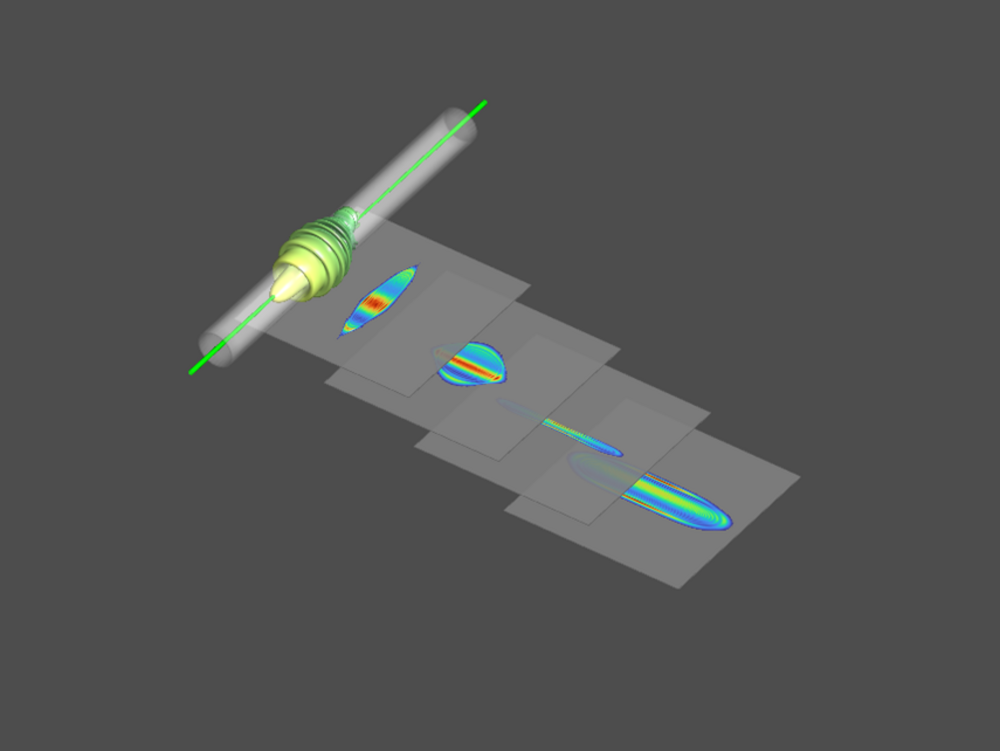
For the cool figures in scientific publications one nowadays uses ray tracing programs: here one traces the light from the object to the camera, and additionally considers light diffractions and reflections. Things get more complicated when wave interferences come into play, such as in a measurement device for nanoparticle characterizations developed at the Medical University of Graz by Brave Analytics. Particles are pumped through a cylindrical capillary alongside a focused laser beam, and the scattered light is observed from the side by a camera. Depending on the focus plane position one observes vertical or horizontal lines, or diamond-shapes features with numerous interferences.

How can one describe this theoretically? Our first considerations “this can be done easily” (but how?) and “this has certainly already been done” (but by whom?) turned out to be equally unsuccessful as our ray tracing attempts. In a publication, which has now appeared in the journal Nanophotonics, we finally chose the old-school attempt with analytical functions. The light scattering of the spherical particles is described using Mie theory, thereafter the scattered fields are transformed from spherical to cylinder coordinates, and are finally propagated through the cylindrical capillary. Everything is not overly complicated but sufficiently unpleasant to do the job only if really needed.

And since nowadays we are not as used to special functions as in the times of James Clark Maxwell and Gustav Mie, we checked our results with experimental images, finding perfect agreement.  Sometimes the good old things still work best.

Imaging the scattered light of a nanoparticle through a cylindrical capillary
Ulrich Hohenester, Christian Neuper, Marko Šimić, Christian Hill
Nanophotonics (2024)

https://www.degruyter.com/document/doi/10.1515/nanoph-2023-0773/html


created by Ulrich Hohenester

Related news

New FWF – WEAVE Project "Longer Acenes: Synthesis, Interfaces, and Thin Films"

Unlocking the Potential of Longer Acenes: A New Era in Organic Electronics

Two Awards for an Outstanding Dissertation

Andreas Windischbacher received two prestigious awards for his outstanding doctoral dissertation. On March 17th, 2025, he was presented with the golden ring of honour of the Republic of Austria by our Federal President as part of the Promotio sub auspiciis Praesidentis rei publicae. On the same day, he was also selected for the Josef Krainer Förderungspreis, whose ceremonial presentation, however, took place later on November 12th, 2025.

NanoGraz Careers & Ideas Days 2025: Career paths after the doctorate

On October 13 and 14, the consortium NanoGraz of the Research Career Campus at the University of Graz organized a two-day event to inform the consortium's doctoral students about their career options after completing their doctorate. In addition to exciting lectures by early-career researchers as well as representatives from industry, the Austrian Science Fund (FWF), and the research management of the University of Graz, a brainstorming competition took place on the second day, in which the participants had the opportunity to develop their own joint mini-projects.

Seed-Funding Grant: Bringing Ideas to Life Together

With the new OpNaQ Seed-Funding Grant, the OpNaQ Group, part of the Institute of Physics, lifts collaboration within the research group to a whole new level, and supports sub-groups in turning their ideas into concrete projects.

Begin of page section:
Additional information:

University of Graz
Universitaetsplatz 3
8010 Graz
Austria
  • Contact
  • Web Editors
  • Moodle
  • UNIGRAZonline
  • Imprint
  • Data Protection Declaration
  • Accessibility Declaration
Weatherstation
Uni Graz

End of this page section. Go to overview of page sections

End of this page section. Go to overview of page sections

Begin of page section:

End of this page section. Go to overview of page sections