Begin of page section:
Page sections:

  • Go to contents (Accesskey 1)
  • Go to position marker (Accesskey 2)
  • Go to main navigation (Accesskey 3)
  • Go to sub navigation (Accesskey 4)
  • Go to additional information (Accesskey 5)
  • Go to page settings (user/language) (Accesskey 8)
  • Go to search (Accesskey 9)

End of this page section. Go to overview of page sections

Begin of page section:
Page settings:

English en
Deutsch de
Search
Login

End of this page section. Go to overview of page sections

Begin of page section:
Search:

Search for details about Uni Graz
Close

End of this page section. Go to overview of page sections


Search

Begin of page section:
Main navigation:

Page navigation:

  • University

    University
    • About the University
    • Organisation
    • Faculties
    • Library
    • Working at University of Graz
    • Campus
    Developing solutions for the world of tomorrow - that is our mission. Our students and our researchers take on the great challenges of society and carry the knowledge out.
  • Research Profile

    Research Profile
    • Our Expertise
    • Research Questions
    • Research Portal
    • Promoting Research
    • Research Transfer
    • Ethics in Research
    Scientific excellence and the courage to break new ground. Research at the University of Graz creates the foundations for making the future worth living.
  • Studies

    Studies
    • Prospective Students
    • Students
  • Community

    Community
    • International
    • Location
    • Research and Business
    • Alumni
    The University of Graz is a hub for international research and brings together scientists and business experts. Moreover, it fosters the exchange and cooperation in study and teaching.
  • Spotlight
Topics
  • Our digital Advent calendar
  • Sustainable University
  • Researchers answer
  • Work for us
Close menu

End of this page section. Go to overview of page sections

Begin of page section:
You are here:

University of Graz Natural sciences Institute of Physics News Optical Imaging – The Next Level
  • About the institute
  • Our research
  • Personalities
  • Student Services
  • News
  • Events

End of this page section. Go to overview of page sections

Friday, 20 May 2022

Optical Imaging – The Next Level

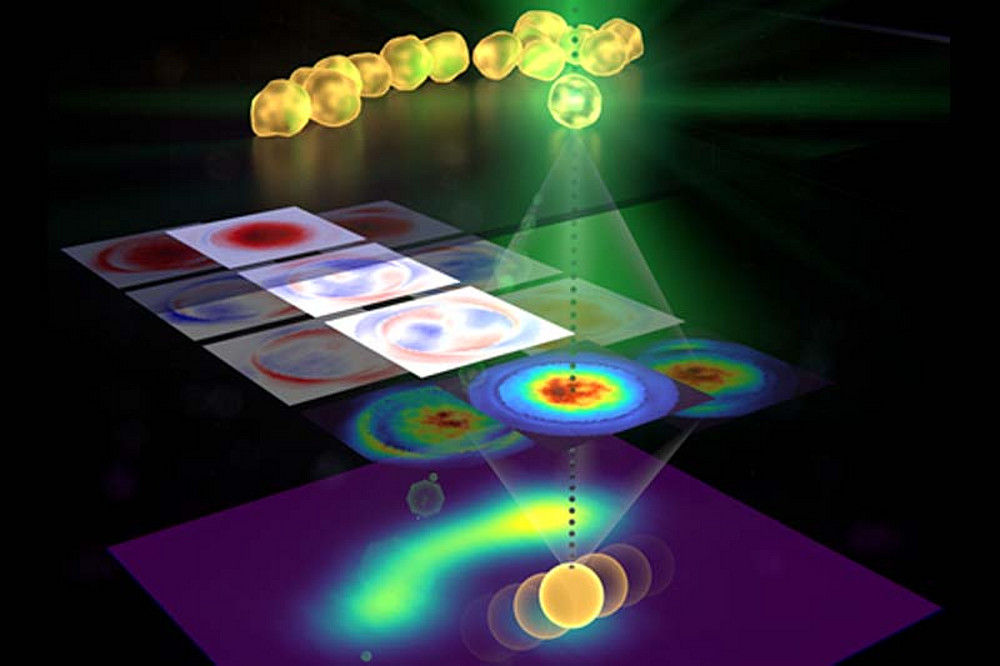
Imaging sub-wavelength-sized objects by looking very carefully at the scattering patterns. Image: Uni Graz/Eismann

Imaging sub-wavelength-sized objects by looking very carefully at the scattering patterns. Image: Uni Graz/Eismann

In a research article published recently in Optica, Jörg Eismann and Peter Banzer from the University of Graz introduce a novel approach to high-resolution microscopy. By analysing the light coming back from a specimen under study in a spatially and polarization resolved fashion, fine details can be reconstructed, which are no ‘visible’ for conventional microscopes.

In our light- and vision-driven world, imaging systems are of utmost importance. In this context, microscopes in particular are the tool of choice, e.g., to gain insights into microscopic and sub-microscopic worlds. But conventional optical microscopy techniques are usually limited in resolution – a direct consequence of fundamental laws of physics. Super-resolution methods, on the other hand, require the introduction of actively emitting molecules, called fluorophores, into the sample, i.e. to embed countless point-like light sources. This rather invasive approach is not always possible or desired. Therefore, there is a strong demand for non-invasive nanoscopic imaging modalities.

In their proof-of-concept study, Jörg Eismann and Peter Banzer now show that by measuring the light field after its interaction with a sample illuminated by a focused laser beam, very fine details can be retrieved if intensity and polarization of the scattered light are analysed in their angular and spatial distributions. To prove their new method, they measure the size and positon of randomly distributed sub-wavelength nanoparticles. Said parameters can be retrieved very precisely, even if the particles are touching.

The article was recently published in Optica. More details can be found in the article and press releases (see links below).


J. S. Eismann and P. Banzer, Sub-diffraction-limit Fourier-plane laser scanning microscopy, Optica 9, 455-460 (2022); https://doi.org/10.1364/OPTICA.450712;

Highlighted on Laser Focus World, OPTICA, EurekAlert!, Phys.org, ScienceDaily, etc.

Contact: Peter Banzer; Optics of Nano and Quantum Materials (website)


created by Peter Banzer

Related news

How Fast Is Ultrafast?

In a recent episode of the podcast Bridge the Gap, Tommaso Mazzocchi and Daniel Werner, two graduate physics students, interviewed Peter Puschnig about ultrafast spectroscopy and his current research. The conversation spans fundamental quantum-mechanical concepts and leads up to state-of-the-art methods for observing electronic dynamics in real time. The episode is titled “How fast is ultrafast spectroscopy?” and is aimed at students and anyone interested in modern physics research.

Accelerated communication with the Kanzelhöhe: solar observatory moves closer to the university

From mid-December, the train journey from Graz to Villach will be reduced to just over an hour. This faster railway connection through the Koralm Tunnel will also bring the Kanzelhöhe Observatory for Solar and Environmental Research closer. Although this unique research station at 1500 metres above sea level is located on the Carinthian Gerlitzen, it has been part of the University of Graz for more than 75 years.

New FWF – WEAVE Project "Longer Acenes: Synthesis, Interfaces, and Thin Films"

Unlocking the Potential of Longer Acenes: A New Era in Organic Electronics

Two Awards for an Outstanding Dissertation

Andreas Windischbacher received two prestigious awards for his outstanding doctoral dissertation. On March 17th, 2025, he was presented with the golden ring of honour of the Republic of Austria by our Federal President as part of the Promotio sub auspiciis Praesidentis rei publicae. On the same day, he was also selected for the Josef Krainer Förderungspreis, whose ceremonial presentation, however, took place later on November 12th, 2025.

Begin of page section:
Additional information:

University of Graz
Universitaetsplatz 3
8010 Graz
Austria
  • Contact
  • Web Editors
  • Moodle
  • UNIGRAZonline
  • Imprint
  • Data Protection Declaration
  • Accessibility Declaration
Weatherstation
Uni Graz

End of this page section. Go to overview of page sections

End of this page section. Go to overview of page sections

Begin of page section:

End of this page section. Go to overview of page sections