Begin of page section:
Page sections:

  • Go to contents (Accesskey 1)
  • Go to position marker (Accesskey 2)
  • Go to main navigation (Accesskey 3)
  • Go to sub navigation (Accesskey 4)
  • Go to additional information (Accesskey 5)
  • Go to page settings (user/language) (Accesskey 8)
  • Go to search (Accesskey 9)

End of this page section. Go to overview of page sections

Begin of page section:
Page settings:

English en
Deutsch de
Search
Login

End of this page section. Go to overview of page sections

Begin of page section:
Search:

Search for details about Uni Graz
Close

End of this page section. Go to overview of page sections


Search

Begin of page section:
Main navigation:

Page navigation:

  • University

    University
    • About the University
    • Organisation
    • Faculties
    • Library
    • Working at University of Graz
    • Campus
    Developing solutions for the world of tomorrow - that is our mission. Our students and our researchers take on the great challenges of society and carry the knowledge out.
  • Research Profile

    Research Profile
    • Our Expertise
    • Research Questions
    • Research Portal
    • Promoting Research
    • Research Transfer
    • Ethics in Research
    Scientific excellence and the courage to break new ground. Research at the University of Graz creates the foundations for making the future worth living.
  • Studies

    Studies
    • Prospective Students
    • Students
  • Community

    Community
    • International
    • Location
    • Research and Business
    • Alumni
    The University of Graz is a hub for international research and brings together scientists and business experts. Moreover, it fosters the exchange and cooperation in study and teaching.
  • Spotlight
Topics
  • Our digital Advent calendar
  • Sustainable University
  • Researchers answer
  • Work for us
Close menu

End of this page section. Go to overview of page sections

Begin of page section:
You are here:

University of Graz Natural sciences Institute of Physics News Organe am Prüfstand
  • About the institute
  • Our research
  • Personalities
  • Student Services
  • News
  • Events

End of this page section. Go to overview of page sections

Friday, 24 July 2020

Organe am Prüfstand

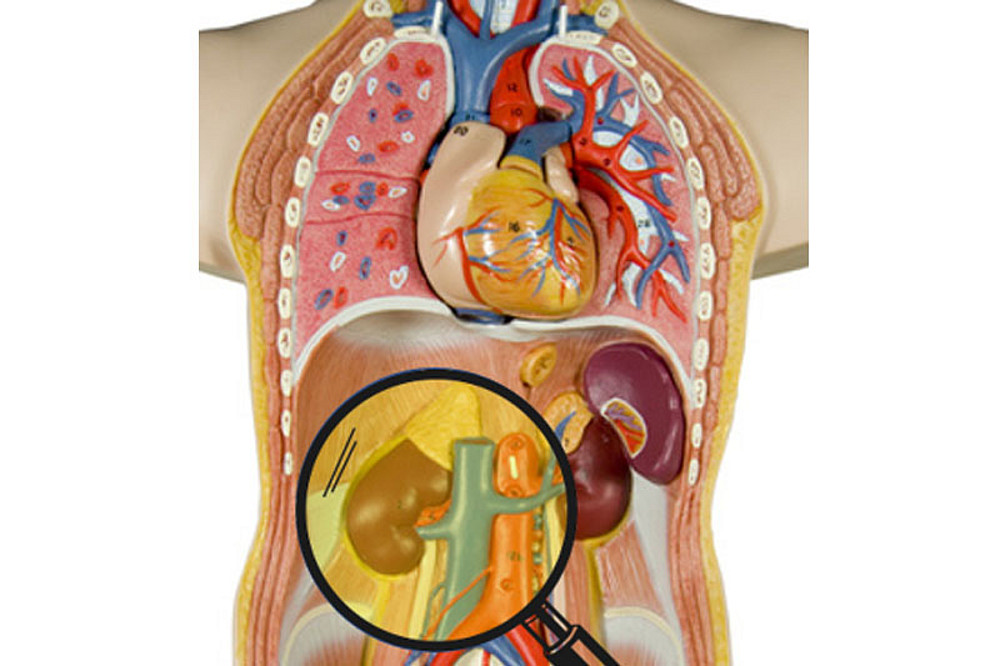
Schematische Darstellung der menschlichen Anatomie mit den Organen, die in Zukunft mit photoakustischer Bildgebung untersucht werden könnten. ©Uni Graz/R. Nuster

Schematische Darstellung der menschlichen Anatomie mit den Organen, die in Zukunft mit photoakustischer Bildgebung untersucht werden könnten.

Photoakustische Bildgebung zur Bewertung der Qualität von Spenderorganen

In einem von der FFG geförderten, interdisziplinären Forschungsprojekt, in dem Mediziner, Physiker und Techniker aus dem universitären und wirtschaftlichen Umfeld zusammenarbeiten, soll wissenschaftliche Grundlagenforschung in die klinische Routine transportiert werden, um so in Zukunft das Leben vieler Menschen retten zu können.

Robert Nuster und Günther Paltauf vom Fachbereich Experimentalphysik der Karl-Franzens-Universität bringen es auf den Punkt: Ziel dieses Projektes ist die Entwicklung eines photoakustischen bildgebenden Verfahrens zur Erforschung der Mikroperfusion im Schweinemodell und an humanen, nicht transplantablen Organen. Die Abbildung einzelner Blutgefäße, die Charakterisierung der Blutflüsse in peripheren sowie zentralen Regionen, sowie die Messung der Oxygenierung sind einige Daten, die mit der photoakustischen Bildgebung gewonnen werden können. Diese sollen mit gängigen Diagnosemethoden verglichen werden, um eine Korrelation mit molekularbiologischen, immunologischen und histologischen Parametern zu ermöglichen. Durch die somit gewonnene exakte Charakterisierung der Mikroperfusion erwartet man eine bessere Beurteilung der Organqualität. Damit hätte man eine innovative Methode, um Therapieformen zur Verbesserung der Transplantatfunktion zu erproben und würde auf lange Sicht die Anzahl der transplantablen Organe erhöhen.

Kooperationspartner: Transplant Chirurgie der Medizinischen Universität Graz und die Fa. MIDES GmbH

created by Robert Nuster

Related news

How Fast Is Ultrafast?

In a recent episode of the podcast Bridge the Gap, Tommaso Mazzocchi and Daniel Werner, two graduate physics students, interviewed Peter Puschnig about ultrafast spectroscopy and his current research. The conversation spans fundamental quantum-mechanical concepts and leads up to state-of-the-art methods for observing electronic dynamics in real time. The episode is titled “How fast is ultrafast spectroscopy?” and is aimed at students and anyone interested in modern physics research.

Accelerated communication with the Kanzelhöhe: solar observatory moves closer to the university

From mid-December, the train journey from Graz to Villach will be reduced to just over an hour. This faster railway connection through the Koralm Tunnel will also bring the Kanzelhöhe Observatory for Solar and Environmental Research closer. Although this unique research station at 1500 metres above sea level is located on the Carinthian Gerlitzen, it has been part of the University of Graz for more than 75 years.

New FWF – WEAVE Project "Longer Acenes: Synthesis, Interfaces, and Thin Films"

Unlocking the Potential of Longer Acenes: A New Era in Organic Electronics

Two Awards for an Outstanding Dissertation

Andreas Windischbacher received two prestigious awards for his outstanding doctoral dissertation. On March 17th, 2025, he was presented with the golden ring of honour of the Republic of Austria by our Federal President as part of the Promotio sub auspiciis Praesidentis rei publicae. On the same day, he was also selected for the Josef Krainer Förderungspreis, whose ceremonial presentation, however, took place later on November 12th, 2025.

Begin of page section:
Additional information:

University of Graz
Universitaetsplatz 3
8010 Graz
Austria
  • Contact
  • Web Editors
  • Moodle
  • UNIGRAZonline
  • Imprint
  • Data Protection Declaration
  • Accessibility Declaration
Weatherstation
Uni Graz

End of this page section. Go to overview of page sections

End of this page section. Go to overview of page sections

Begin of page section:

End of this page section. Go to overview of page sections