Begin of page section:
Page sections:

  • Go to contents (Accesskey 1)
  • Go to position marker (Accesskey 2)
  • Go to main navigation (Accesskey 3)
  • Go to sub navigation (Accesskey 4)
  • Go to additional information (Accesskey 5)
  • Go to page settings (user/language) (Accesskey 8)
  • Go to search (Accesskey 9)

End of this page section. Go to overview of page sections

Begin of page section:
Page settings:

English en
Deutsch de
Search
Login

End of this page section. Go to overview of page sections

Begin of page section:
Search:

Search for details about Uni Graz
Close

End of this page section. Go to overview of page sections


Search

Begin of page section:
Main navigation:

Page navigation:

  • University

    University
    • About the University
    • Organisation
    • Faculties
    • Library
    • Working at University of Graz
    • Campus
    Developing solutions for the world of tomorrow - that is our mission. Our students and our researchers take on the great challenges of society and carry the knowledge out.
  • Research Profile

    Research Profile
    • Our Expertise
    • Research Questions
    • Research Portal
    • Promoting Research
    • Research Transfer
    • Ethics in Research
    • Commission for Scientific Integrity
    Scientific excellence and the courage to break new ground. Research at the University of Graz creates the foundations for making the future worth living.
  • Studies

    Studies
    • Prospective Students
    • Students
  • Community

    Community
    • International
    • Location
    • Research and Business
    • Alumni
    The University of Graz is a hub for international research and brings together scientists and business experts. Moreover, it fosters the exchange and cooperation in study and teaching.
  • Spotlight
Topics
  • Sustainable University
  • Researchers answer
  • Work for us
Close menu

End of this page section. Go to overview of page sections

Begin of page section:
You are here:

University of Graz Natural sciences Institute of Physics News Quantum dot laser
  • About the institute
  • Our research
  • Personalities
  • Student Services
  • News
  • Events

End of this page section. Go to overview of page sections

Friday, 11 November 2022

Quantum dot laser

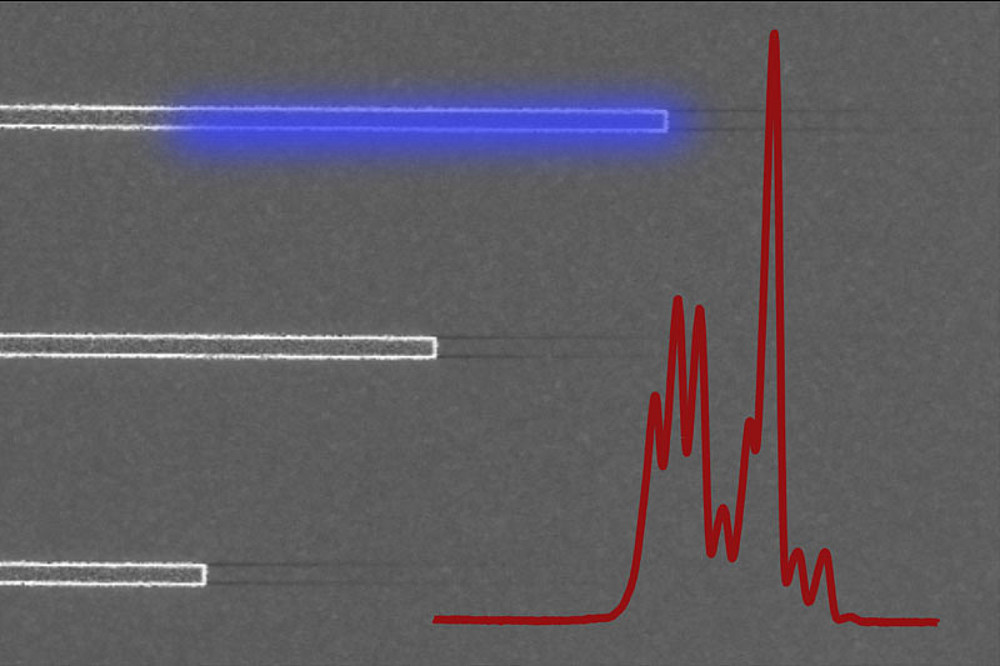
Three lasers made up of nanoplatelets in the form of strips (electron microscopic image), the blue area illustrates the area of optical excitation, the red curve shows an emission spectrum. Image: UniGraz/J. Krenn

Three lasers made up of nanoplatelets in the form of strips (electron microscopic image), the blue area illustrates the area of optical excitation, the red curve shows an emission spectrum. Image: UniGraz/J. Krenn

The Nanooptics research group generates laser light from novel nanoparticles with high optical gain

Thanks to improved manufacturing processes, nanomaterials keep surprising us with unexpected physical properties. In recent years, the light-emitting properties of semiconducting nanoparticles known as "quantum dots" have surpassed existing systems to such an extent that they have become the basis for the latest generation of displays.

So far, however, one thing has not been the strength of quantum dots: coherently amplifying light in order to create a laser source. Non-radiative effects competing with the light amplification are too strong, due to the interaction of the charge carriers in conventional, mostly spherical quantum dots. A limitation that required a solution in view of the extremely attractive properties of quantum dots for the development of new types of miniaturized lasers.

A project partner of the Graz team at ETH Zurich found such a solution with "quantum nanoplatelets". These are only 10 atomic layers thick and thus show the optical properties of quantum dots. At the same time, however, they are up to 20 nm in size in the two remaining spatial directions, which greatly reduces the interaction of the charge carriers.

As part of his dissertation in the Nanooptics research group at the Physics Institute of the University of Graz, Martin Belitsch showed that a laser can actually be realized with this. His optically pumped strip-shaped waveguides, which are several micrometers long and made of densely packed nanoplatelets, are manufactured using lithographic processes and have not only proven to be efficient pulsed lasers. They also enabled the analysis of the optical gain, which is among the highest ever observed on such systems.

The data also showed an unexpected dependence of the spectral width of the laser emission on its intensity. A second project partner at the Vienna University of Technology provided the theoretical explanation in the form of an amplification-related shortening of the laser pulses. This effect expands the possibilities to control the properties of the laser emission from quantum nanoplatelets, enabling a new class of miniaturized lasers.

Martin Belitsch, Dmitry N. Dirin, Maksym V. Kovalenko, Kevin Pichler, Stefan Rotter, Ahmed Ghalgaoui, Harald Ditlbacher, Andreas Hohenau, Joachim R. Krenn
Gain and lasing from CdSe/CdS nanoplatelet stripe waveguides
Micro and Nano Engineering 17, 100167 (2022)

https://doi.org/10.1016/j.mne.2022.100167

created by Joachim Krenn

Related news

The Josef Krainer „Förderungspreis“ goes to Stefan Purkhart

Stefan Purkhart from the Institute of Physics at the University of Graz has been awarded the Josef Krainer „Förderungspreis“ 2026 for his dissertation.

80 Jahre Innovation und Austausch

Der Fachbereich Physikdidaktik bei der 80. Fortbildungswoche für Physik- und Chemielehrkräfte in Wien

Committed to the highest standards

Three young researchers from the OpNaQ group gain insight into the world of standardization.

And the winner is ...

The winner of this year's indoor soccer tournament for employees of Styrian universities, universities of applied sciences and teacher education comes from our Institute! We congratulate our team with the prestigious name ‘We All have Potential!’ on this great success!

Begin of page section:
Additional information:

University of Graz
Universitaetsplatz 3
8010 Graz
Austria
  • Contact
  • Web Editors
  • Moodle
  • UNIGRAZonline
  • Imprint
  • Data Protection Declaration
  • Accessibility Declaration
Weatherstation
Uni Graz

End of this page section. Go to overview of page sections

End of this page section. Go to overview of page sections

Begin of page section:

End of this page section. Go to overview of page sections