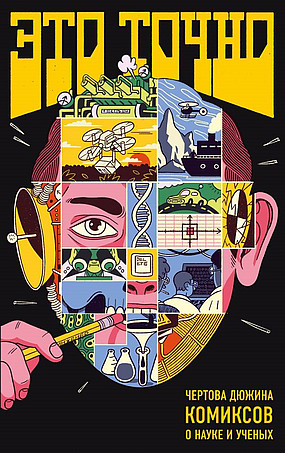
Wissenschaft und Forschung spannend, verständlich und unterhaltsam zu präsentieren ist Ziel eines ungewöhnlichen Kooperationsprojekts der Universität Graz mit dem Skolkovo Institute of Science and Technology (Skoltech) in Moskau und „Schrödingers Katze“, einem russischen Journal zur Wissenschaftsvermittlung. Das Comic-Buch „Это точно“ (auf Deutsch: „Das ist wahr “, Eksmo-Verlag) versammelt 13 Geschichten, in dem es um reale Forschungen geht, deren Ergebnisse in renommierten Journalen erschienen sind. Die Geschichte mit dem Titel „Die gefährliche Sonne“ basiert auf einer kürzlich veröffentlichten Publikation, an der Astrid Veronig, Astrophysikerin an der Universität Graz und Leiterin des Observatoriums Kanzelhöhe, als Erstautorin federführend beteiligt war. Die Studie wurde in einer groß angelegten internationalen Zusammenarbeit mit Tatiana Podladchikova vom Skoltech Institut Moskau, WissenschafterInnen der Universitäten Zagreb, Kiel, Potsdam, Colorado sowie dem Mullard Space Science Lab und der NOAA durchgeführt. Von Grazer Seite waren zudem Karin Dissauer und Manuela Temmer an der Studie beteiligt.
Gegenwärtig befinden wir uns im ausklingenden Sonnenzyklus Nummer 24, der der schwächste Sonnenzyklus seit mehr als hundert Jahren ist. Wie etwa die Aufnahmen des Observatoriums Kanzelhöhe zeigen (https://www.kso.ac.at/index.php), ist die Sonnenaktivität zur Zeit extrem gering: kein einziger Sonnenfleck ist auf der Sonne zu sehen. Am 6. und 10. September 2017 wurden die ForscherInnen jedoch von zwei extremen Ausbrüchen überrascht: Die bei dieser Sonneneruption gemessenen Beschleunigungen und Geschwindigkeiten gehören zu den höchsten, die je verzeichnet wurden. „Mit mehr als 3 500 Kilometern pro Sekunde wurde das Plasma durch unser Sonnensystem geschleudert“, präzisiert Astrid Veronig. Das Forschungsteam konnte als Konsequenz dieses Ausbruchs eine extreme Schockwelle identifizieren und im Detail analysieren, die sich über die ganze Sonne ausgebreitet hatte. Außerdem wiesen die WissenschafterInnen bei diesem Ausbruch eine Abweichung von der klassischen Interpretation der Struktur eines koronalen Massenauswurfs nach. „Erstmals konnte gezeigt werden, dass der innere Kern des koronalen Massenauswurfs eine Signatur extrem starker Magnetfeldverschmelzung darstellt, was zugleich auch die enorm hohe Geschwindigkeit und Beschleunigung erklären kann“ schildert Astrid Veronig. Die Publikation ist vor Kurzem im renommierten „Astrophysical Journal“ erschienen: https://doi.org/10.3847/1538-4357/aaeac5
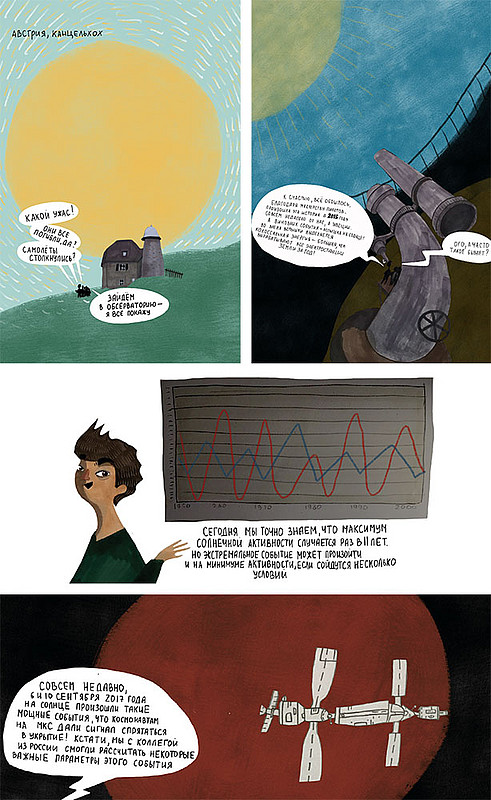
Die betreffende Comic-Geschichte aus „Это точно“ basiert auf genau diesen Forschungen von Astrid Veronig, die darin auch als sie selbst vorkommt. Weitere Hauptfiguren sind der englische Astronom Richard Carrington, der im Jahr 1859 den ersten Flare-Ausbruch beobachtet hatte, der russische Weltraumwissenschafter Alexander Chizhevsky, der sich in der ersten Hälfte des 20. Jahrhunderts mit mit Sonnenstürmen und deren Einfluss auf die Erde beschäftigt hatte, sowie Tatiana Podladchikova, Weltraumwissenschafterin am Skoltech Institut. In dem Comic geht es um eine Parallelgeschichte von Kindern in Österreich und Russland, die das Observatorium Kanzelhöhe der Universität Graz in Kärnten und das Sirius Education Center für begabte Kinder in Sotschi besuchen. Dabei erfahren sie erstmals von den möglichen Auswirkungen und Gefahren von Sonneneruptionen: von Satelliten, die ihre Bahnen ändern, von Stromausfällen auf der Erde, Funkstörungen, aber auch von den wunderschönen Polarlichtern, die diese Ausbrüche hervorrufen.
Das Comic-Buch wurde kürzlich auf der großen Buchmesse Non/Fiction in Moskau vorgestellt und soll im kommenden Jahr auf Englisch erscheinen.
Fotonachweise: Skoltech and Eksmo.
Publikation: Astrid M. Veronig, Tatiana Podladchikova, Karin Dissauer, Manuela Temmer et al (2018) ApJ 868, 107. Genesis and Impulsive Evolution of the 2017 September 10 Coronal Mass Ejection”. https://doi.org/10.3847/1538-4357/aaeac5
Mehr Informationen zum Comic und zur Publikation auf der Website des Skoltech Instituts:
https://www.skoltech.ru/en/2018/11/skoltech-releases-a-unique-comic-book-inspired-by-real-research/
https://www.skoltech.ru/en/2018/12/getting-a-grip-on-space-weather/
Super-fast through space
Astrophysicist Astrid Veronig is part of a comic project for science popularization
To present science and research in an interesting and understandable way to the public is the aim of an unusual cooperation of the University of Graz with the Skolkovo Institute of Science and Technology (Skoltech) in Moscow und „Schrödingers Cat“, a Russian Journal for science popularization. The comic book „Это точно“ (in English: „This is true“, Eksmo publisher) includes 13 stories about recent scientific studies, published in renowned journals. The story with the title „The dangerous Sun“ is based on a paper published this week, which was led by Astrid Veronig, Astrophysicist at the University of Graz and Head of Kanzelhöhe Observatory. The study was performed in an international collaboration with Tatiana Podladchikova from the Skoltech Institute in Moscow, and scientists from the Universities of Zagreb, Kiel, Potsdam, Colorado, the Mullard Space Science Lab and NOAA. From the University of Graz, Karin Dissauer and Manuela Temmer were involved in the study.
Currently, we are in the late phase of solar cycle 24, which is the weakest cycle since about 100 years. Solar activity is extremely low, as one can see on the real-time solar images of Kanzelhöhe Observatory (https://www.kso.ac.at/index.php), which currently reveal not even a single sunspot. However, on 2017 September 6 and 10 two extreme solar events surprised the scientists: The accelerations and speeds observed in these solar eruptions belong to the highest ever reported: „Plasma was ejected with speeds of more than 3 500 kilometers per second from the Sun to interplanetary space“, Astrid Veronig explains. The international research team identified and studied a strong shock wave initiated by this eruption, which propagated all over the Sun as was identified from the multipoint observations from the SDO, GOES and STEREO satellites. They also showed that this coronal mass ejection (CME) revealed a significant deviation from the classical interpretation of the CME structure. For the first time, signatures of strong magnetic reconnection were identified to build up the core of the CME, which provides a natural explanation of the extreme high accelerations and speeds observed. The study was published this week in the renowned „Astrophysical Journal“: https://doi.org/10.3847/1538-4357/aaeac5
The related story in the comic-book „Это точно“ is based on these research results of Astrid Veronig, who also appears herself in the book. Further main characters are the English Astronomer Richard Carrington, who observed the first solar flare eruption in 1859, the Russian space scientist Alexander Chizhevsky, who worked in the first half of the 20th century on solar storms and their influence on Earth, and Tatiana Podladchikova, a space scientist at the Skoltech Institute. The story line of the comic is a parallel story of kids in Austria and Russia, visiting Kanzelhöhe Observatory of the University of Graz in Carinthia and the Sirius Educational Center for talended kids in Sochi. At these visits, they learn for the first time about the dangers of solar eruptions and their influence on Earth: about satellite that change their orbits, power outages on Earth, communication disruptions, and also about the beautiful polar lights that are induced by solar eruptions.
The comic book was recently presented at the well-known international book Fair Non/Fiction in Moscow and will be translated and published in English next year.
Photo credits: Skoltech and Eksmo.
Publication: Astrid M. Veronig, Tatiana Podladchikova, Karin Dissauer, Manuela Temmer et al (2018) ApJ 868, 107. Genesis and Impulsive Evolution of the 2017 September 10 Coronal Mass Ejection”. https://doi.org/10.3847/1538-4357/aaeac5
More information on the comic and the publication on the Skoltech website:
https://www.skoltech.ru/en/2018/11/skoltech-releases-a-unique-comic-book-inspired-by-real-research/
https://www.skoltech.ru/en/2018/12/getting-a-grip-on-space-weather/