Begin of page section:
Page sections:

  • Go to contents (Accesskey 1)
  • Go to position marker (Accesskey 2)
  • Go to main navigation (Accesskey 3)
  • Go to sub navigation (Accesskey 4)
  • Go to additional information (Accesskey 5)
  • Go to page settings (user/language) (Accesskey 8)
  • Go to search (Accesskey 9)

End of this page section. Go to overview of page sections

Begin of page section:
Page settings:

English en
Deutsch de
Search
Login

End of this page section. Go to overview of page sections

Begin of page section:
Search:

Search for details about Uni Graz
Close

End of this page section. Go to overview of page sections


Search

Begin of page section:
Main navigation:

Page navigation:

  • University

    University
    • About the University
    • Organisation
    • Faculties
    • Library
    • Working at University of Graz
    • Campus
    Developing solutions for the world of tomorrow - that is our mission. Our students and our researchers take on the great challenges of society and carry the knowledge out.
  • Research Profile

    Research Profile
    • Our Expertise
    • Research Questions
    • Research Portal
    • Promoting Research
    • Research Transfer
    • Ethics in Research
    Scientific excellence and the courage to break new ground. Research at the University of Graz creates the foundations for making the future worth living.
  • Studies

    Studies
    • Prospective Students
    • Students
  • Community

    Community
    • International
    • Location
    • Research and Business
    • Alumni
    The University of Graz is a hub for international research and brings together scientists and business experts. Moreover, it fosters the exchange and cooperation in study and teaching.
  • Spotlight
Topics
  • Our digital Advent calendar
  • Sustainable University
  • Researchers answer
  • Work for us
Close menu

End of this page section. Go to overview of page sections

Begin of page section:
You are here:

University of Graz Natural sciences Institute of Physics News Schwarze Löcher und Quantenmechanik
  • About the institute
  • Our research
  • Personalities
  • Student Services
  • News
  • Events

End of this page section. Go to overview of page sections

Wednesday, 28 February 2018

Schwarze Löcher und Quantenmechanik

 ©Kanizaj | 2018

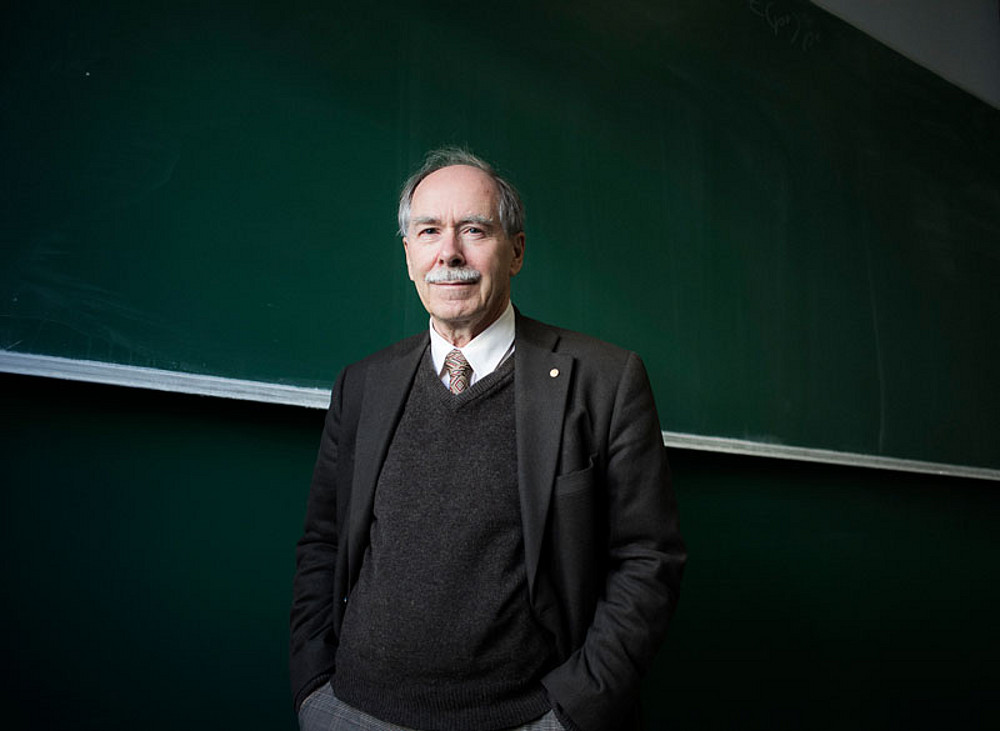
Physiknobelpreisträger Gerard `t Hooft war zu Besuch an der Uni Graz. Anlass war unter anderem die 12-Jahres-Feier des Doktoratskollegs "Hadronen im Vakuum, in Kernen und Sternen". Foto: Uni Graz/Kanizaj

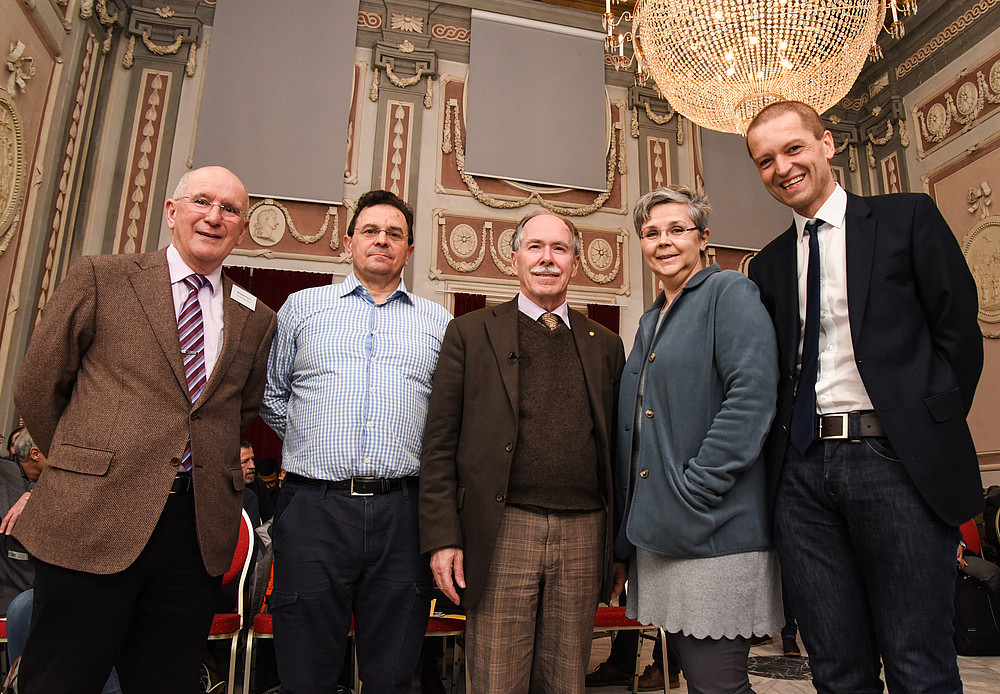
Willibald Plessas, Vortragender Robert Pisarski, Nobelpreisträger Gerard 't Hooft, Renate Dworczak, NAWI-Dekan und Leiter des DK Christoph Gattringer (v.l.). Foto: Uni Graz/Tzivanopoulos

Willibald Plessas, Vortragender Robert Pisarski, Nobelpreisträger Gerard 't Hooft, Renate Dworczak, NAWI-Dekan und Leiter des DK Christoph Gattringer (v.l.). Foto: Uni Graz/Tzivanopoulos

Der Physik-Nobelpreisträger Gerard ´t Hooft sprach über seine Forschung. Er besuchte die Uni Graz auch, weil ein Doktoratskolleg Bilanz feierte

Spitzenforschung macht die Universität Graz international sichtbar. Unsere WissenschafterInnen tragen mit ihrer Arbeit Entscheidendes dazu bei, die Gesellschaft von morgen zu gestalten. Ein sehr gutes Beispiel dafür ist das Doktoratskolleg (DK) „Hadronen im Vakuum, in Kernen und Sternen“. Exzellenter wissenschaftlicher Nachwuchs wurde in den vergangenen zwölf Jahren durch internationalen Austausch und Zugang zu aktuellen Forschungsergebnissen gefördert. Insgesamt investierten Wissenschaftsfonds FWF, Universität Graz und Land Steiermark 4,7 Millionen Euro in das erfolgreiche Projekt.

Die Bilanz kann sich sehen lassen: Immerhin waren bislang knapp 60 DissertantInnen aus 17 Nationen im Doktoratskolleg beschäftigt, 42 haben auf dem Gebiet der Teilchenphysik promoviert, drei davon sogar sub auspiciis, resümierte Univ.-Prof. Dr. Christoph Gattringer, Leiter des DK und Dekan der Naturwissenschaftlichen Fakultät, beim Festkolloquium am 27. Februar 2018 im Meerscheinschlössl. In den vergangenen Tagen traf sich die Teilchenphysik-Welt in Graz, in mehreren Workshops und rund 40 Vorträgen tauschen sich WissenschafterInnen aus. Den Auftakt zum Festkolloquium gab Robert Pisarski vom Brookhaven National Laboratory. Als „Highlight der Veranstaltung“ zog der niederländische Physiker Gerard `t Hooft (Universität Utrecht), der gemeinsam mit Martin Veltman 1999 den Nobelpreis für Physik bekommen hat, mit dem Vortrag „Schwarze Löcher und Quantenmechanik“ das (Fach-)Publikum in seinen Bann. Vizerektorin Renate Dworczak, die zu ihren Agenden auch die wissenschaftliche Lehr- und Forschungskooperation NAWI Graz zählt, begrüßte den Ehrengast und das Publikum im Namen der Universität.

created by Konstantinos Tzivanopoulos

Related news

New FWF – WEAVE Project "Longer Acenes: Synthesis, Interfaces, and Thin Films"

Unlocking the Potential of Longer Acenes: A New Era in Organic Electronics

Two Awards for an Outstanding Dissertation

Andreas Windischbacher received two prestigious awards for his outstanding doctoral dissertation. On March 17th, 2025, he was presented with the golden ring of honour of the Republic of Austria by our Federal President as part of the Promotio sub auspiciis Praesidentis rei publicae. On the same day, he was also selected for the Josef Krainer Förderungspreis, whose ceremonial presentation, however, took place later on November 12th, 2025.

NanoGraz Careers & Ideas Days 2025: Career paths after the doctorate

On October 13 and 14, the consortium NanoGraz of the Research Career Campus at the University of Graz organized a two-day event to inform the consortium's doctoral students about their career options after completing their doctorate. In addition to exciting lectures by early-career researchers as well as representatives from industry, the Austrian Science Fund (FWF), and the research management of the University of Graz, a brainstorming competition took place on the second day, in which the participants had the opportunity to develop their own joint mini-projects.

Seed-Funding Grant: Bringing Ideas to Life Together

With the new OpNaQ Seed-Funding Grant, the OpNaQ Group, part of the Institute of Physics, lifts collaboration within the research group to a whole new level, and supports sub-groups in turning their ideas into concrete projects.

Begin of page section:
Additional information:

University of Graz
Universitaetsplatz 3
8010 Graz
Austria
  • Contact
  • Web Editors
  • Moodle
  • UNIGRAZonline
  • Imprint
  • Data Protection Declaration
  • Accessibility Declaration
Weatherstation
Uni Graz

End of this page section. Go to overview of page sections

End of this page section. Go to overview of page sections

Begin of page section:

End of this page section. Go to overview of page sections