Begin of page section:
Page sections:

  • Go to contents (Accesskey 1)
  • Go to position marker (Accesskey 2)
  • Go to main navigation (Accesskey 3)
  • Go to sub navigation (Accesskey 4)
  • Go to additional information (Accesskey 5)
  • Go to page settings (user/language) (Accesskey 8)
  • Go to search (Accesskey 9)

End of this page section. Go to overview of page sections

Begin of page section:
Page settings:

English en
Deutsch de
Search
Login

End of this page section. Go to overview of page sections

Begin of page section:
Search:

Search for details about Uni Graz
Close

End of this page section. Go to overview of page sections


Search

Begin of page section:
Main navigation:

Page navigation:

  • University

    University
    • About the University
    • Organisation
    • Faculties
    • Library
    • Working at University of Graz
    • Campus
    Developing solutions for the world of tomorrow - that is our mission. Our students and our researchers take on the great challenges of society and carry the knowledge out.
  • Research Profile

    Research Profile
    • Our Expertise
    • Research Questions
    • Research Portal
    • Promoting Research
    • Research Transfer
    • Ethics in Research
    Scientific excellence and the courage to break new ground. Research at the University of Graz creates the foundations for making the future worth living.
  • Studies

    Studies
    • Prospective Students
    • Students
  • Community

    Community
    • International
    • Location
    • Research and Business
    • Alumni
    The University of Graz is a hub for international research and brings together scientists and business experts. Moreover, it fosters the exchange and cooperation in study and teaching.
  • Spotlight
Topics
  • Our digital Advent calendar
  • Sustainable University
  • Researchers answer
  • Work for us
Close menu

End of this page section. Go to overview of page sections

Begin of page section:
You are here:

University of Graz Natural sciences Institute of Physics News Spin me round
  • About the institute
  • Our research
  • Personalities
  • Student Services
  • News
  • Events

End of this page section. Go to overview of page sections

Monday, 26 June 2023

Spin me round

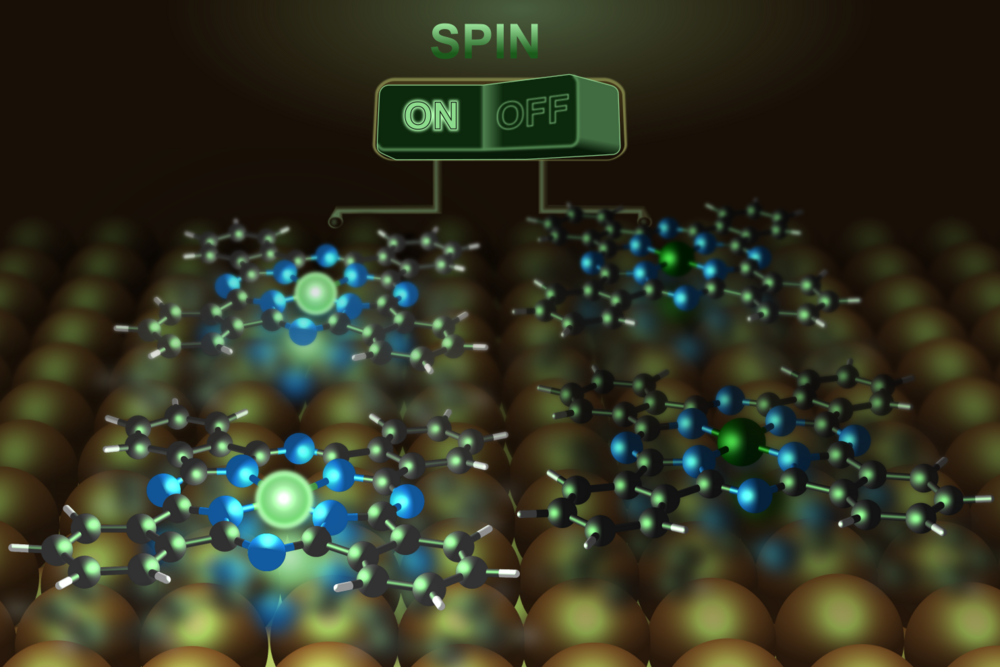
Nickel-Phthalocynine wechseln ihren Spinzustand - Bild: Uni Graz/Windischbacher

Nickel-Phthalocynine wechseln ihren Spinzustand - Bild: Uni Graz/Windischbacher

Ein spezieller, metall-organischer Komplex kann sich nicht entscheiden, welchen Spinzustand er auf einer Kupfer-Oberfläche einnehmen soll.

Mit der wissenschaftlichen Eroberung der Quantenwelt ist auch das Interesse gestiegen, Teilcheneigenschaften auf atomarer Ebene zu kontrollieren und manipulieren. Von Interesse ist beispielsweise der Elektronenspin, der für das magnetische Moment von Molekülen verantwortlich ist, und der in molekularen Schaltern Anwendung finden kann. Die Kontrolle der magnetischen Eigenschaften von Molekülen auf Oberflächen steht auch im Fokus eines kürzlich unter Mitwirkung von Grazer Forschern in Advanced Science erschienenen Artikels (DOI: https://doi.org/10.1002/advs.202300223). Ein genauer Blick auf den Elektronenspin hat dabei ungewöhnliche Ergebnisse geliefert.

Je nach Elektronanzahl können Moleküle unterschiedlichen Spin aufweisen. Um nun Spinzustände näher zu untersuchen, eignen sich besonders gut organische Moleküle, in deren Zentrum ein Übergangsmetallatom gebunden ist. Im Vergleich zu anderen Elementen, sind Übergangsmetalle flexibel in ihrer Elektronenanzahl und können leicht zwischen verschiedenen magnetischen und nicht-magnetischen Spinzuständen wechseln. Einem dieser metall-organischen Komplexe, dem sogenannten Nickel-Phthalocyanin, widmete sich die internationale Kooperation von Experimenten und theoretischen Berechnungen unter Beteiligung des Instituts für Physik der Universität Graz. Messungen an einer Monolage dieses Moleküls auf einer Kupfer-Oberfläche ließen das gleichzeitige Auftreten zweier Spinzustände in derselben Lage vermuten – ein seltener Effekt.

In Graz durchgeführte Simulationen im Rahmen der Dichtefunktionaltheorie haben die Interpretation der experimentellen Beobachtungen ermöglicht. Die beiden Spinzustände resultieren von zwei verschiedenen Geometrien des Moleküls, die sich maßgeblich in der Position des Nickelatoms unterscheiden. Während der ursprüngliche Komplex kein magnetisches Moment aufweist, wird das Nickelatom durch die Wechelwirkung mit der Kupferoberfläche aus dem Molekülkomplex in Richtung Oberfläche gezogen werden. Diese energetisch ähnlich stabile Geometrie besitzt nun sehr wohl ein magnetisches Moment. Die Verankerung beider Spezies auf der Oberfläche ist so stark, dass das Phänomen sogar bei Raumtemperatur beobachtet werden kann.

Publikation:

Surface-Mediated Spin Locking and Thermal Unlocking in a 2D Molecular Array
Iulia Cojocariu, Andreas Windischbacher, Daniel Baranowski, Matteo Jugovac, Rodrigo Cezar de Campos Ferreira, Jiří Doležal, Martin Švec, Jorge Manuel Zamalloa-Serrano, Massimo Tormen, Luca Schio, Luca Floreano, Jan Dreiser, Peter Puschnig, Vitaliy Feyer, Claus M. Schneider
Advanced Science: https://doi.org/10.1002/advs.202300223

created by Peter Puschnig

Related news

New FWF – WEAVE Project "Longer Acenes: Synthesis, Interfaces, and Thin Films"

Unlocking the Potential of Longer Acenes: A New Era in Organic Electronics

Two Awards for an Outstanding Dissertation

Andreas Windischbacher received two prestigious awards for his outstanding doctoral dissertation. On March 17th, 2025, he was presented with the golden ring of honour of the Republic of Austria by our Federal President as part of the Promotio sub auspiciis Praesidentis rei publicae. On the same day, he was also selected for the Josef Krainer Förderungspreis, whose ceremonial presentation, however, took place later on November 12th, 2025.

NanoGraz Careers & Ideas Days 2025: Career paths after the doctorate

On October 13 and 14, the consortium NanoGraz of the Research Career Campus at the University of Graz organized a two-day event to inform the consortium's doctoral students about their career options after completing their doctorate. In addition to exciting lectures by early-career researchers as well as representatives from industry, the Austrian Science Fund (FWF), and the research management of the University of Graz, a brainstorming competition took place on the second day, in which the participants had the opportunity to develop their own joint mini-projects.

Seed-Funding Grant: Bringing Ideas to Life Together

With the new OpNaQ Seed-Funding Grant, the OpNaQ Group, part of the Institute of Physics, lifts collaboration within the research group to a whole new level, and supports sub-groups in turning their ideas into concrete projects.

Begin of page section:
Additional information:

University of Graz
Universitaetsplatz 3
8010 Graz
Austria
  • Contact
  • Web Editors
  • Moodle
  • UNIGRAZonline
  • Imprint
  • Data Protection Declaration
  • Accessibility Declaration
Weatherstation
Uni Graz

End of this page section. Go to overview of page sections

End of this page section. Go to overview of page sections

Begin of page section:

End of this page section. Go to overview of page sections