Begin of page section:
Page sections:

  • Go to contents (Accesskey 1)
  • Go to position marker (Accesskey 2)
  • Go to main navigation (Accesskey 3)
  • Go to sub navigation (Accesskey 4)
  • Go to additional information (Accesskey 5)
  • Go to page settings (user/language) (Accesskey 8)
  • Go to search (Accesskey 9)

End of this page section. Go to overview of page sections

Begin of page section:
Page settings:

English en
Deutsch de
Search
Login

End of this page section. Go to overview of page sections

Begin of page section:
Search:

Search for details about Uni Graz
Close

End of this page section. Go to overview of page sections


Search

Begin of page section:
Main navigation:

Page navigation:

  • University

    University
    • About the University
    • Organisation
    • Faculties
    • Library
    • Working at University of Graz
    • Campus
    Developing solutions for the world of tomorrow - that is our mission. Our students and our researchers take on the great challenges of society and carry the knowledge out.
  • Research Profile

    Research Profile
    • Our Expertise
    • Research Questions
    • Research Portal
    • Promoting Research
    • Research Transfer
    • Ethics in Research
    • Commission for Scientific Integrity
    Scientific excellence and the courage to break new ground. Research at the University of Graz creates the foundations for making the future worth living.
  • Studies

    Studies
    • Prospective Students
    • Students
  • Community

    Community
    • International
    • Location
    • Research and Business
    • Alumni
    The University of Graz is a hub for international research and brings together scientists and business experts. Moreover, it fosters the exchange and cooperation in study and teaching.
  • Spotlight
Topics
  • Sustainable University
  • Researchers answer
  • Work for us
Close menu

End of this page section. Go to overview of page sections

Begin of page section:
You are here:

University of Graz Natural sciences Institute of Physics News Weltraum-Wettbewerb
  • About the institute
  • Our research
  • Personalities
  • Student Services
  • News
  • Events

End of this page section. Go to overview of page sections

Friday, 26 May 2017

Weltraum-Wettbewerb

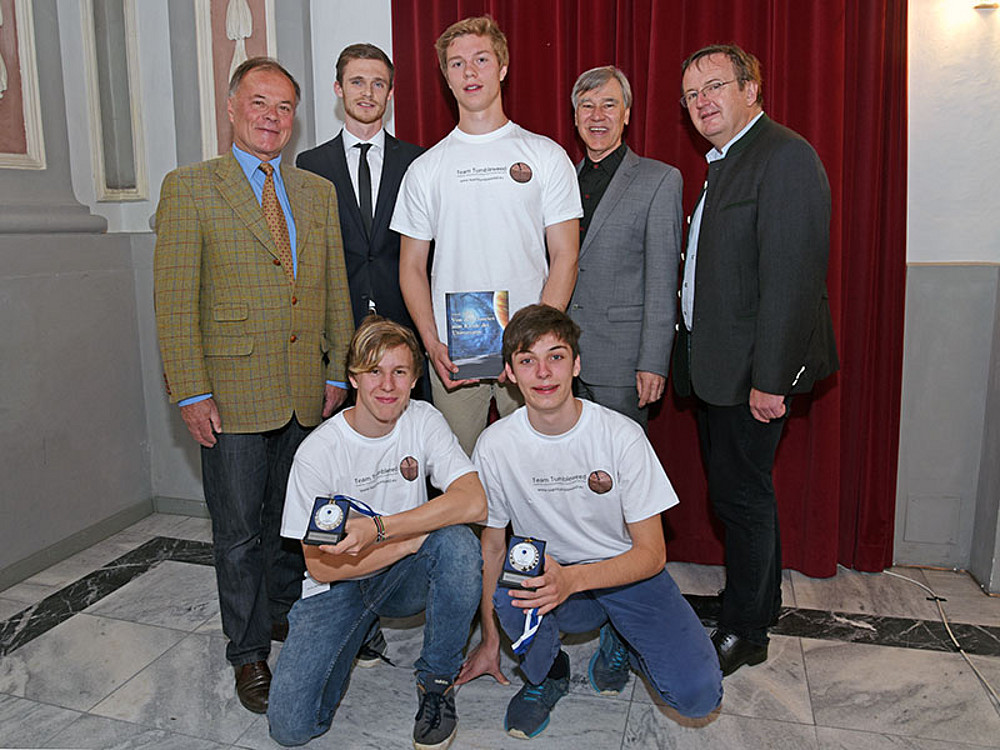
Das Siegerteam des ODYSSEUS II-Regionalfinales mit Lehrer Joseph E. Pürmayr in Vertretung von Kollege Markus Holler, Gemeinderat Peter Piffl-Percevic (l.), Vizedekan Karl Lohner (2.v.r.) und Koordinator Arnold Hanslmeier (r.). Foto: Uni Graz/Pichler

Das Siegerteam des ODYSSEUS II-Regionalfinales – Team "Tumbleweed" von der Sir Karl Popper Schule Wien mit Lehrer Joseph E. Pürmayr in Vertretung von Kollege Markus Holler –, Gemeinderat Peter Piffl-Percevic (l.), Vizedekan Karl Lohner (2.v.r.) und Koordinator Arnold Hanslmeier (r.). Foto: Uni Graz/Pichler

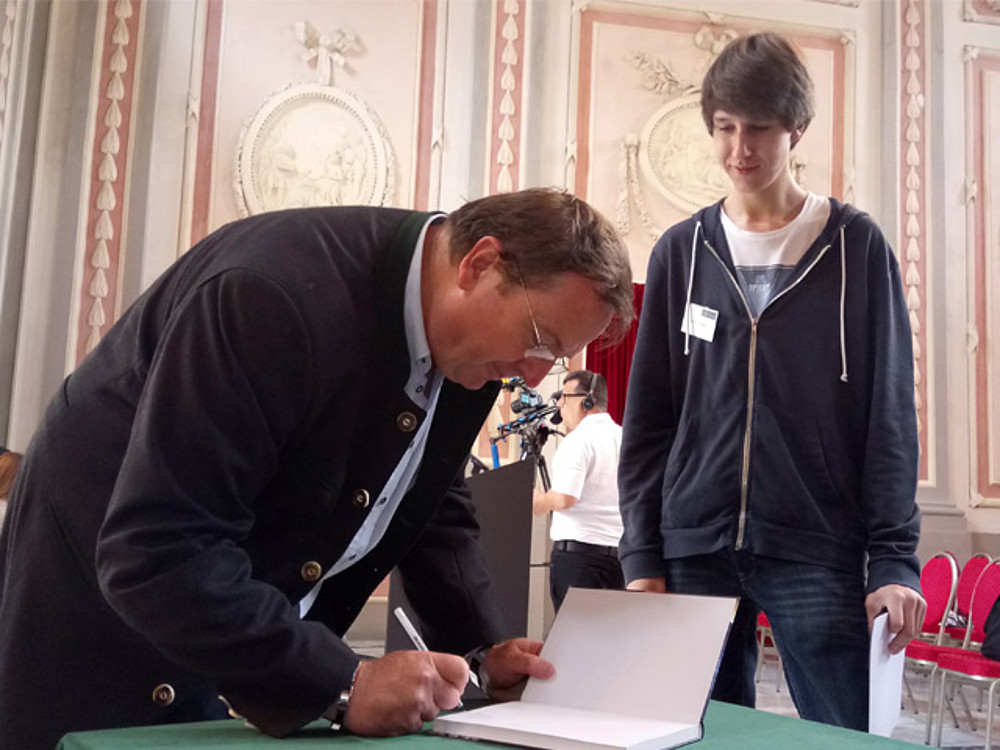
Arnold Hanslmeier signiert Bücher für Preisträger. Foto: IGAM/Maderbacher

Arnold Hanslmeier signiert Bücher für Preisträger. Foto: IGAM/Maderbacher

Die Top-Projekte des ODYSSEUS II-Regionalfinales wurden an der Uni Graz prämiert

Bei jungen Menschen Interesse und Begeisterung für Weltraumforschung zu wecken, das ist das Ziel des europäischen Bildungswettbewerbs ODYSSEUS. Die TeilnehmerInnen sind in drei verschiedenen Altersgruppen aufgerufen, spannende Ideen und Projekte einzureichen. Die besten Teams von ODYSSEUS II – dem Bewerb für OberstufenschülerInnen und Studierende – aus Deutschland, Österreich und Ungarn, die es ins Regionalfinale geschafft hatten, wurden am 24. Mai 2017 im Meerscheinschlössl der Karl-Franzens-Universität prämiert. Koordinator des Regionalfinales ist Univ.-Prof. Dr. Arnold Hanslmeier vom Institut für Physik der Uni Graz, Bereich Geophysik, Astrophysik und Meteorologie (IGAM).

Den 1. Platz eroberte das Team „Tumbleweed“ der Sir Karl Popper Schule Wien mit Stefan Rietzinger, Julian Rothenbuchner und Moritz Stephan, das einen windgetriebenen Mars Rover entworfen, gebaut und getestet hat. Das Gerät soll die Identifizierung viel versprechender Ziele für die Forschung am Roten Planeten optimieren. Die Sieger werden von 4 bis 7. Juli 2017 am Finale im französischen Toulouse teilnehmen.

Auf Platz 2 landete das Team „MCG-MarsRover“ vom Marie-Curie-Gymnasium Kirchzarten/Deutschland mit seinem hölzernen Gefährt zur Erkundung des Planeten. Platz 3 ging an das österreichische Team „Saints“ der St. Gilgen International School, das Möglichkeiten der Kommunikation mit außerirdischem Leben diskutierte.


created by Gudrun Pichler

Related news

The Josef Krainer „Förderungspreis“ goes to Stefan Purkhart

Stefan Purkhart from the Institute of Physics at the University of Graz has been awarded the Josef Krainer „Förderungspreis“ 2026 for his dissertation.

80 Jahre Innovation und Austausch

Der Fachbereich Physikdidaktik bei der 80. Fortbildungswoche für Physik- und Chemielehrkräfte in Wien

Committed to the highest standards

Three young researchers from the OpNaQ group gain insight into the world of standardization.

And the winner is ...

The winner of this year's indoor soccer tournament for employees of Styrian universities, universities of applied sciences and teacher education comes from our Institute! We congratulate our team with the prestigious name ‘We All have Potential!’ on this great success!

Begin of page section:
Additional information:

University of Graz
Universitaetsplatz 3
8010 Graz
Austria
  • Contact
  • Web Editors
  • Moodle
  • UNIGRAZonline
  • Imprint
  • Data Protection Declaration
  • Accessibility Declaration
Weatherstation
Uni Graz

End of this page section. Go to overview of page sections

End of this page section. Go to overview of page sections

Begin of page section:

End of this page section. Go to overview of page sections