Three questions for Axel Maas
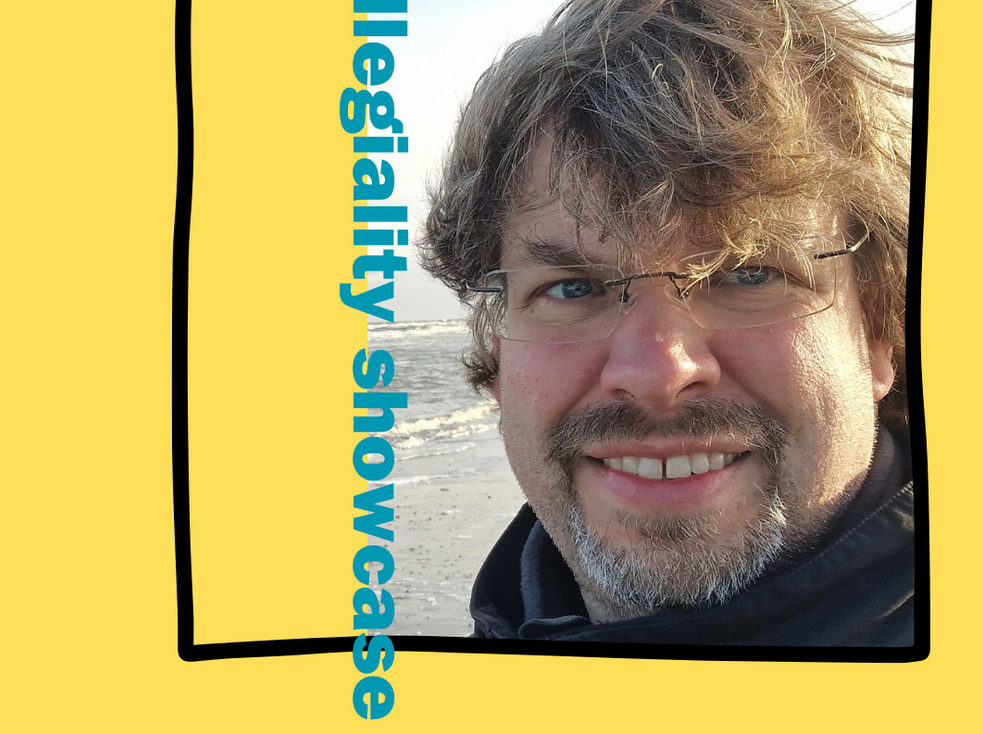
Who are the leaders who reflect on systemic injustices and how they may affect younger researchers? We're back with our collegiality showcase, to highlight Axel Maas, professor at the Institute for Physics.
Among other things, Axel Maas is speaker of the RCC Consortium "Theoretical Particle Physics", which recently won a FWF doc.funds grant (for the project "Conceptual Aspects of Composite States”) dedicated to structured PhD training. Here are his three answers to our three questions.
1) Which activities for contributing to a positive research environment are most important in your view, and what is your personal contribution to this cause?
Taking care. In particular, being available and willing to listen without judgement. Making the costs of errors low to encourage initiative. Being an example for a healthy work-life-balance, and knowing the state of the art on research about it, to give the opportunity to be optimally productive. In particular, do not expect anyone to put their research above their own well-being.
E.g., I have always an open chat with everyone in my group, in which I usually react quickly. But only at the times where I am anyhow in my research environment, and I make clear everyone is aware of that. But no questions will ever go unanswered, and I strive that I give the understanding that every question is ok. And to always making time for a meeting with people from my group.
2) What do you personally get out of your engagement as a mentor and supervisor?
Experience and understanding. Learning about how the people I work with see the research we are doing. What is important to them, what is obvious, what is difficult. What are the attitudes towards the questions there are. Ideas and insights from them are particularly great, and often lead far.
3) What helped you the most in your own leadership development, and what would you suggest to others who are starting out on their leadership path?
Read up on what we know about mental health, systemic injustices and how they may affect the various people you will lead, and what makes you really productive. Learn to not be someone who puts the research above the people. If you are willing to sacrifice part of your well-being for the research do never, ever expect if from anyone you lead, and learn not to consider this as a flaw.
Note that you are usually older, and have another lived experience than those you lead. Especially, in a time of escalating polycrisis, every generation is going through much more much more earlier than yourself.
Be forgiving and take care of them.
Thanks a lot, Axel Maas, for taking the time to answer our questions!
The Research Careers Campus Graz showcases people and networks which shape our research environment here in Graz - towards a more collegial, friendly and diverse academia, where all research talents can thrive. More here.
Interview: Johanna Stadlbauer, RCC, 15.1.2026
Podcast: Quanta and philosophy
Which relevance has quantum physics, and what about measurements?
In the popular science popdcast "Bridging the Gap", which is produced at TU Graz, this time Dr Berghofer (Institute of Philosophy) and Prof Maas (Institute of Physics) talk in two episodes about the interface between quantum physics and philosophy, and what we can learn from it about the world we live in. And what is real.

Martin Sterrer
"In the Graz Centre of Physics, we will be able to collaborate even more intensively and in a more structured way than before with our colleagues at TU Graz in the field of experimental physics. This concerns, for example, the joint use of cost-intensive infrastructure. However, personal contact is also very important. I expect the physical proximity to my colleagues to result in a much closer scientific exchange and thus the opportunity to open up new fields of research in co-operation. Our aim will be to make Graz even more visible worldwide as a centre of physics and to attract international students and researchers to us through excellent teaching and research."


Karin Sorko
"The GCP will strengthen synergies in research, teaching and administration by merging the physics departments of TU Graz and the University of Graz. Students will benefit from the short distances at the joint location as well as from new teaching rooms and infrastructure. The greatest potential probably lies in student support and the handling of joint teaching. A central contact point for student enquiries is planned. Other administrative areas will also work more closely together and explore new administrative approaches. I'm also curious to see which sustainable concepts will find their way into the building."
Advancing science with pooled expertise. Teaching, research and technology for tomorrow.
The Graz Centre of Physics is one of the largest university construction projects in Austria. It will unite the physics institutes of the University of Graz and Graz University of Technology at a single location.