Begin of page section:
Page sections:

  • Go to contents (Accesskey 1)
  • Go to position marker (Accesskey 2)
  • Go to main navigation (Accesskey 3)
  • Go to sub navigation (Accesskey 4)
  • Go to additional information (Accesskey 5)
  • Go to page settings (user/language) (Accesskey 8)
  • Go to search (Accesskey 9)

End of this page section. Go to overview of page sections

Begin of page section:
Page settings:

English en
Deutsch de
Search
Login

End of this page section. Go to overview of page sections

Begin of page section:
Search:

Search for details about Uni Graz
Close

End of this page section. Go to overview of page sections


Search

Begin of page section:
Main navigation:

Page navigation:

  • University

    University
    • About the University
    • Organisation
    • Faculties
    • Library
    • Working at University of Graz
    • Campus
    Developing solutions for the world of tomorrow - that is our mission. Our students and our researchers take on the great challenges of society and carry the knowledge out.
  • Research Profile

    Research Profile
    • Our Expertise
    • Research Questions
    • Research Portal
    • Promoting Research
    • Research Transfer
    • Ethics in Research
    Scientific excellence and the courage to break new ground. Research at the University of Graz creates the foundations for making the future worth living.
  • Studies

    Studies
    • Prospective Students
    • Students
  • Community

    Community
    • International
    • Location
    • Research and Business
    • Alumni
    The University of Graz is a hub for international research and brings together scientists and business experts. Moreover, it fosters the exchange and cooperation in study and teaching.
  • Spotlight
Topics
  • Our digital Advent calendar
  • Sustainable University
  • Researchers answer
  • Work for us
Close menu

End of this page section. Go to overview of page sections

Begin of page section:
You are here:

University of Graz Natural sciences Institute of Physics News Exploring the Sun-Earth-coupling
  • About the institute
  • Our research
  • Personalities
  • Student Services
  • News
  • Events

End of this page section. Go to overview of page sections

Friday, 31 March 2023

Exploring the Sun-Earth-coupling

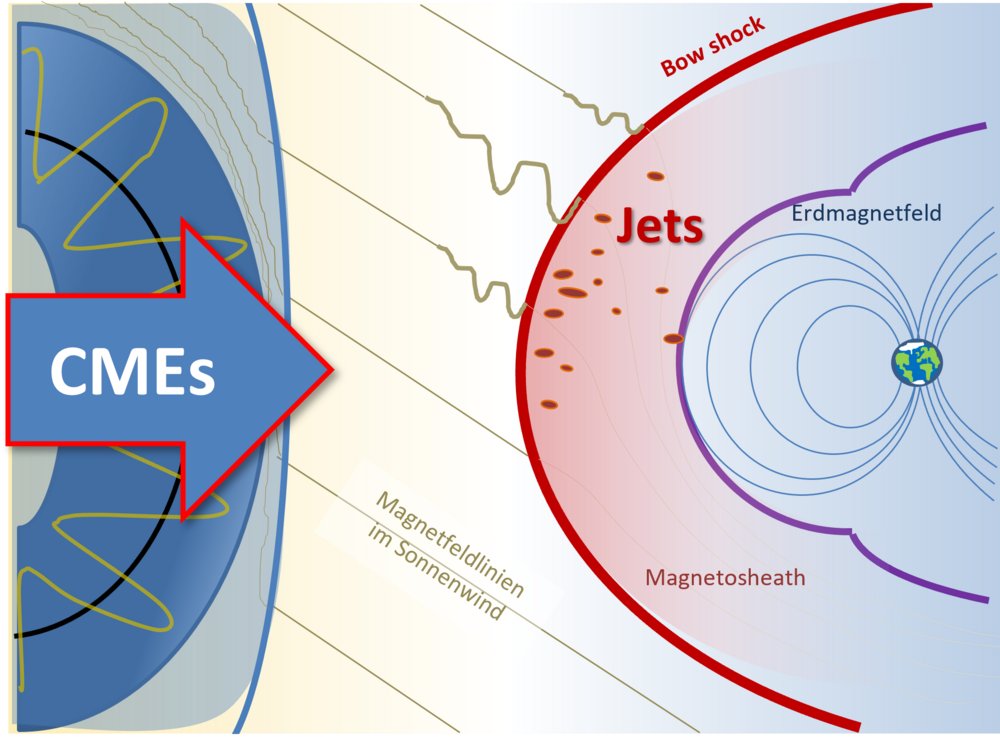
Graphic illustration of Sun-Earth boundary. Image: UniGraz/F. Koller

Graphic illustration of Sun-Earth boundary. Image: UniGraz/F. Koller

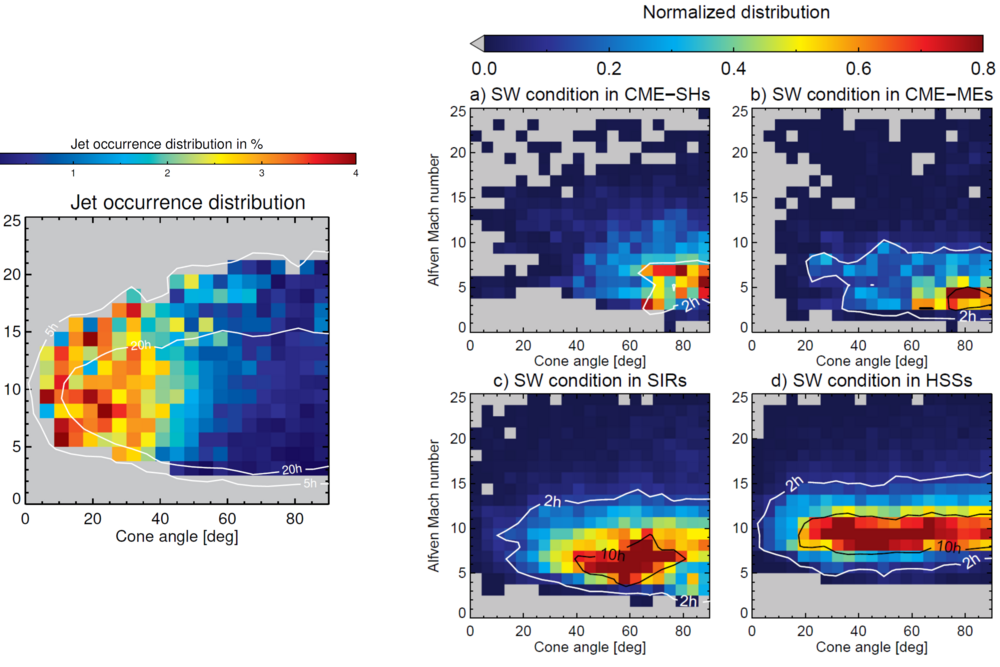
Probability distribution of magnetosheath jets compared to parameter distribution in solar wind structures. Source: Koller et al. 2023, „Magnetosheath jet formation influenced by parameters in Solar Wind structures“

Probability distribution of magnetosheath jets compared to parameter distribution in solar wind structures. Source: Koller et al. 2023, „Magnetosheath jet formation influenced by parameters in Solar Wind structures“

New results on how solar wind structures influence the boundary region between the solar wind and Earth’s magnetic field.

The Earth’s magnetic field protects us from the constant flow of particles coming form the Sun, which we call the solar wind. The particles get suddenly decelerated when they meet the Earth’s magnetic field and form a thin, turbulent region between Earth and Sun: the magnetosheath. Within the magnetosheath, we regularly find faster or denser flows of particles, which we call jets. Jets get generated frequently and can impinge on our magnetic field, causing waves in the field lines and even geoeffective substorms.

The occurrence and formation of these jets are actively discussed in research. It has been shown that jets are mainly caused when solar wind plasma arrives at Earth very quickly with a high Mach number and with a certain orientation of the magnetic field inside it. In our current study, we demonstrated that large isolated magnetic plasma structures, such as coronal mass ejections (CMEs), lead to a reduction in jets. The reason is that magnetic field line angles with a different orientation often occur in them. In addition, the strong magnetic field in CMEs leads to lower Mach numbers, which also reduces the production of jets.

On the other hand, fast solar wind streams and associated compression regions (SIRs) offer ideal conditions for the formation of jets in the magnetosheath. They often have extended periods in which the magnetic field angle is aligned with the flow and continuously high velocities and Mach numbers, which promote jet formation. Figure 2 shows the probability of occurrence of jets as a function of Mach number and magnetic field line angle. This probability distribution is compared with the conditions found in CMEs and SIRs.

These results contribute to a better understanding of the statistical relationships between the solar wind, the structures contained therein, and how these structures cause secondary effects in near-Earth space. These findings stem from an active collaboration with the Institute of Physics in Graz, the TU Braunschweig, and the IWF Graz and open up further interdisciplinary research opportunities for a better understanding of Sun-Earth coupling (financially supported by the FWF in project P33285-N). The research results will be presented at the planned conference "Heliophysics in Europe" in October of this year.

Florian Koller, Ferdinand Plaschke, Manuela Temmer, Luis Preisser, Owen W. Roberts, Zoltan Vörös
Magnetosheath jet formation influenced by parameters in Solar Wind structures
Journal of Geophysical Research: Space Physics (accepted)
https://agupubs.onlinelibrary.wiley.com/doi/abs/10.1029/2023JA031339


created by Florian Koller

Related news

New FWF – WEAVE Project "Longer Acenes: Synthesis, Interfaces, and Thin Films"

Unlocking the Potential of Longer Acenes: A New Era in Organic Electronics

Two Awards for an Outstanding Dissertation

Andreas Windischbacher received two prestigious awards for his outstanding doctoral dissertation. On March 17th, 2025, he was presented with the golden ring of honour of the Republic of Austria by our Federal President as part of the Promotio sub auspiciis Praesidentis rei publicae. On the same day, he was also selected for the Josef Krainer Förderungspreis, whose ceremonial presentation, however, took place later on November 12th, 2025.

NanoGraz Careers & Ideas Days 2025: Career paths after the doctorate

On October 13 and 14, the consortium NanoGraz of the Research Career Campus at the University of Graz organized a two-day event to inform the consortium's doctoral students about their career options after completing their doctorate. In addition to exciting lectures by early-career researchers as well as representatives from industry, the Austrian Science Fund (FWF), and the research management of the University of Graz, a brainstorming competition took place on the second day, in which the participants had the opportunity to develop their own joint mini-projects.

Seed-Funding Grant: Bringing Ideas to Life Together

With the new OpNaQ Seed-Funding Grant, the OpNaQ Group, part of the Institute of Physics, lifts collaboration within the research group to a whole new level, and supports sub-groups in turning their ideas into concrete projects.

Begin of page section:
Additional information:

University of Graz
Universitaetsplatz 3
8010 Graz
Austria
  • Contact
  • Web Editors
  • Moodle
  • UNIGRAZonline
  • Imprint
  • Data Protection Declaration
  • Accessibility Declaration
Weatherstation
Uni Graz

End of this page section. Go to overview of page sections

End of this page section. Go to overview of page sections

Begin of page section:

End of this page section. Go to overview of page sections