Begin of page section:
Page sections:

  • Go to contents (Accesskey 1)
  • Go to position marker (Accesskey 2)
  • Go to main navigation (Accesskey 3)
  • Go to sub navigation (Accesskey 4)
  • Go to additional information (Accesskey 5)
  • Go to page settings (user/language) (Accesskey 8)
  • Go to search (Accesskey 9)

End of this page section. Go to overview of page sections

Begin of page section:
Page settings:

English en
Deutsch de
Search
Login

End of this page section. Go to overview of page sections

Begin of page section:
Search:

Search for details about Uni Graz
Close

End of this page section. Go to overview of page sections


Search

Begin of page section:
Main navigation:

Page navigation:

  • University

    University
    • About the University
    • Organisation
    • Faculties
    • Library
    • Working at University of Graz
    • Campus
    Developing solutions for the world of tomorrow - that is our mission. Our students and our researchers take on the great challenges of society and carry the knowledge out.
  • Research Profile

    Research Profile
    • Our Expertise
    • Research Questions
    • Research Portal
    • Promoting Research
    • Research Transfer
    • Ethics in Research
    Scientific excellence and the courage to break new ground. Research at the University of Graz creates the foundations for making the future worth living.
  • Studies

    Studies
    • Prospective Students
    • Students
    • Welcome Weeks for First Year Students
  • Community

    Community
    • International
    • Location
    • Research and Business
    • Alumni
    The University of Graz is a hub for international research and brings together scientists and business experts. Moreover, it fosters the exchange and cooperation in study and teaching.
  • Spotlight
Topics
  • Sustainable University
  • Researchers answer
  • Work for us
Close menu

End of this page section. Go to overview of page sections

Begin of page section:
You are here:

University of Graz Natural sciences Institute of Physics News Happy birthday Schrödinger equation!
  • About the institute
  • Our research
  • Personalities
  • Student Services
  • News
  • Events

End of this page section. Go to overview of page sections

Tuesday, 27 January 2026

Happy birthday Schrödinger equation!

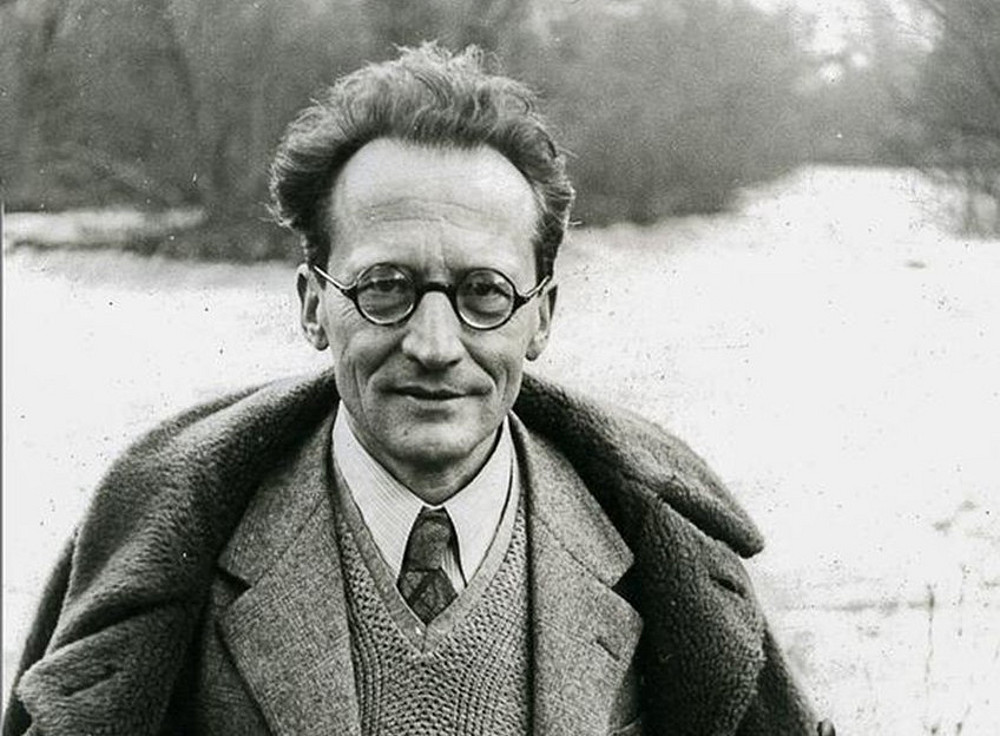
Erwin Schrödinger

Erwin Schrödinger - © Österreichische Zentralbibliothek für Physik

One of the most important equations of physics celebrates a round birthday.

For everyone who likes news like that: exactly 100 years ago, on January 27, 1926, Erwin Schrödinger submitted his famous paper on “Quantization as an eigenvalue problem” to the Annals of Physics. There he presented for the first time the equation that is named after him nowadays.

The way to the celebrated equation was surprisingly short and straight. On November 23, 2025, Schrödinger held at the ETH Zürich a seminar talk on the work of Louis de Broglie. Felix Bloch, a young student at that time, recalls in Physics Today his recollection:

Schrödinger gave a beautifully clear account of how de Broglie associated a wave with a particle and how he could obtain the quantization rules of Niels Bohr and Sommerfeld by demanding that an integer number of waves should be fitted along a stationary orbit. When he had finished, Debye casually remarked that this way of talking was rather childish. As a student of Sommerfeld he had learned that, to deal properly with waves, one had to have a wave equation.

A few days before Christmas 1925 Schrödinger left Zurich for a short vacation in the Swiss Alps, at a resort near Davos. And when he returned on January 8, he had discovered his famous wave equation. Happy birthday!


Related news

Letzte freie Termine im Sommersemester: Schülerlabor „Candela“

Letzte freie Termine für Schüler:innenlabore, die für für die 3. bzw. 4. Klassen der SEK I konzipiert wurden, stehen für das Sommersemester 2026 noch zur Verfügung.

How Fast Is Ultrafast?

In a recent episode of the podcast Bridge the Gap, Tommaso Mazzocchi and Daniel Werner, two graduate physics students, interviewed Peter Puschnig about ultrafast spectroscopy and his current research. The conversation spans fundamental quantum-mechanical concepts and leads up to state-of-the-art methods for observing electronic dynamics in real time. The episode is titled “How fast is ultrafast spectroscopy?” and is aimed at students and anyone interested in modern physics research.

Accelerated communication with the Kanzelhöhe: solar observatory moves closer to the university

From mid-December, the train journey from Graz to Villach will be reduced to just over an hour. This faster railway connection through the Koralm Tunnel will also bring the Kanzelhöhe Observatory for Solar and Environmental Research closer. Although this unique research station at 1500 metres above sea level is located on the Carinthian Gerlitzen, it has been part of the University of Graz for more than 75 years.

New FWF – WEAVE Project "Longer Acenes: Synthesis, Interfaces, and Thin Films"

Unlocking the Potential of Longer Acenes: A New Era in Organic Electronics

Begin of page section:
Additional information:

University of Graz
Universitaetsplatz 3
8010 Graz
Austria
  • Contact
  • Web Editors
  • Moodle
  • UNIGRAZonline
  • Imprint
  • Data Protection Declaration
  • Accessibility Declaration
Weatherstation
Uni Graz

End of this page section. Go to overview of page sections

End of this page section. Go to overview of page sections

Begin of page section:

End of this page section. Go to overview of page sections