Begin of page section:
Page sections:

  • Go to contents (Accesskey 1)
  • Go to position marker (Accesskey 2)
  • Go to main navigation (Accesskey 3)
  • Go to sub navigation (Accesskey 4)
  • Go to additional information (Accesskey 5)
  • Go to page settings (user/language) (Accesskey 8)
  • Go to search (Accesskey 9)

End of this page section. Go to overview of page sections

Begin of page section:
Page settings:

English en
Deutsch de
Search
Login

End of this page section. Go to overview of page sections

Begin of page section:
Search:

Search for details about Uni Graz
Close

End of this page section. Go to overview of page sections


Search

Begin of page section:
Main navigation:

Page navigation:

  • University

    University
    • About the University
    • Organisation
    • Faculties
    • Library
    • Working at University of Graz
    • Campus
    Developing solutions for the world of tomorrow - that is our mission. Our students and our researchers take on the great challenges of society and carry the knowledge out.
  • Research Profile

    Research Profile
    • Our Expertise
    • Research Questions
    • Research Portal
    • Promoting Research
    • Research Transfer
    • Ethics in Research
    Scientific excellence and the courage to break new ground. Research at the University of Graz creates the foundations for making the future worth living.
  • Studies

    Studies
    • Prospective Students
    • Students
  • Community

    Community
    • International
    • Location
    • Research and Business
    • Alumni
    The University of Graz is a hub for international research and brings together scientists and business experts. Moreover, it fosters the exchange and cooperation in study and teaching.
  • Spotlight
Topics
  • Our digital Advent calendar
  • Sustainable University
  • Researchers answer
  • Work for us
Close menu

End of this page section. Go to overview of page sections

Begin of page section:
You are here:

University of Graz Natural sciences Institute of Physics News Lichtfelder erstmals in 3D
  • About the institute
  • Our research
  • Personalities
  • Student Services
  • News
  • Events

End of this page section. Go to overview of page sections

Monday, 26 June 2017

Lichtfelder erstmals in 3D

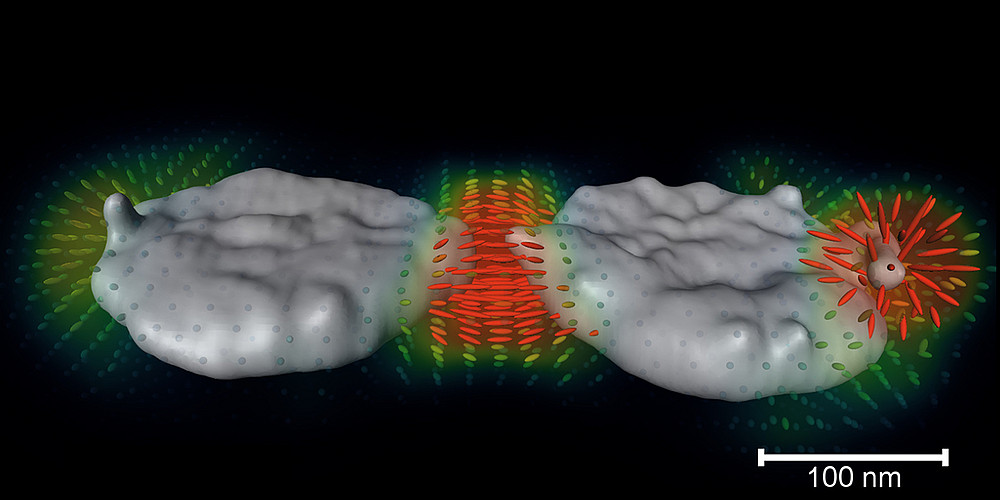
3D-Darstellung von Plasmonenfelder an Nanopartikeln. Foto: Haberfehlner - TU Graz

3D-Darstellung von Plasmonenfelder an Nanopartikeln. Foto: Haberfehlner - TU Graz

ForscherInnen von TU Graz und Uni Graz stellen in Nature Communications die neuartige Methode der 3D-Plasmonen-Tomographie vor

Licht als Informationsträger ist aus der modernen Kommunikationstechnologie nicht wegzudenken. Die kontrollierte Manipulation von Lichtquanten, sogenannten Photonen, bildet die Basis etwa für drahtlose Datenübertragung oder den Datentransport in optischen Glasfasern. Aufgrund der Wellennatur des Lichts und seiner Beugungsgrenze kann es mit rein optischen Komponenten allerdings nur auf den Mikrometerbereich (10-6 m) fokussiert werden. Ulrich Hohenester vom Institut für Physik der Karl-Franzens-Universität Graz erklärt: „Um eine effizientere Wechselwirkung zwischen Photonen und Nanostrukturen zu ermöglichen, koppeln wir im Forschungsfeld der Plasmonik Licht an metallische Nanopartikel, etwa Gold oder Silber.“ Abhängig von Größe, Form, Umgebung und Material bilden sich resonant schwingende Elektronenwolken aus, sogenannte Oberflächenplasmonen. Hohenester weiter: „Diese kollektive Elektronenschwingung ermöglicht uns eine Lichtfokussierung im Nanometerbereich und so vielfältige Anwendungen in der Sensorik oder Photovoltaik.“

Plasmonenfelder abbilden

Möglich wird die direkte Beobachtung der Plasmonenfelder erst dank Österreichs leistungsfähigstem Elektronenmikroskop ASTEM, Austrian Scanning Transmission Electron Microscope, am Zentrum für Elektronenmikroskopie Graz. Die Elektronenmikroskopie hat sich in den letzten Jahren als ideale Methode zur Vermessung von Plasmonenfeldern entwickelt. Gerald Kothleitner, Leiter der Arbeitsgruppe für analytische Transmissionselektronenmikroskopie des Instituts für Elektronenmikroskopie und Nanoanalytik der TU Graz führt aus: „Ein hochenergetischer Elektronenstrahl bewegt sich nah an der Probe vorbei oder durchdringt diese. Elektronen in der Umgebung der Probe erfahren Energieverluste, die wir spektroskopisch messen können. So entstehen zweidimensionale Abbildungen der Plasmonenfelder mit Sub-Nanometerauflösung. Informationen über die dritte Raumrichtung, entlang der sich die Elektronen bewegen, gehen bei diesem Verfahren zunächst verloren.“

Durchbruch in 3D

In der vorliegenden Arbeit, die jetzt im Open Access Journal Nature Communications veröffentlicht wurde, konnten die NAWI Graz-Forschenden erstmals zeigen, dass durch Drehung der Probe und Bearbeitung einer Serie von gekippten, zweidimensionalen Projektionen die dritte Dimension vollständig im Rahmen einer tomographischen Aufnahme rekonstruiert werden kann. Diese Methode funktioniert ähnlich der in der Medizin angewandten Computertomographie und trägt in Anlehnung dazu die Bezeichnung 3D-Plasmonen-Tomographie. Kothleitner und Hohenester über die Auswirkungen ihres Forschungserfolges: „Durch dieses neuartige Verfahren wird es nun erstmals möglich, die Plasmonenfelder so zu vermessen, dass damit Anwendungen im Bereich der Sensorik, Solarzellentechnologie und Computer-Storage besser verstanden oder überhaupt erst möglich werden.“

Publikation: Tomographic imaging of the photonic environment of plasmonic nanoparticles
Nature Communications
| DOI s41467-017-00051-3

NAWI Graz

Stärkung, Ausbau und internationale Positionierung sowie die Bündelung von Know-how der naturwissenschaftlichen Forschung und Lehre in Graz – das sind die Ziele von NAWI Graz.
NAWI Graz ist eine naturwissenschaftliche interuniversitäre Kooperation der Karl-Franzens-Universität Graz und der TU Graz: gemeinsame Lehre, Forschung und Doktoratsprogramme. Alle Studien im naturwissenschaftlichen Bereich werden gemeinsam angeboten – rund 5.200 Studierende nutzen dieses Angebot. www.nawigraz.at


created by Barbara Gigler & Andreas Schweiger

Related news

New FWF – WEAVE Project "Longer Acenes: Synthesis, Interfaces, and Thin Films"

Unlocking the Potential of Longer Acenes: A New Era in Organic Electronics

Two Awards for an Outstanding Dissertation

Andreas Windischbacher received two prestigious awards for his outstanding doctoral dissertation. On March 17th, 2025, he was presented with the golden ring of honour of the Republic of Austria by our Federal President as part of the Promotio sub auspiciis Praesidentis rei publicae. On the same day, he was also selected for the Josef Krainer Förderungspreis, whose ceremonial presentation, however, took place later on November 12th, 2025.

NanoGraz Careers & Ideas Days 2025: Career paths after the doctorate

On October 13 and 14, the consortium NanoGraz of the Research Career Campus at the University of Graz organized a two-day event to inform the consortium's doctoral students about their career options after completing their doctorate. In addition to exciting lectures by early-career researchers as well as representatives from industry, the Austrian Science Fund (FWF), and the research management of the University of Graz, a brainstorming competition took place on the second day, in which the participants had the opportunity to develop their own joint mini-projects.

Seed-Funding Grant: Bringing Ideas to Life Together

With the new OpNaQ Seed-Funding Grant, the OpNaQ Group, part of the Institute of Physics, lifts collaboration within the research group to a whole new level, and supports sub-groups in turning their ideas into concrete projects.

Begin of page section:
Additional information:

University of Graz
Universitaetsplatz 3
8010 Graz
Austria
  • Contact
  • Web Editors
  • Moodle
  • UNIGRAZonline
  • Imprint
  • Data Protection Declaration
  • Accessibility Declaration
Weatherstation
Uni Graz

End of this page section. Go to overview of page sections

End of this page section. Go to overview of page sections

Begin of page section:

End of this page section. Go to overview of page sections