Begin of page section:
Page sections:

  • Go to contents (Accesskey 1)
  • Go to position marker (Accesskey 2)
  • Go to main navigation (Accesskey 3)
  • Go to sub navigation (Accesskey 4)
  • Go to additional information (Accesskey 5)
  • Go to page settings (user/language) (Accesskey 8)
  • Go to search (Accesskey 9)

End of this page section. Go to overview of page sections

Begin of page section:
Page settings:

English en
Deutsch de
Search
Login

End of this page section. Go to overview of page sections

Begin of page section:
Search:

Search for details about Uni Graz
Close

End of this page section. Go to overview of page sections


Search

Begin of page section:
Main navigation:

Page navigation:

  • University

    University
    • About the University
    • Organisation
    • Faculties
    • Library
    • Working at University of Graz
    • Campus
    Developing solutions for the world of tomorrow - that is our mission. Our students and our researchers take on the great challenges of society and carry the knowledge out.
  • Research Profile

    Research Profile
    • Our Expertise
    • Research Questions
    • Research Portal
    • Promoting Research
    • Research Transfer
    • Ethics in Research
    Scientific excellence and the courage to break new ground. Research at the University of Graz creates the foundations for making the future worth living.
  • Studies

    Studies
    • Prospective Students
    • Students
  • Community

    Community
    • International
    • Location
    • Research and Business
    • Alumni
    The University of Graz is a hub for international research and brings together scientists and business experts. Moreover, it fosters the exchange and cooperation in study and teaching.
  • Spotlight
Topics
  • Our digital Advent calendar
  • Sustainable University
  • Researchers answer
  • Work for us
Close menu

End of this page section. Go to overview of page sections

Begin of page section:
You are here:

University of Graz Natural sciences Institute of Physics News Maxwell at the boundary
  • About the institute
  • Our research
  • Personalities
  • Student Services
  • News
  • Events

End of this page section. Go to overview of page sections

Monday, 28 February 2022

Maxwell at the boundary

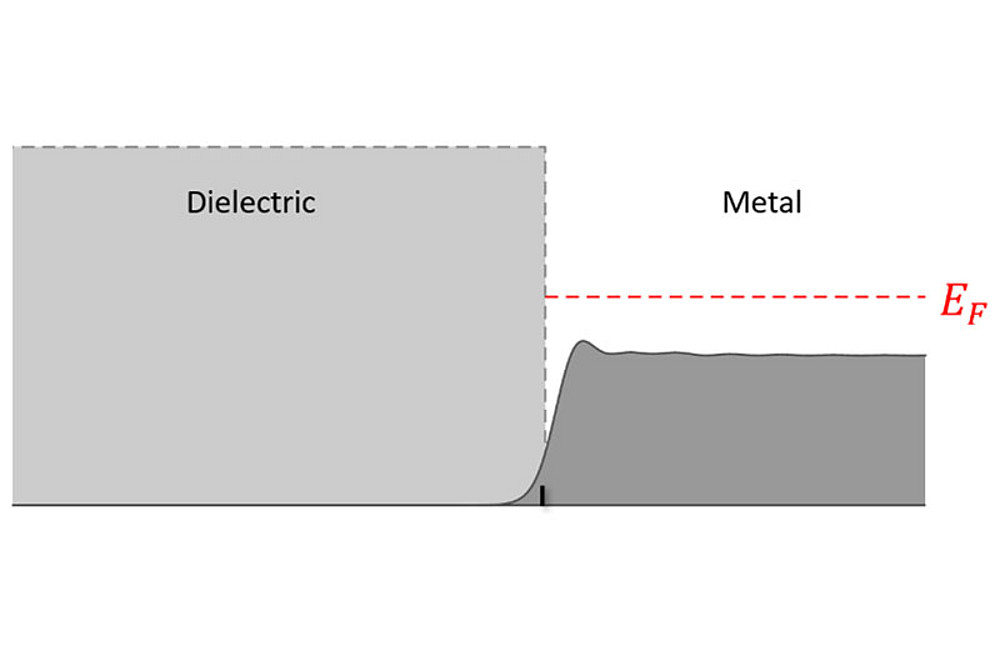
Fig.: Quantum mechanical electron density at the interface between a metal and a dielectric, © Ulrich Hohenester. ©Uni Graz/Hohenester

Fig.: Quantum mechanical electron density at the interface between a metal and a dielectric, © Ulrich Hohenester.

Maxwell’s equations belong to the cultural heritage of physics, the number of different phenomena they can describe is truly impressive. Even the interaction between light and matter can be elegantly accounted for through coarse graining and a few material parameters, which can be extracted from either experiment or quantum mechanical calculations. Only for Maxwell’s boundary conditions things occasionally turn out to be slightly involved, at the very boundary where the quantum mechanical wavefunction of the optically excited electrons leaks out of the material.

In the 1970s Peter Feibelman suggested to account for quantum mechanical modifications at planar boundaries through two frequency dependent parameters, which are nowadays named after him. The approach has been recently generalized by Yang et al., Nature 576, 248 (2019), for arbitrary boundaries, where the Feibelman parameters become part of modified, mesoscopic boundary conditions. However, the implementation of these boundary conditions into commercial Maxwell solvers turns out to be somewhat intricate.

In a paper that has just been accepted for publication in Physical Review B, Ulrich Hohenester and Gerhard Unger show how to implement mesoscopic boundary conditions elegantly and without too much effort into a boundary element method approach for the solution of Maxwell’s equations. Textbooks on electrodynamics will not have to be rewritten in the light of these results, mesoscopic boundary conditions remain a boundary effect. There (namely at the boundary), however, it now becomes possible to consider a wealth of quantum mechanical effects, which have gained increasing importance in the last couple of years for nanophotonic structures.


Ulrich Hohenester and Gerhard Unger, Nanoscale electromagnetism with the boundary element method, to appear in Phys. Rev. B (2022), https://link.aps.org/doi/10.1103/PhysRevB.105.075428


created by Ulrich Hohenester

Related news

New FWF – WEAVE Project "Longer Acenes: Synthesis, Interfaces, and Thin Films"

Unlocking the Potential of Longer Acenes: A New Era in Organic Electronics

Two Awards for an Outstanding Dissertation

Andreas Windischbacher received two prestigious awards for his outstanding doctoral dissertation. On March 17th, 2025, he was presented with the golden ring of honour of the Republic of Austria by our Federal President as part of the Promotio sub auspiciis Praesidentis rei publicae. On the same day, he was also selected for the Josef Krainer Förderungspreis, whose ceremonial presentation, however, took place later on November 12th, 2025.

NanoGraz Careers & Ideas Days 2025: Career paths after the doctorate

On October 13 and 14, the consortium NanoGraz of the Research Career Campus at the University of Graz organized a two-day event to inform the consortium's doctoral students about their career options after completing their doctorate. In addition to exciting lectures by early-career researchers as well as representatives from industry, the Austrian Science Fund (FWF), and the research management of the University of Graz, a brainstorming competition took place on the second day, in which the participants had the opportunity to develop their own joint mini-projects.

Seed-Funding Grant: Bringing Ideas to Life Together

With the new OpNaQ Seed-Funding Grant, the OpNaQ Group, part of the Institute of Physics, lifts collaboration within the research group to a whole new level, and supports sub-groups in turning their ideas into concrete projects.

Begin of page section:
Additional information:

University of Graz
Universitaetsplatz 3
8010 Graz
Austria
  • Contact
  • Web Editors
  • Moodle
  • UNIGRAZonline
  • Imprint
  • Data Protection Declaration
  • Accessibility Declaration
Weatherstation
Uni Graz

End of this page section. Go to overview of page sections

End of this page section. Go to overview of page sections

Begin of page section:

End of this page section. Go to overview of page sections