Begin of page section:
Page sections:

  • Go to contents (Accesskey 1)
  • Go to position marker (Accesskey 2)
  • Go to main navigation (Accesskey 3)
  • Go to sub navigation (Accesskey 4)
  • Go to additional information (Accesskey 5)
  • Go to page settings (user/language) (Accesskey 8)
  • Go to search (Accesskey 9)

End of this page section. Go to overview of page sections

Begin of page section:
Page settings:

English en
Deutsch de
Search
Login

End of this page section. Go to overview of page sections

Begin of page section:
Search:

Search for details about Uni Graz
Close

End of this page section. Go to overview of page sections


Search

Begin of page section:
Main navigation:

Page navigation:

  • University

    University
    • About the University
    • Organisation
    • Faculties
    • Library
    • Working at University of Graz
    • Campus
    Developing solutions for the world of tomorrow - that is our mission. Our students and our researchers take on the great challenges of society and carry the knowledge out.
  • Research Profile

    Research Profile
    • Our Expertise
    • Research Questions
    • Research Portal
    • Promoting Research
    • Research Transfer
    • Ethics in Research
    Scientific excellence and the courage to break new ground. Research at the University of Graz creates the foundations for making the future worth living.
  • Studies

    Studies
    • Prospective Students
    • Students
  • Community

    Community
    • International
    • Location
    • Research and Business
    • Alumni
    The University of Graz is a hub for international research and brings together scientists and business experts. Moreover, it fosters the exchange and cooperation in study and teaching.
  • Spotlight
Topics
  • Our digital Advent calendar
  • Sustainable University
  • Researchers answer
  • Work for us
Close menu

End of this page section. Go to overview of page sections

Begin of page section:
You are here:

University of Graz Natural sciences Institute of Physics News Mehr als 100 Jahre Klima
  • About the institute
  • Our research
  • Personalities
  • Student Services
  • News
  • Events

End of this page section. Go to overview of page sections

Thursday, 13 July 2017

Mehr als 100 Jahre Klima

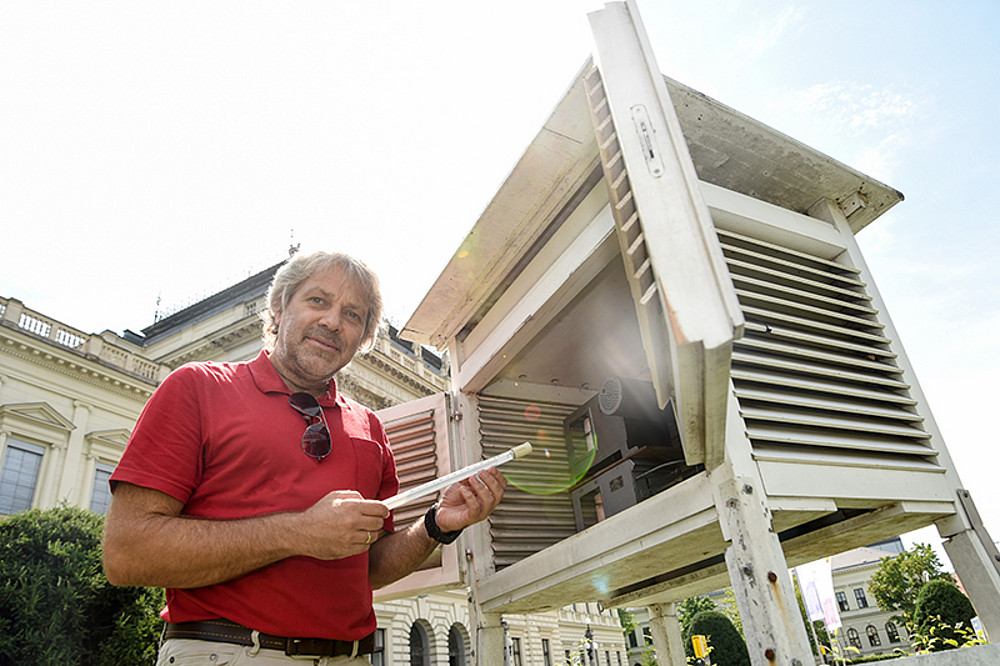
Die Temperaturen im Blick: Ulrich Foelsche vor der Wetterstation der Universität Graz. Foto: Uni Graz/Tzivanopoulos.

Die Temperaturen im Blick: Ulrich Foelsche vor der Wetterstation der Universität Graz. Foto: Uni Graz/Tzivanopoulos.

Archivdaten der Wetterstation sind online verfügbar

Seit 1890 dokumentiert die Wetterstation vor dem Hauptgebäude der Karl-Franzens-Universität Graz die Außentemperaturen im Schatten. „Unsere Messungen fließen zwar von Anfang an in die allgemeine Übersicht der Zentralanstalt für Meteorologie und Geodynamik (ZAMG) ein, waren bis jetzt aber nicht individuell für die Öffentlichkeit abrufbar“, erklärt Assoz.-Prof. Dr. Ulrich Foelsche, Leiter des Instituts für Physik der Uni Graz. In Kooperation mit der Universitätsbibliothek Graz, die die Klimabögen digitalisierte, wurden die gesamten Archivdaten nun erstmals von der ZAMG entkoppelt verfügbar gemacht und gestern auf der Instituts-Website veröffentlicht. So können nun auch einzelne Tage aus der Zeit von Juli 1890 bis November 2004 genau auf Lufttemperatur, Niederschlag, Windspitzen und Sonnenscheindauer überprüft werden. „Man kann so beispielsweise nachschauen, wie heiß oder kalt es am eigenen Geburtstag in Graz war, welche Form die Wolken hatten oder wie weit man sehen konnte“, erklärt Foelsche. Den Zeitraum 2004 bis 2017 bildet die ZAMG ab, diese Daten werden aber ebenfalls in Kürze auf der Website des Instituts für Physik verfügbar sein. Auch tagesaktuelle Einträge sind dort zu finden.


Ein Blick auf die Übersicht verrät: Die Temperaturen sind heuer so hoch wie selten zuvor: „Wir haben zum Stichtag 12. Juli 2017 bereits 14 Tage mit mindestens 30 Grad gemessen, sechs davon am Stück. Zum Vergleich: Im Zeitraum 1961 bis 1990 kletterte das Thermometer durchschnittlich nur vier Mal pro Sommer über diese Marke“, so Foelsche. Außerdem ist es heute täglich im Schnitt um zwei Grad wärmer als zu Beginn des 20. Jahrhunderts. Auch die Anzahl der Tropennächte, also Nächte, in denen die Temperatur nicht unter 20 Grad sinkt, hat deutlich zugenommen: Bis jetzt gab es 2017 davon schon drei. Auf dem ersten Platz, was die Hitze in der steirischen Landeshauptstadt betrifft, landen gleich zwei Tage: Plus 38,1 Grad Celsius wurden am 29. Juli 2013 und am 8. August 2013 an der Wetterstation der Universität gemessen. Die Kälterekorde liegen dagegen schon weit zurück: Bei minus 23,7 Grad Celsius froren die GrazerInnen am 24. Jänner 1903 und am 3. Februar 1929. Der meiste Niederschlag – 105 Liter pro Quadratmeter – ergoss sich am 7. Juli 1938 auf die Murmetropole.

Die gesammelten Klima-Archivdaten von Juli 1890 bis November 2004 sind hier verfügbar: https://physik.uni-graz.at/de/geophysik/klimadaten-archiv/

Realisiert wurde das Projekt in einer gemeinschaftlichen Zusammenarbeit von Ulrich Foelsche, Christoph Bichler, Ing. Roland Maderbacher und Mag. Ing. Helga Pietsch.


created by Gerhild Kastrun

Related news

New FWF – WEAVE Project "Longer Acenes: Synthesis, Interfaces, and Thin Films"

Unlocking the Potential of Longer Acenes: A New Era in Organic Electronics

Two Awards for an Outstanding Dissertation

Andreas Windischbacher received two prestigious awards for his outstanding doctoral dissertation. On March 17th, 2025, he was presented with the golden ring of honour of the Republic of Austria by our Federal President as part of the Promotio sub auspiciis Praesidentis rei publicae. On the same day, he was also selected for the Josef Krainer Förderungspreis, whose ceremonial presentation, however, took place later on November 12th, 2025.

NanoGraz Careers & Ideas Days 2025: Career paths after the doctorate

On October 13 and 14, the consortium NanoGraz of the Research Career Campus at the University of Graz organized a two-day event to inform the consortium's doctoral students about their career options after completing their doctorate. In addition to exciting lectures by early-career researchers as well as representatives from industry, the Austrian Science Fund (FWF), and the research management of the University of Graz, a brainstorming competition took place on the second day, in which the participants had the opportunity to develop their own joint mini-projects.

Seed-Funding Grant: Bringing Ideas to Life Together

With the new OpNaQ Seed-Funding Grant, the OpNaQ Group, part of the Institute of Physics, lifts collaboration within the research group to a whole new level, and supports sub-groups in turning their ideas into concrete projects.

Begin of page section:
Additional information:

University of Graz
Universitaetsplatz 3
8010 Graz
Austria
  • Contact
  • Web Editors
  • Moodle
  • UNIGRAZonline
  • Imprint
  • Data Protection Declaration
  • Accessibility Declaration
Weatherstation
Uni Graz

End of this page section. Go to overview of page sections

End of this page section. Go to overview of page sections

Begin of page section:

End of this page section. Go to overview of page sections