Begin of page section:
Page sections:

  • Go to contents (Accesskey 1)
  • Go to position marker (Accesskey 2)
  • Go to main navigation (Accesskey 3)
  • Go to sub navigation (Accesskey 4)
  • Go to additional information (Accesskey 5)
  • Go to page settings (user/language) (Accesskey 8)
  • Go to search (Accesskey 9)

End of this page section. Go to overview of page sections

Begin of page section:
Page settings:

English en
Deutsch de
Search
Login

End of this page section. Go to overview of page sections

Begin of page section:
Search:

Search for details about Uni Graz
Close

End of this page section. Go to overview of page sections


Search

Begin of page section:
Main navigation:

Page navigation:

  • University

    University
    • About the University
    • Organisation
    • Faculties
    • Library
    • Working at University of Graz
    • Campus
    Developing solutions for the world of tomorrow - that is our mission. Our students and our researchers take on the great challenges of society and carry the knowledge out.
  • Research Profile

    Research Profile
    • Our Expertise
    • Research Questions
    • Research Portal
    • Promoting Research
    • Research Transfer
    • Ethics in Research
    Scientific excellence and the courage to break new ground. Research at the University of Graz creates the foundations for making the future worth living.
  • Studies

    Studies
    • Prospective Students
    • Students
  • Community

    Community
    • International
    • Location
    • Research and Business
    • Alumni
    The University of Graz is a hub for international research and brings together scientists and business experts. Moreover, it fosters the exchange and cooperation in study and teaching.
  • Spotlight
Topics
  • Our digital Advent calendar
  • Sustainable University
  • Researchers answer
  • Work for us
Close menu

End of this page section. Go to overview of page sections

Begin of page section:
You are here:

University of Graz Natural sciences Institute of Physics News Targeting Nanostructures: Heptacene and its Versatility
  • About the institute
  • Our research
  • Personalities
  • Student Services
  • News
  • Events

End of this page section. Go to overview of page sections

Monday, 16 October 2023

Targeting Nanostructures: Heptacene and its Versatility

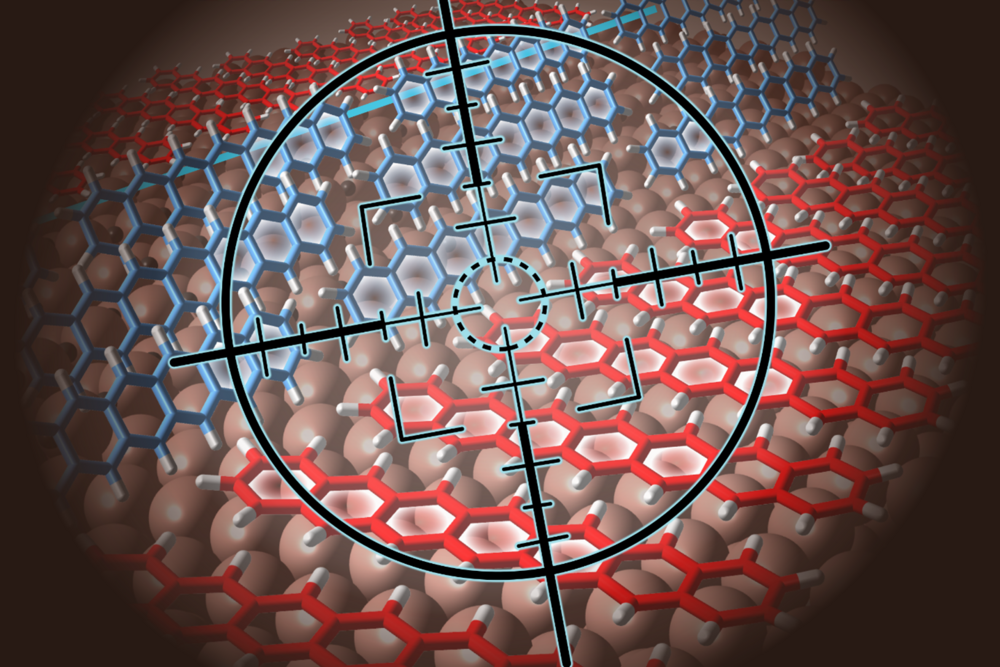
Adsorption of heptacene molecules on copper oxide nanostripes

Adsorption of heptacene molecules on copper oxide nanostripes - image: Uni Graz/Windischbacher

On nanometer-patterned templates, the electronic properties of long-chain organic semiconductors can be deliberately tailored.

The Surface Science Team at the University of Graz, led by Professors Sterrer and Koller (Experimental Physics), in collaboration with the Puschnig Research Group (Theory), investigates the interfaces of ultrathin layers of organic semiconductors with surfaces. In cooperation with the University of Tübingen (Bettinger Group and Chassé Group), a peculiar molecule-oxide-metal system has been in the focus of a recently published work. In this study, it has been demonstrated that the electronic properties of the interface could not only be characterized in great detail but also modified in a controlled way.

Significant contributions to the findings were made by the NanoESCA momentum microscope of the NAWI Graz Core Facility "Photoemission Electron Microscopy of Nanomaterials", an innovative and advanced method for examining the electronic structure of nanomaterials. In this experimental technique, electrons are ejected from the system by ultra-violet light pulses and the intensity of the emitted photoelectrons is measured as a function of energy and emission angle. A comparison of experimental data with simulations provides insights not only into the energy states of electrons at the interface but also allows for deep insights into the structure of the molecular orbitals from which the electron get ejected.

The studied molecule, heptacene, belongs to the chemical group of acenes and is a new relative of pentacene, a well-known organic semiconductor. When heptacene comes into contact with a copper surface, electrons are transferred from the metal substrate to the molecule. Treatment with oxygen passivates the surface, thereby completely suppressing the charge transfer to the adsorbed heptacene molecules. Instead, the interaction between the molecules intensifies. This pronounced change in the electronic structure illustrates the strong effect of surface passivation on the behavior of organic molecules on metal surfaces. By controlling the amount of oxygen during passivation, approximately 2-4 nanometer-wide strips of alternating pure and passivated copper can be created. These stripes act as templates to orient the molecules and determine their respective electronic properties. By producing such a stripe phase, the researchers succeeded in creating and controlling periodic nanostructures of heptacene with and without charge transfer in close proximity on the same surface. These results not only deepen our understanding of molecular adsorption but also demonstrate how molecular films with tailored electronic properties can be fabricated using such a "bottom-up" approach.

The research was conducted as part of the FWF project "Photoemission Tomography of Excited Molecular States" I4145-N36.

 “Orientation, electronic decoupling and band dispersion of heptacene on modified and nanopatterned copper surfaces”
Thomas Boné, Andreas Windischbacher, Lukas Scheucher, Francesco Presel, Paul Schnabl, Marie S Wagner, Holger F Bettinger, Heiko Peisert, Thomas Chassé, Peter Puschnig, Michael G Ramsey, Martin Sterrer, Georg Koller
Journal of Physics: Condensed Matter, 2023 Aug 31;35(47).  doi: 10.1088/1361-648X/acf105.

Authors:
Thomas Boné and Andreas Windischbacher

Related news

New FWF – WEAVE Project "Longer Acenes: Synthesis, Interfaces, and Thin Films"

Unlocking the Potential of Longer Acenes: A New Era in Organic Electronics

Two Awards for an Outstanding Dissertation

Andreas Windischbacher received two prestigious awards for his outstanding doctoral dissertation. On March 17th, 2025, he was presented with the golden ring of honour of the Republic of Austria by our Federal President as part of the Promotio sub auspiciis Praesidentis rei publicae. On the same day, he was also selected for the Josef Krainer Förderungspreis, whose ceremonial presentation, however, took place later on November 12th, 2025.

NanoGraz Careers & Ideas Days 2025: Career paths after the doctorate

On October 13 and 14, the consortium NanoGraz of the Research Career Campus at the University of Graz organized a two-day event to inform the consortium's doctoral students about their career options after completing their doctorate. In addition to exciting lectures by early-career researchers as well as representatives from industry, the Austrian Science Fund (FWF), and the research management of the University of Graz, a brainstorming competition took place on the second day, in which the participants had the opportunity to develop their own joint mini-projects.

Seed-Funding Grant: Bringing Ideas to Life Together

With the new OpNaQ Seed-Funding Grant, the OpNaQ Group, part of the Institute of Physics, lifts collaboration within the research group to a whole new level, and supports sub-groups in turning their ideas into concrete projects.

Begin of page section:
Additional information:

University of Graz
Universitaetsplatz 3
8010 Graz
Austria
  • Contact
  • Web Editors
  • Moodle
  • UNIGRAZonline
  • Imprint
  • Data Protection Declaration
  • Accessibility Declaration
Weatherstation
Uni Graz

End of this page section. Go to overview of page sections

End of this page section. Go to overview of page sections

Begin of page section:

End of this page section. Go to overview of page sections