
Begin of page section:
Page sections:

  • Go to contents (Accesskey 1)
  • Go to position marker (Accesskey 2)
  • Go to main navigation (Accesskey 3)
  • Go to sub navigation (Accesskey 4)
  • Go to additional information (Accesskey 5)
  • Go to page settings (user/language) (Accesskey 8)
  • Go to search (Accesskey 9)

End of this page section. Go to overview of page sections

Begin of page section:
Page settings:

English en
Deutsch de
Search
Login

End of this page section. Go to overview of page sections

Begin of page section:
Search:

Search for details about Uni Graz
Close

End of this page section. Go to overview of page sections


Search

Begin of page section:
Main navigation:

Page navigation:

  • University

    University
    • About the University
    • Organisation
    • Faculties
    • Library
    • Working at University of Graz
    • Campus
    Developing solutions for the world of tomorrow - that is our mission. Our students and our researchers take on the great challenges of society and carry the knowledge out.
  • Research Profile

    Research Profile
    • Our Expertise
    • Research Questions
    • Research Portal
    • Promoting Research
    • Research Transfer
    • Ethics in Research
    Scientific excellence and the courage to break new ground. Research at the University of Graz creates the foundations for making the future worth living.
  • Studies

    Studies
    • Prospective Students
    • Students
  • Community

    Community
    • International
    • Location
    • Research and Business
    • Alumni
    The University of Graz is a hub for international research and brings together scientists and business experts. Moreover, it fosters the exchange and cooperation in study and teaching.
  • Spotlight
Topics
  • Our digital Advent calendar
  • Sustainable University
  • Researchers answer
  • Work for us
Close menu

End of this page section. Go to overview of page sections

Begin of page section:
You are here:

University of Graz Natural sciences Institute of Physics News Oberflächenprozesse besser verstehen
  • About the institute
  • Our research
  • Personalities
  • Student Services
  • News
  • Events

End of this page section. Go to overview of page sections

Thursday, 22 January 2015

Oberflächenprozesse besser verstehen

Foto: M. Sterrer

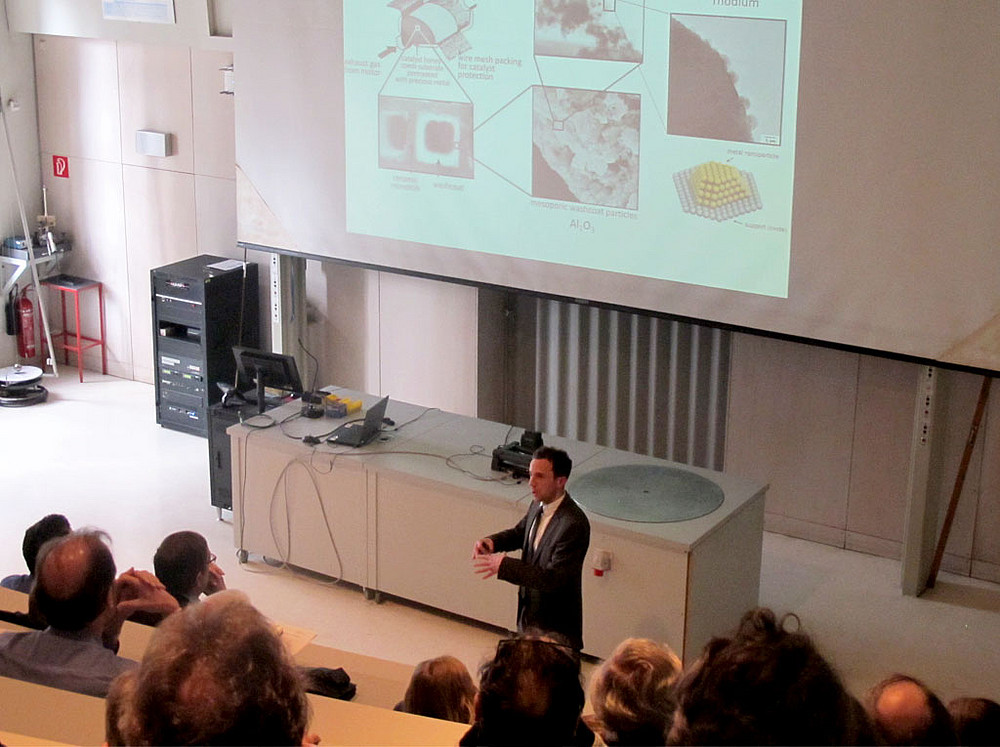
Antrittsvorlesung M. Sterrer im HS 05.01

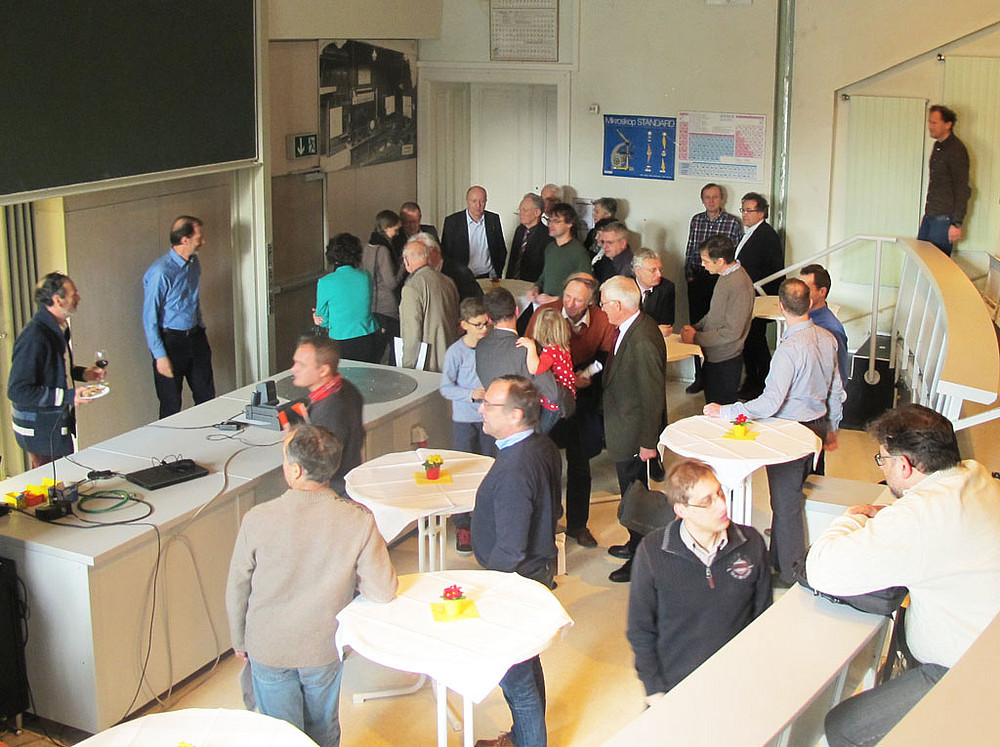
Buffet im Anschluss

Antrittsvorlesung von Experimentalphysiker Martin Sterrer - ein Rückblick

Herr Univ.-Prof. Dr. Martin Sterrer hielt am 19. Jänner 2015 seine Antrittsvorlesung zum Thema „2D Modelle in der Katalysatorforschung“. Nach einer Einführung durch die Vizerektorin der Karl-Franzens-Universität Graz, Frau Ao.Univ.-Prof. Dr. R. Dworczak, sprach der Dekan der NAWI Fakultät, Herr Univ.-Prof. Dr. K. Crailsheim die Begrüßungsworte. Danach präsentierte der Institutsleiter, Herr Univ.-Prof. Dr. Walter Pötz, den akademischen Lebenslauf von Herrn Sterrer einem zahlreich erschienen Publikum, unter dem sich auch dessen Doktorvater (Prof. Knözinger) befand.


Zu Beginn seines Vortrages gab Sterrer einen Überblick über die Bedeutung der Katalyseforschung für die industrielle Werkstoffsynthese, wobei er auch auf die Schwierigkeit geeignete Katalysatorsysteme zu finden einging. „Um die elementaren Prozesse von chemischen Reaktionen auf den Oberflächen von Katalysatoren besser verstehen zu können, ist es notwendig vereinfachte Modellsysteme zu entwickeln, die unter kontrollierten Umgebungs- und Reaktionsbedingungen untersucht werden können“, erklärte Sterrer. Im Folgenden wurde ein vielversprechender Modellansatz vorgestellt, der in der Verwendung von wohlgeordneten, nur wenige Atomlagen dünnen Oxidschichten als Träger für Metall-Nanopartikel besteht, da diese einerseits relevante Aspekte der Komplexität der realen Systeme abdecken, und andererseits für viele oberflächenphysikalische Untersuchungsmethoden zugänglich sind. Deren Präparation und die Charakterisierung dieser Modell-systeme, sowie Untersuchungen, die auf ein atomares Verständnis von der Wechselwirkung zwischen Metall und Oxid abzielen, wurden anhand von ausgewählten Beispielen diskutiert.


Martin Sterrer studierte Technische Chemie an der TU Wien und hat dort am Institut für Materialchemie seine Diplom- und Doktorarbeit zu photo-chemischen und photophysikalischen Oberflächenprozessen auf Oxid-Nano-partikeln bei Prof. Erich Knözinger angefertigt. Mit einem Erwin-Schrödinger-Stipendium des FWF ist er 2003 als PostDoc nach Berlin in die Abteilung Chemische Physik (Prof. Hajo Freund) des Fritz-Haber-Instituts (FHI) der Max-Planck-Gesellschaft gekommen und hat sich fortan mit den Eigenschaften von einkristallinen Oberflächen und Metall-Nanopartikeln beschäftigt. 2006 führte ihn ein von der Deutschen Forschungsgemeinschaft gefördertes PostDoc-Projekt zum Thema Ultrakurzzeit-Spektroskopie ans FOM-Institut für Atom- und Molekülphysik in Amsterdam (Prof. Mischa Bonn). Er leitete von 2007 bis 2014 die Arbeitsgruppe „Katalyse und Laser-Spektroskopie“ in der Abteilung Chemische Physik am FHI und erhielt während dieser Zeit einen Starting Grant des Europäischen Forschungsrats (ERC). Im Jahr 2013 wurde er an der TU Berlin im Fach Physikalische Chemie habilitiert und erhielt kurz darauf einen Ruf an die Universität Graz, wo er seit September 2014 als Professor für Experimentalphysik tätig ist und der Arbeitsgruppe Oberflächen- und Grenzflächenphysik vorsteht.

Related news

New FWF – WEAVE Project "Longer Acenes: Synthesis, Interfaces, and Thin Films"

Unlocking the Potential of Longer Acenes: A New Era in Organic Electronics

Two Awards for an Outstanding Dissertation

Andreas Windischbacher received two prestigious awards for his outstanding doctoral dissertation. On March 17th, 2025, he was presented with the golden ring of honour of the Republic of Austria by our Federal President as part of the Promotio sub auspiciis Praesidentis rei publicae. On the same day, he was also selected for the Josef Krainer Förderungspreis, whose ceremonial presentation, however, took place later on November 12th, 2025.

NanoGraz Careers & Ideas Days 2025: Career paths after the doctorate

On October 13 and 14, the consortium NanoGraz of the Research Career Campus at the University of Graz organized a two-day event to inform the consortium's doctoral students about their career options after completing their doctorate. In addition to exciting lectures by early-career researchers as well as representatives from industry, the Austrian Science Fund (FWF), and the research management of the University of Graz, a brainstorming competition took place on the second day, in which the participants had the opportunity to develop their own joint mini-projects.

Seed-Funding Grant: Bringing Ideas to Life Together

With the new OpNaQ Seed-Funding Grant, the OpNaQ Group, part of the Institute of Physics, lifts collaboration within the research group to a whole new level, and supports sub-groups in turning their ideas into concrete projects.

Begin of page section:
Additional information:

University of Graz
Universitaetsplatz 3
8010 Graz
Austria
  • Contact
  • Web Editors
  • Moodle
  • UNIGRAZonline
  • Imprint
  • Data Protection Declaration
  • Accessibility Declaration
Weatherstation
Uni Graz

End of this page section. Go to overview of page sections

End of this page section. Go to overview of page sections

Begin of page section:

End of this page section. Go to overview of page sections