Begin of page section:
Page sections:

  • Go to contents (Accesskey 1)
  • Go to position marker (Accesskey 2)
  • Go to main navigation (Accesskey 3)
  • Go to sub navigation (Accesskey 4)
  • Go to additional information (Accesskey 5)
  • Go to page settings (user/language) (Accesskey 8)
  • Go to search (Accesskey 9)

End of this page section. Go to overview of page sections

Begin of page section:
Page settings:

English en
Deutsch de
Search
Login

End of this page section. Go to overview of page sections

Begin of page section:
Search:

Search for details about Uni Graz
Close

End of this page section. Go to overview of page sections


Search

Begin of page section:
Main navigation:

Page navigation:

  • University

    University
    • About the University
    • Organisation
    • Faculties
    • Library
    • Working at University of Graz
    • Campus
    Developing solutions for the world of tomorrow - that is our mission. Our students and our researchers take on the great challenges of society and carry the knowledge out.
  • Research Profile

    Research Profile
    • Our Expertise
    • Research Questions
    • Research Portal
    • Promoting Research
    • Research Transfer
    • Ethics in Research
    Scientific excellence and the courage to break new ground. Research at the University of Graz creates the foundations for making the future worth living.
  • Studies

    Studies
    • Prospective Students
    • Students
  • Community

    Community
    • International
    • Location
    • Research and Business
    • Alumni
    The University of Graz is a hub for international research and brings together scientists and business experts. Moreover, it fosters the exchange and cooperation in study and teaching.
  • Spotlight
Topics
  • Our digital Advent calendar
  • Sustainable University
  • Researchers answer
  • Work for us
Close menu

End of this page section. Go to overview of page sections

Begin of page section:
You are here:

University of Graz Natural sciences Institute of Physics News Sonniger und wärmer: Was die Wetterstation an der Uni Graz verrät
  • About the institute
  • Our research
  • Personalities
  • Student Services
  • News
  • Events

End of this page section. Go to overview of page sections

Friday, 28 June 2024

Sunnier and warmer: what the weather station at the University of Graz reveals

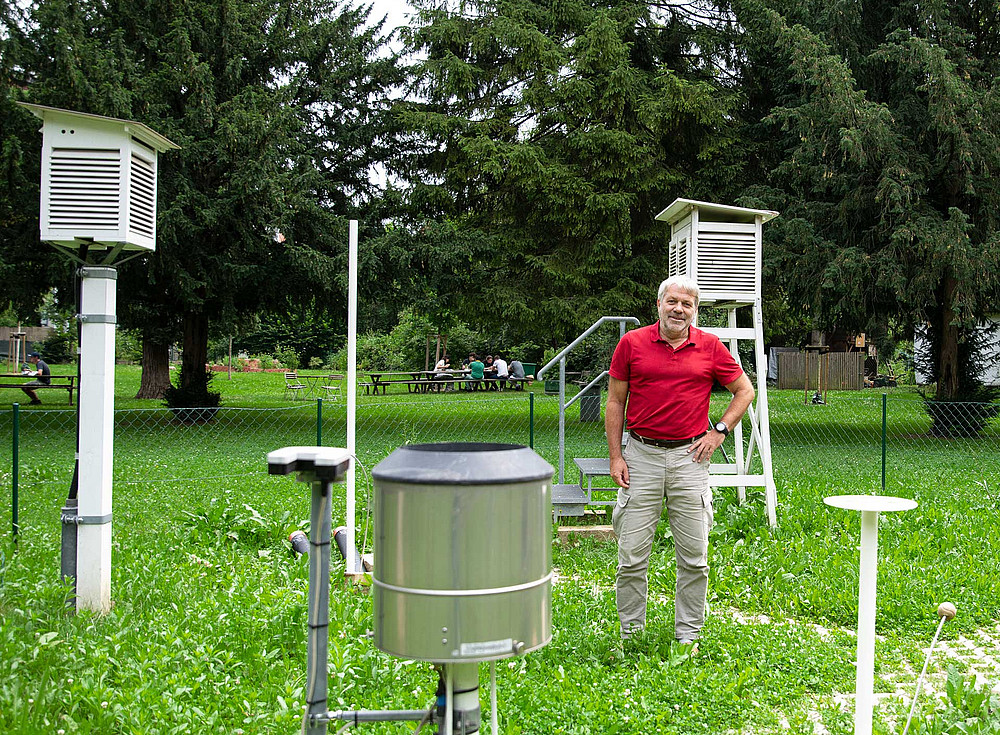
Ulrich Foelsche ©Uni Graz/Tzivanopoulos

Ulrich Foelsche from the Institute of Physics is the scientific director of the weather station at the University of Graz. Photo: Uni Graz/Tzivanopoulos

Anyone calling up the official weather for Graz ends up at the University of Graz. This is because the meteorological station, in cooperation with GeoSphere Austria, provides the current values for the provincial capital, which can be found on many media portals - including the footer of the University of Graz website.

Data for weather and climate studies has been collected on campus since 1891. Albeit at different locations. Until the Graz Center of Physics was completed, the station was moved from the meadow near the main building to near the Center for Molecular Biosciences. "It is on average 0.3 degrees Celsius cooler there," explains atmospheric physicist Ulrich Foelsche, scientific director of the station. This is why measurements were taken at both locations in parallel for a while.
Nonetheless, the temperature curve is continuously rising, as Foelsche confirms: "In the past 50 years, the average annual temperature has risen by two degrees to 12.2 degrees, and in summer by as much as three degrees. This means that we are now in a different climate zone."

In addition to temperature, humidity, air pressure, precipitation, wind speed and direction as well as sunshine duration are measured. The latter has increased by ten percent since the 1960s and is also fueling global warming because - an almost paradoxical situation - air quality has improved. "Less turbidity allows more sunlight through and leads to less cloud formation," explains Foelsche.
The station at the University of Graz was accepted as a Centennial Observing Station of the World Meteorological Organization, as the series of measurements go back more than 130 years. And even further back: the scientists are currently evaluating weather data recorded by a Graz family from 1780 and at the "Alte Uni" in Hofgasse from 1836.

Records in measurement history at the University of Graz

Even though summer arrived on June 19, 2024 with 33.6 degrees, the record was set in 2013 on July 29 and August 8 with 38.1 degrees.
The coldest days were minus 23.7 degrees on 24 January 1903 and 3 February 1929. The station recorded its wettest day to date on 30 July 2021, when it poured 113 liters per square meter.

► Learn more about the meteorological station

created by Andreas Schweiger

Related news

New FWF – WEAVE Project "Longer Acenes: Synthesis, Interfaces, and Thin Films"

Unlocking the Potential of Longer Acenes: A New Era in Organic Electronics

Two Awards for an Outstanding Dissertation

Andreas Windischbacher received two prestigious awards for his outstanding doctoral dissertation. On March 17th, 2025, he was presented with the golden ring of honour of the Republic of Austria by our Federal President as part of the Promotio sub auspiciis Praesidentis rei publicae. On the same day, he was also selected for the Josef Krainer Förderungspreis, whose ceremonial presentation, however, took place later on November 12th, 2025.

NanoGraz Careers & Ideas Days 2025: Career paths after the doctorate

On October 13 and 14, the consortium NanoGraz of the Research Career Campus at the University of Graz organized a two-day event to inform the consortium's doctoral students about their career options after completing their doctorate. In addition to exciting lectures by early-career researchers as well as representatives from industry, the Austrian Science Fund (FWF), and the research management of the University of Graz, a brainstorming competition took place on the second day, in which the participants had the opportunity to develop their own joint mini-projects.

Seed-Funding Grant: Bringing Ideas to Life Together

With the new OpNaQ Seed-Funding Grant, the OpNaQ Group, part of the Institute of Physics, lifts collaboration within the research group to a whole new level, and supports sub-groups in turning their ideas into concrete projects.

Begin of page section:
Additional information:

University of Graz
Universitaetsplatz 3
8010 Graz
Austria
  • Contact
  • Web Editors
  • Moodle
  • UNIGRAZonline
  • Imprint
  • Data Protection Declaration
  • Accessibility Declaration
Weatherstation
Uni Graz

End of this page section. Go to overview of page sections

End of this page section. Go to overview of page sections

Begin of page section:

End of this page section. Go to overview of page sections