Begin of page section:
Page sections:

  • Go to contents (Accesskey 1)
  • Go to position marker (Accesskey 2)
  • Go to main navigation (Accesskey 3)
  • Go to sub navigation (Accesskey 4)
  • Go to additional information (Accesskey 5)
  • Go to page settings (user/language) (Accesskey 8)
  • Go to search (Accesskey 9)

End of this page section. Go to overview of page sections

Begin of page section:
Page settings:

English en
Deutsch de
Search
Login

End of this page section. Go to overview of page sections

Begin of page section:
Search:

Search for details about Uni Graz
Close

End of this page section. Go to overview of page sections


Search

Begin of page section:
Main navigation:

Page navigation:

  • University

    University
    • About the University
    • Organisation
    • Faculties
    • Library
    • Working at University of Graz
    • Campus
    Developing solutions for the world of tomorrow - that is our mission. Our students and our researchers take on the great challenges of society and carry the knowledge out.
  • Research Profile

    Research Profile
    • Our Expertise
    • Research Questions
    • Research Portal
    • Promoting Research
    • Research Transfer
    • Ethics in Research
    Scientific excellence and the courage to break new ground. Research at the University of Graz creates the foundations for making the future worth living.
  • Studies

    Studies
    • Prospective Students
    • Students
  • Community

    Community
    • International
    • Location
    • Research and Business
    • Alumni
    The University of Graz is a hub for international research and brings together scientists and business experts. Moreover, it fosters the exchange and cooperation in study and teaching.
  • Spotlight
Topics
  • Our digital Advent calendar
  • Sustainable University
  • Researchers answer
  • Work for us
Close menu

End of this page section. Go to overview of page sections

Begin of page section:
You are here:

University of Graz Natural sciences Institute of Physics News Weltraum-Wetter: Forscher:innen der Universität Graz entwickeln Methode, um Sonnenausbrüche vorherzusagen
  • About the institute
  • Our research
  • Personalities
  • Student Services
  • News
  • Events

End of this page section. Go to overview of page sections

Thursday, 13 July 2023

Weltraum-Wetter: Forscher:innen der Universität Graz entwickeln Methode, um Sonnenausbrüche vorherzusagen

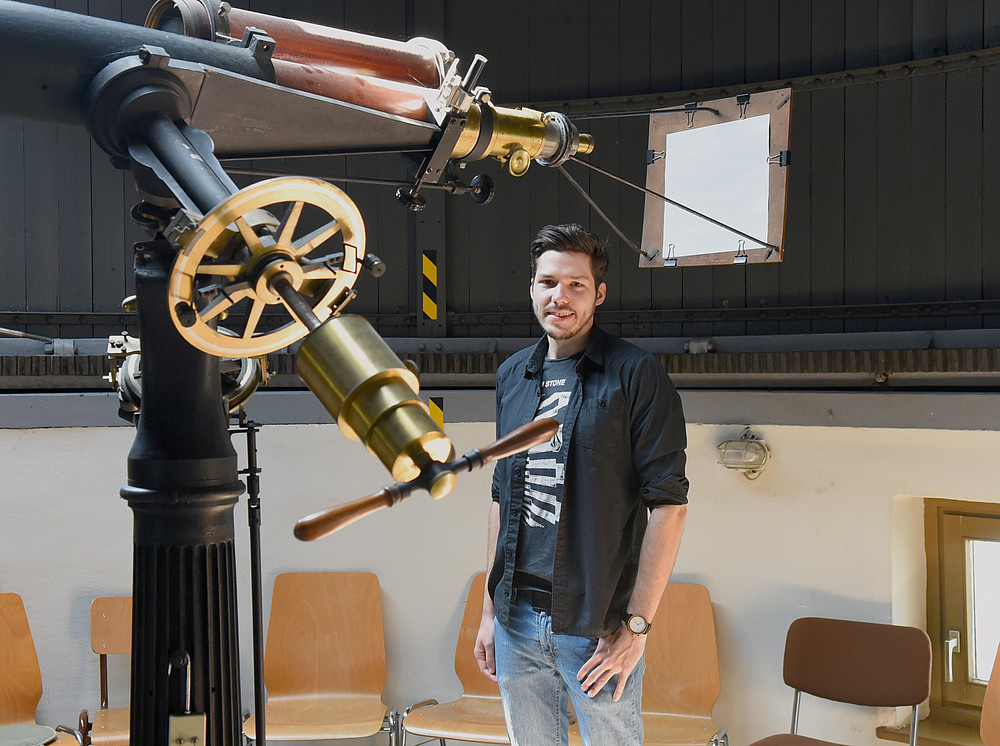
Robert Jarolim im Astronomie-Turm der Universität Graz ©Universität Graz/Vilgut

Robert Jarolim im Astronomie-Turm der Universität Graz Foto: Uni Graz/Vilgut

Sonneneruptionen sind spektakuläre Ausbrüche von Materie und Strahlung und können massive Auswirkungen auf die Erde haben, indem sie beispielsweise Satelliten stören. Forscher:innen der Universität Graz und des Skoltech Institute in Moskau haben eine Methode entwickelt, um solche Ereignisse besser vorhersagen zu können, die das sogenannte Weltraumwetter bestimmen. Die Arbeit wurde in der Juli-Ausgabe des Fachmagazins Nature Astronomy publiziert.

Mithilfe von künstlicher Intelligenz ist es den Wissenschaftler:innen der Universität Graz und des Skoltech Institute in Moskau gelungen, das Magnetfeld in den oberen Schichten der Sonnenatmosphäre zu simulieren, in denen Eruptionen entstehen. „In diesen Bereichen sind Messungen nicht möglich. Wir brauchen daher Modellierungen, um die Vorgänge beschreiben und verstehen zu können“, erklärt Hauptautor Robert Jarolim vom Institut für Physik der Universität Graz.

Um Vorhersagen treffen zu können, beobachten und messen die Forscher:innen die Sonnenflecken. „Das sind Gebiete mit sehr starkem Magnetfeld“, sagt Jarolim. Diese Daten werden mittels künstlicher Intelligenz mit physikalischen Modellen kombiniert, um die Vorgänge in den oberen Schichten der Sonnenatmosphäre zu simulieren.

Bisher dauerte dieser Vorgang viele Stunden. „Mit unserer Methode konnten wir die Dauer der Berechnung deutlich reduzieren. Das ermöglicht es uns, fast in Echtzeit neue Daten einzupflegen und dadurch können wir Sonnenstürme wesentlich besser vorhersagen, die auf die Erde treffen“, unterstreicht der Astrophysiker.

Die Ergebnisse der Simulationen verbessern das Verständnis für das Magnetfeld der Sonne und das Weltraumwetter. Damit sind sie auch für die Raum- und Luftfahrt bedeutend, ergänzt Jarolim: „Bereits wenige Minuten nach einer Sonneneruption kommen hochgeladene Teilchen auf der Erde an. Diese sind eine Gefahr für Astronaut:innen und können ein erhöhtes Strahlungsrisiko für Flugzeugpassagiere bedeuten.“

Publikation

R. Jarolim, J. K. Thalmann, A. M. Veronig, T. Podladchikova. Probing the solar coronal magnetic field with physics-informed neuronal networks. Nature Astronomy, Volume 7, No. 6, 2023

https://www.nature.com/articles/s41550-023-02030-9


created by Roman Vilgut

Related news

New FWF – WEAVE Project "Longer Acenes: Synthesis, Interfaces, and Thin Films"

Unlocking the Potential of Longer Acenes: A New Era in Organic Electronics

Two Awards for an Outstanding Dissertation

Andreas Windischbacher received two prestigious awards for his outstanding doctoral dissertation. On March 17th, 2025, he was presented with the golden ring of honour of the Republic of Austria by our Federal President as part of the Promotio sub auspiciis Praesidentis rei publicae. On the same day, he was also selected for the Josef Krainer Förderungspreis, whose ceremonial presentation, however, took place later on November 12th, 2025.

NanoGraz Careers & Ideas Days 2025: Career paths after the doctorate

On October 13 and 14, the consortium NanoGraz of the Research Career Campus at the University of Graz organized a two-day event to inform the consortium's doctoral students about their career options after completing their doctorate. In addition to exciting lectures by early-career researchers as well as representatives from industry, the Austrian Science Fund (FWF), and the research management of the University of Graz, a brainstorming competition took place on the second day, in which the participants had the opportunity to develop their own joint mini-projects.

Seed-Funding Grant: Bringing Ideas to Life Together

With the new OpNaQ Seed-Funding Grant, the OpNaQ Group, part of the Institute of Physics, lifts collaboration within the research group to a whole new level, and supports sub-groups in turning their ideas into concrete projects.

Begin of page section:
Additional information:

University of Graz
Universitaetsplatz 3
8010 Graz
Austria
  • Contact
  • Web Editors
  • Moodle
  • UNIGRAZonline
  • Imprint
  • Data Protection Declaration
  • Accessibility Declaration
Weatherstation
Uni Graz

End of this page section. Go to overview of page sections

End of this page section. Go to overview of page sections

Begin of page section:

End of this page section. Go to overview of page sections