Begin of page section:
Page sections:

  • Go to contents (Accesskey 1)
  • Go to position marker (Accesskey 2)
  • Go to main navigation (Accesskey 3)
  • Go to sub navigation (Accesskey 4)
  • Go to additional information (Accesskey 5)
  • Go to page settings (user/language) (Accesskey 8)
  • Go to search (Accesskey 9)

End of this page section. Go to overview of page sections

Begin of page section:
Page settings:

English en
Deutsch de
Search
Login

End of this page section. Go to overview of page sections

Begin of page section:
Search:

Search for details about Uni Graz
Close

End of this page section. Go to overview of page sections


Search

Begin of page section:
Main navigation:

Page navigation:

  • University

    University
    • About the University
    • Organisation
    • Faculties
    • Library
    • Working at University of Graz
    • Campus
    Developing solutions for the world of tomorrow - that is our mission. Our students and our researchers take on the great challenges of society and carry the knowledge out.
  • Research Profile

    Research Profile
    • Our Expertise
    • Research Questions
    • Research Portal
    • Promoting Research
    • Research Transfer
    • Ethics in Research
    • Commission for Scientific Integrity
    Scientific excellence and the courage to break new ground. Research at the University of Graz creates the foundations for making the future worth living.
  • Studies

    Studies
    • Prospective Students
    • Students
  • Community

    Community
    • International
    • Location
    • Research and Business
    • Alumni
    The University of Graz is a hub for international research and brings together scientists and business experts. Moreover, it fosters the exchange and cooperation in study and teaching.
  • Spotlight
Topics
  • Sustainable University
  • Researchers answer
  • Work for us
Close menu

End of this page section. Go to overview of page sections

Begin of page section:
You are here:

University of Graz Natural sciences Institute of Physics News In voller Schärfe: KI-Methode revolutioniert Beobachtung der Sonne
  • About the institute
  • Our research
  • Personalities
  • Student Services
  • News
  • Events

End of this page section. Go to overview of page sections

Tuesday, 07 April 2026

Crystal-clear: AI method revolutionises solar observation

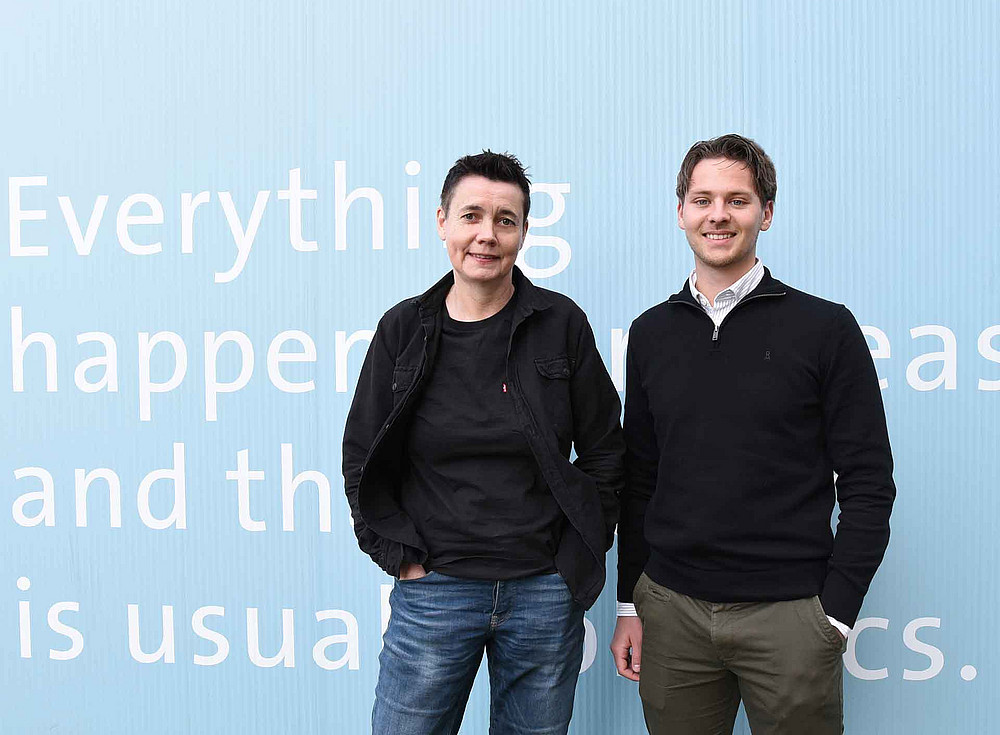
Astrid Veronig and Christoph Schirninger ©Uni Graz/Schweiger

Astrophysicist Astrid Veronig and PhD student Christoph Schirninger are able to observe the Sun even more closely with the help of AI. Photo: Uni Graz/Schweiger

The Sun makes life on Earth possible. However, its magnetic fields can also cause massive disruption. This makes it all the more important to gain a better understanding of the processes taking place on our nearest star. A research team from the University of Graz and the High Altitude Observatory in Boulder (USA) has succeeded in doing just that. The astrophysicists have developed an AI-supported method that makes even the smallest structures on the Sun visible. The scientists are convinced that this will bring about a lasting change in solar observation and that the new method can be used for the planned European Solar Telescope.

The Daniel K. Inouye Solar Telescope in Hawaii is currently the world’s largest solar telescope and provides spectacular, high-resolution images of the Sun. “These images give us insight into the dynamic processes of the solar plasma and magnetic field,” explains Astrid Veronig, astrophysicist and head of the research group at the University of Graz. “However, the Earth’s atmosphere poses a challenge, as turbulence significantly impairs image quality. As a result, fine details on the Sun’s surface often appear blurred or even unrecognisable. Even adaptive optics and traditional reconstruction methods cannot reproduce these small-scale structures with full sharpness.”

The international team has now solved this problem with the help of artificial intelligence. The method combines expert physical knowledge with the power of machine learning. “Our AI is not simply a black box,” emphasises Astrid Veronig. “It uses physical models and equations describing how light and the atmosphere interact, and can thus separate the image information from atmospheric disturbances and reconstruct the image.”

Tiny structures made visible

Christoph Schirninger, a PhD student at the University of Graz and lead author of the study, first tested the procedure using simulation data. The method was then applied to real observational data – with resounding success. “Tiny structures that were previously hidden could thus be made visible,” explains Schirninger.
“Physics-informed neural networks open up entirely new perspectives for solar research. In the long term, this technology could revolutionise image reconstruction for future large telescopes,” adds Robert Jarolim, a researcher and NASA Jack Eddy Fellow at the High Altitude Observatory in Boulder.

⇒ The study was published in the journal Astronomy & Astrophysics.
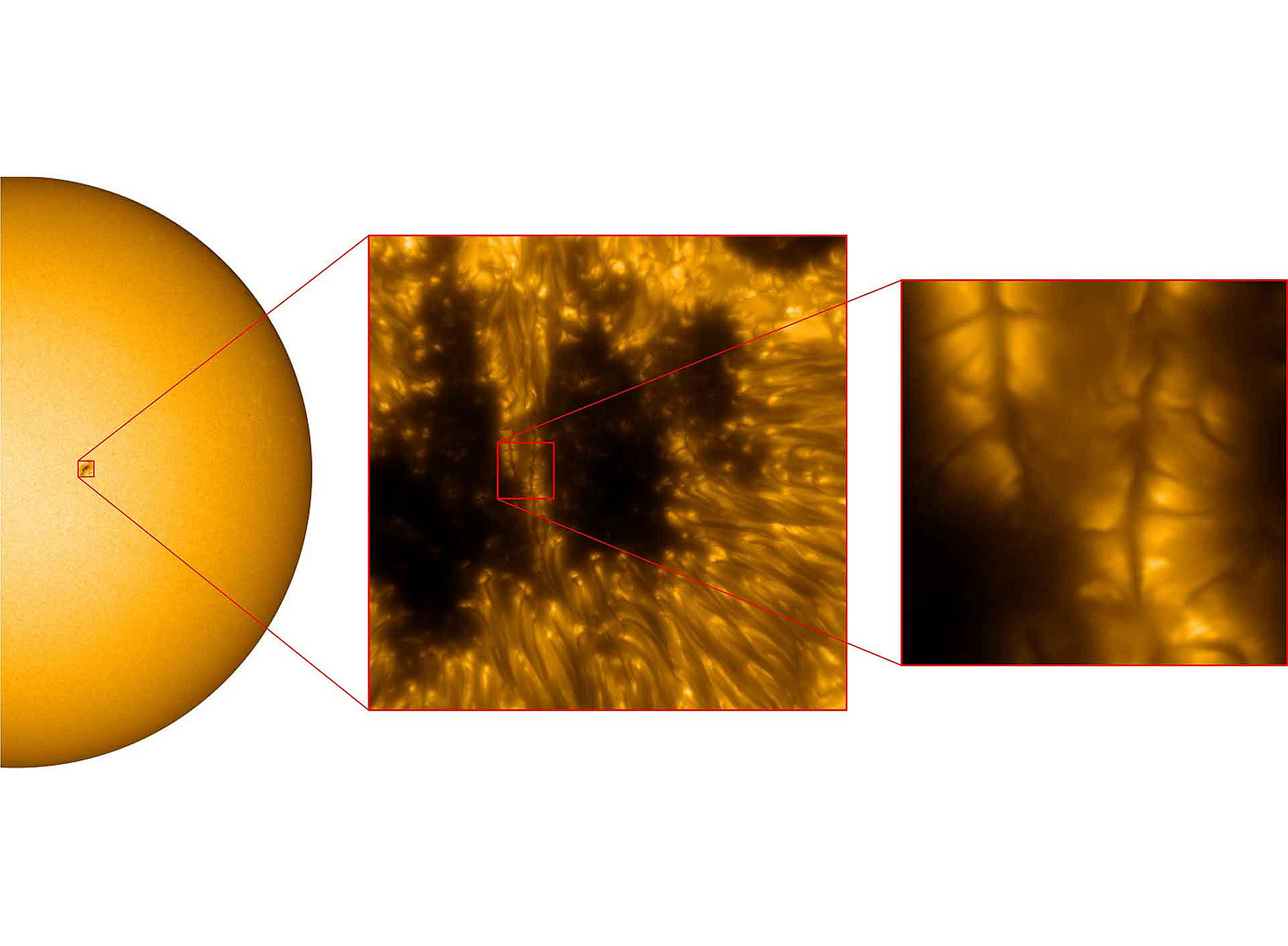
Images of the Sun using the new AI method
Left: Image of the Sun taken from the Kanzelhöhe Observatory at the University of Graz.
Centre and right: High-resolution images of a small section of the Sun taken by the Daniel K. Inouye Solar Telescope in Hawaii, reconstructed using the newly developed method. The finest details on the Sun’s surface have been made visible. Photo: Uni Graz/Schirninger
created by Andreas Schweiger

Related news

The Josef Krainer „Förderungspreis“ goes to Stefan Purkhart

Stefan Purkhart from the Institute of Physics at the University of Graz has been awarded the Josef Krainer „Förderungspreis“ 2026 for his dissertation.

80 Jahre Innovation und Austausch

Der Fachbereich Physikdidaktik bei der 80. Fortbildungswoche für Physik- und Chemielehrkräfte in Wien

Committed to the highest standards

Three young researchers from the OpNaQ group gain insight into the world of standardization.

And the winner is ...

The winner of this year's indoor soccer tournament for employees of Styrian universities, universities of applied sciences and teacher education comes from our Institute! We congratulate our team with the prestigious name ‘We All have Potential!’ on this great success!

Begin of page section:
Additional information:

University of Graz
Universitaetsplatz 3
8010 Graz
Austria
  • Contact
  • Web Editors
  • Moodle
  • UNIGRAZonline
  • Imprint
  • Data Protection Declaration
  • Accessibility Declaration
Weatherstation
Uni Graz

End of this page section. Go to overview of page sections

End of this page section. Go to overview of page sections

Begin of page section:

End of this page section. Go to overview of page sections