Begin of page section:
Page sections:

  • Go to contents (Accesskey 1)
  • Go to position marker (Accesskey 2)
  • Go to main navigation (Accesskey 3)
  • Go to sub navigation (Accesskey 4)
  • Go to additional information (Accesskey 5)
  • Go to page settings (user/language) (Accesskey 8)
  • Go to search (Accesskey 9)

End of this page section. Go to overview of page sections

Begin of page section:
Page settings:

English en
Deutsch de
Search
Login

End of this page section. Go to overview of page sections

Begin of page section:
Search:

Search for details about Uni Graz
Close

End of this page section. Go to overview of page sections


Search

Begin of page section:
Main navigation:

Page navigation:

  • University

    University
    • About the University
    • Organisation
    • Faculties
    • Library
    • Working at University of Graz
    • Campus
    Developing solutions for the world of tomorrow - that is our mission. Our students and our researchers take on the great challenges of society and carry the knowledge out.
  • Research Profile

    Research Profile
    • Our Expertise
    • Research Questions
    • Research Portal
    • Promoting Research
    • Research Transfer
    • Ethics in Research
    • Commission for Scientific Integrity
    Scientific excellence and the courage to break new ground. Research at the University of Graz creates the foundations for making the future worth living.
  • Studies

    Studies
    • Prospective Students
    • Students
    • Registration for Study Programme (Winter semester 2026/27)
    • Study Days 22-26 June 2026
  • Community

    Community
    • International
    • Location
    • Research and Business
    • Alumni
    The University of Graz is a hub for international research and brings together scientists and business experts. Moreover, it fosters the exchange and cooperation in study and teaching.
Topics
  • Sustainable University
  • Researchers answer
  • Work for us
Close menu

End of this page section. Go to overview of page sections

Begin of page section:
You are here:

University of Graz Natural sciences Institute of Physics News Under Current
  • About the institute
  • Our research
  • Personalities
  • Student Services
  • News
  • Events

End of this page section. Go to overview of page sections

Monday, 11 May 2026

Under Current

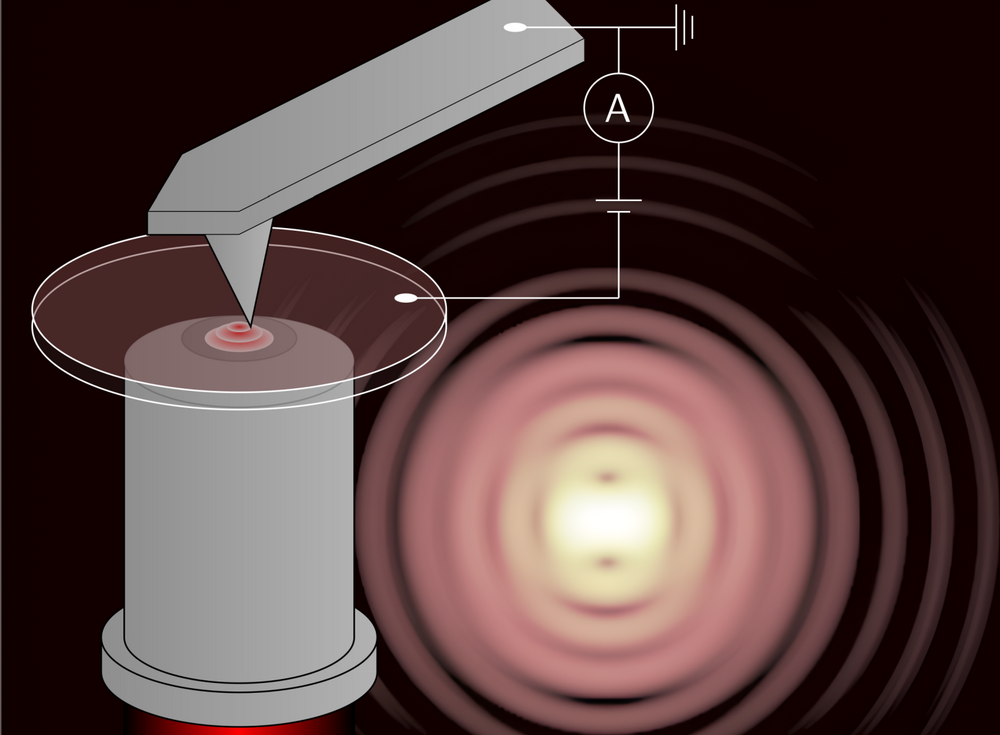
Scheme of the atomic force microscope with a conductive probe tip, along with the simulated image of a laser focus (Uni Graz / Florian Küstner). ©Uni Graz / Küstner

Scheme of the atomic force microscope with a conductive probe tip, along with the simulated image of a laser focus (Uni Graz / Florian Küstner).

High-Resolution Imaging with Quantum Dots and Atomic Force Microscopy

The conversion of light into electricity is a key technological process, for solar cells as well as for the image sensors in our cameras. As in other fields, research in this area has now progressed to the investigation of nanostructures. This allows the underlying elementary processes to be studied, thus laying the foundation for following technology generations.

The Nanooptics research group works, among other things, on semiconducting nanoparticles, so-called quantum dots. In recent years, they have not only been able to clarify open questions regarding light-induced currents in quantum dots. With atomic force microscopy, they have also adapted a high-resolution imaging method so that a conductive probe tip delivers current measurements with a spatial resolution of a few nanometers.

Work on monolayers of lead sulfide quantum dots (provided by the project partner at ETH Zürich) showed that this experimental approach also makes it possible to image light fields. The current through each individual quantum dot reflects the light intensity acting upon it. The high-quality monolayer and the resolution of the atomic force microscope enable high-resolution imaging. This was demonstrated using the focus of a microscope objective with a high numerical aperture and the light field around regularly arranged plasmonic nanoparticles. In both cases, numerical simulations confirmed the experimental data.

F. Küstner, A. Hohenau, H. Ditlbacher, J. R. Krenn, Quantum-dot-mediated light field imaging by photocurrent scanning force microscopy, Nanophotonics 15, e70057 (2026)

https://doi.org/10.1002/nap2.70057

 

Related news

Nano but Mighty: Innovations in confined spaces

At the University of Graz, Peter Banzer and his team (OpNaQ group) are controlling light in extremely confined spaces, enabling entirely new applications in physics, biology, and medicine. By precisely tailoring light fields at the nanometer scale, they can exert forces, extract information, and make hidden features visible.

Gold Medal of Honour for Willibald Plessas

On 11 June 2026, Willibald Plessas was awarded the Golden Medal of Honour for Services to the Republic of Austria in the auditorium of the Old University of Graz.

A quantum black hole?

First hints for a bound state of gravitons, which could be a primordial black hole

Teaching vignettes for working with Arduino in teacher education

The field of physics education focuses, among other things, on how pre-service teachers can be supported in using digital media effectively in science education. One area of research specifically addresses digital data acquisition using Arduino microcontrollers.

Begin of page section:
Additional information:

University of Graz
Universitaetsplatz 3
8010 Graz
Austria
  • Contact
  • Web Editors
  • Moodle
  • UNIGRAZonline
  • Imprint
  • Data Protection Declaration
  • Accessibility Declaration
Weatherstation
Uni Graz

End of this page section. Go to overview of page sections

End of this page section. Go to overview of page sections

Begin of page section:

End of this page section. Go to overview of page sections