Begin of page section:
Page sections:

  • Go to contents (Accesskey 1)
  • Go to position marker (Accesskey 2)
  • Go to main navigation (Accesskey 3)
  • Go to sub navigation (Accesskey 4)
  • Go to additional information (Accesskey 5)
  • Go to page settings (user/language) (Accesskey 8)
  • Go to search (Accesskey 9)

End of this page section. Go to overview of page sections

Begin of page section:
Page settings:

English en
Deutsch de
Search
Login

End of this page section. Go to overview of page sections

Begin of page section:
Search:

Search for details about Uni Graz
Close

End of this page section. Go to overview of page sections


Search

Begin of page section:
Main navigation:

Page navigation:

  • University

    University
    • About the University
    • Organisation
    • Faculties
    • Library
    • Working at University of Graz
    • Campus
    Developing solutions for the world of tomorrow - that is our mission. Our students and our researchers take on the great challenges of society and carry the knowledge out.
  • Research Profile

    Research Profile
    • Our Expertise
    • Research Questions
    • Research Portal
    • Promoting Research
    • Research Transfer
    • Ethics in Research
    • Commission for Scientific Integrity
    Scientific excellence and the courage to break new ground. Research at the University of Graz creates the foundations for making the future worth living.
  • Studies

    Studies
    • Prospective Students
    • Students
    • Registration for Study Programme (Winter semester 2026/27)
    • Welcome Weeks for First Year Students
  • Community

    Community
    • International
    • Location
    • Research and Business
    • Alumni
    The University of Graz is a hub for international research and brings together scientists and business experts. Moreover, it fosters the exchange and cooperation in study and teaching.
Topics
  • Sustainable University
  • Researchers answer
  • Work for us
Close menu

End of this page section. Go to overview of page sections

Begin of page section:
You are here:

University of Graz Natural sciences Institute of Physics News Staunen, Schauspiel, Science: Astrophysiker:innen begleiteten partielle Sonnenfinsternis
  • About the institute
  • Our research
  • Personalities
  • Student Services
  • News
  • Events

End of this page section. Go to overview of page sections

Thursday, 13 August 2026

Surprise, spectacle, science: Astrophysicists observed a partial solar eclipse

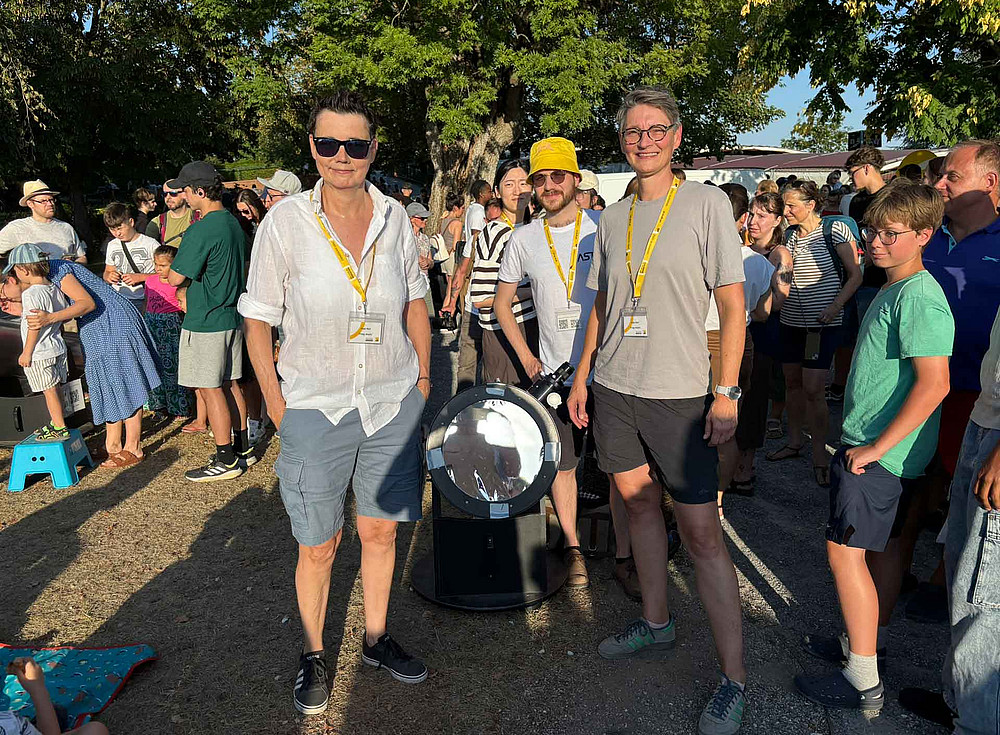
Zwei Frauen und viele andere Menschen stehen bei einem großen Teleskop

Astrophysicists Astrid Veronig (left) and Manuela Stadlober-Temmer, accompanied by a large team of young scientists, witnessed the natural spectacle on the Schloßberg. Photo: Uni Graz/Schweiger

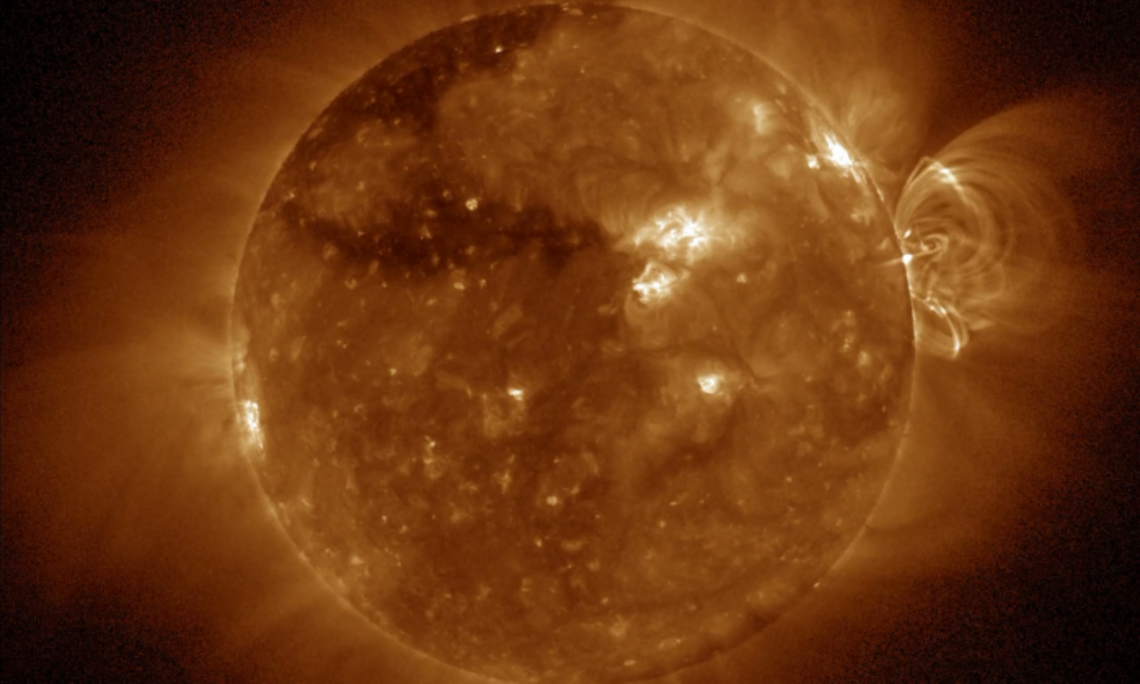
The star of the show was the sun, and the programme featured a natural spectacle: the partial solar eclipse on the evening of 12 August 2026 drew crowds to Graz’s Schloßberg. The ‘sun-downer’ was accompanied by a dash of science from astrophysicists at the University of Graz.

Led by Astrid Veronig, Head of the Kanzelhöhe Observatory for Solar and Environmental Research at the University of Graz, and Manuela Stadlober-Temmer, a team of 15 scientists in total – including numerous PhD students – was on hand to answer the visitors’ many questions. With the aid of telescopes and protective glasses, hundreds of people were able to catch a glimpse of the Sun as it was obscured by the Moon. Although the event lasted just under half an hour – the Sun disappeared behind the Plabutsch shortly before 8 pm – it was met with enthusiastic applause at the end.

The next opportunity to experience a partial solar eclipse in Graz will be as early as 2 August 2027. In the late morning, the Moon will once again pass in front of the Sun, obscuring up to 40 per cent of it. 

created by Andreas Schweiger

Related news

Future Education Talk with Angelika Bernsteiner and Lilith Rüschenpöhler

How Young People Can Help Shape Research

Nano but Mighty: Innovations in confined spaces

At the University of Graz, Peter Banzer and his team (OpNaQ group) are controlling light in extremely confined spaces, enabling entirely new applications in physics, biology, and medicine. By precisely tailoring light fields at the nanometer scale, they can exert forces, extract information, and make hidden features visible.

Gold Medal of Honour for Willibald Plessas

On 11 June 2026, Willibald Plessas was awarded the Golden Medal of Honour for Services to the Republic of Austria in the auditorium of the Old University of Graz.

A quantum black hole?

First hints for a bound state of gravitons, which could be a primordial black hole

Begin of page section:
Additional information:

University of Graz
Universitaetsplatz 3
8010 Graz
Austria
  • Contact
  • Web Editors
  • Moodle
  • UNIGRAZonline
  • Imprint
  • Data Protection Declaration
  • Accessibility Declaration
Weatherstation
Uni Graz

End of this page section. Go to overview of page sections

End of this page section. Go to overview of page sections

Begin of page section:

End of this page section. Go to overview of page sections