Begin of page section:
Page sections:

  • Go to contents (Accesskey 1)
  • Go to position marker (Accesskey 2)
  • Go to main navigation (Accesskey 3)
  • Go to sub navigation (Accesskey 4)
  • Go to additional information (Accesskey 5)
  • Go to page settings (user/language) (Accesskey 8)
  • Go to search (Accesskey 9)

End of this page section. Go to overview of page sections

Begin of page section:
Page settings:

English en
Deutsch de
Search
Login

End of this page section. Go to overview of page sections

Begin of page section:
Search:

Search for details about Uni Graz
Close

End of this page section. Go to overview of page sections


Search

Begin of page section:
Main navigation:

Page navigation:

  • University

    University
    • About the University
    • Organisation
    • Faculties
    • Library
    • Working at University of Graz
    • Campus
    Developing solutions for the world of tomorrow - that is our mission. Our students and our researchers take on the great challenges of society and carry the knowledge out.
  • Research Profile

    Research Profile
    • Our Expertise
    • Research Questions
    • Research Portal
    • Promoting Research
    • Research Transfer
    • Ethics in Research
    • Commission for Scientific Integrity
    Scientific excellence and the courage to break new ground. Research at the University of Graz creates the foundations for making the future worth living.
  • Studies

    Studies
    • Prospective Students
    • Students
    • Welcome Weeks for First Year Students
  • Community

    Community
    • International
    • Location
    • Research and Business
    • Alumni
    The University of Graz is a hub for international research and brings together scientists and business experts. Moreover, it fosters the exchange and cooperation in study and teaching.
Topics
  • Sustainable University
  • Researchers answer
  • Work for us
Close menu

End of this page section. Go to overview of page sections

Begin of page section:
You are here:

University of Graz Natural sciences Institute of Physics News Control over interfacial charge transfer
  • About the institute
  • Our research
  • Personalities
  • Student Services
  • News
  • Events

End of this page section. Go to overview of page sections

Monday, 28 September 2020

Control over interfacial charge transfer

https://onlinelibrary.wiley.com/doi/full/10.1002/admi.202000592 ©Uni Graz/Sterrer
©Uni Graz/Sterrer

https://onlinelibrary.wiley.com/doi/full/10.1002/admi.202000592

Researchers at University of Graz show that the charge transfer into organic molecules through ultrathin dielectric interlayers via electron tunneling can be precisely controlled.

Ultrathin dielectric layers can be found in many technologies ranging from catalysis to organic electronics. Their presence (whether intentional or unintentional) can have profound influence on the chemical and electronic properties of a material. For example, it has been shown that ultrathin dielectrics on metals can reduce the work function of the metal such that charge transfer via tunneling through the dielectric layer into adsorbed atoms or molecules becomes possible, which might have strong effect on the surface reactivity, magnetic moments and charge injection at the contacts of organic devices. Whether this charge transfer occurs in integer units of electronic charge or not, and how the potential equilibration at the interface is accomplished, has long been a matter of debate and remained elusive from an experimental point of view.


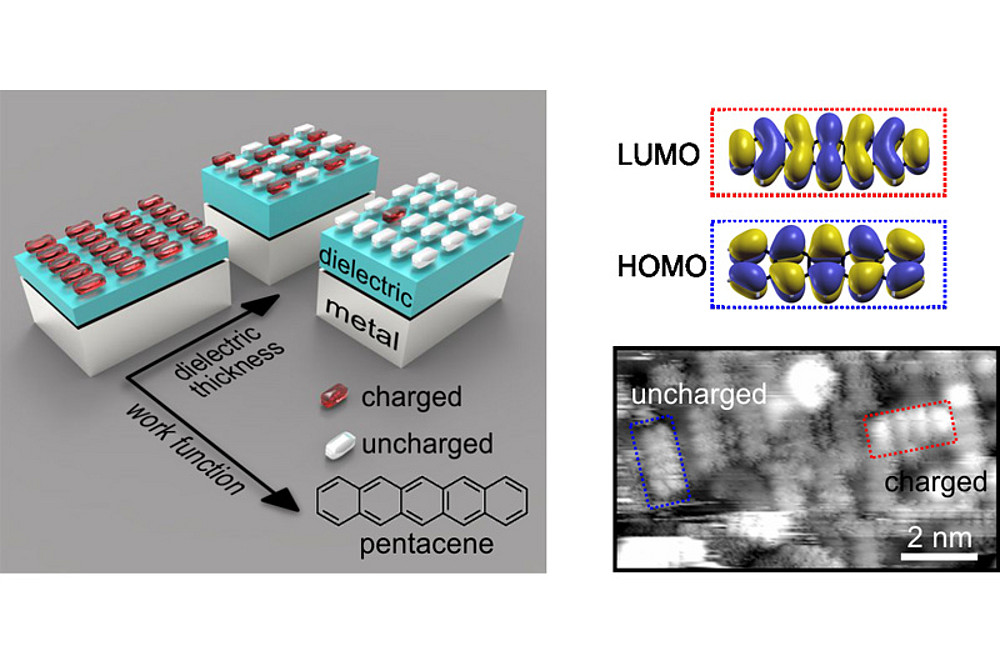
In a recent publication (link: https://onlinelibrary.wiley.com/doi/full/10.1002/admi.202000592) the team around Michael G. Ramsey, Martin Sterrer and Peter Puschnig from the Institute of Physics could demonstrate with a combined experimental and computational work on a model system (ultrathin MgO films on Ag(100) with adsorbed pentacene molecules) that the charge transfer process and the potential equilibration is governed by the proportion of integer charged and uncharged molecules. Moreover, they could show that the ratio of charged and uncharged molecules can be controlled by either tuning the work function of the substrate or the thickness of the dielectric, confirming that the process can be understood and explained with a simple capacitor model. The understanding gained in this work demonstrates how charge transfer in such systems is controlled and paves the way for tuning their chemical and electronic properties in desired directions.

 

created by Martin Sterrer

Related news

Cycling Adventure: Guest reseacher Gregory Kopp Tours Austria

During his stay as a guest researcher at the University of Graz, Gregory Kopp embarked on an impressive five-day bike tour: from Lienz over the Großglockner High Alpine Road, through Zell am See, into Berchtesgaden and to Königsee in Germany, then through Salzburg and along the lakes to the east, and finally south to Hallstatt. Covering more than 340 km and about 6,000 meters of elevation, this route took him through some of Austria’s most stunning scenery.

Future Education Talk with Angelika Bernsteiner and Lilith Rüschenpöhler

How Young People Can Help Shape Research

Nano but Mighty: Innovations in confined spaces

At the University of Graz, Peter Banzer and his team (OpNaQ group) are controlling light in extremely confined spaces, enabling entirely new applications in physics, biology, and medicine. By precisely tailoring light fields at the nanometer scale, they can exert forces, extract information, and make hidden features visible.

Gold Medal of Honour for Willibald Plessas

On 11 June 2026, Willibald Plessas was awarded the Golden Medal of Honour for Services to the Republic of Austria in the auditorium of the Old University of Graz.

Begin of page section:
Additional information:

University of Graz
Universitaetsplatz 3
8010 Graz
Austria
  • Contact
  • Web Editors
  • Moodle
  • UNIGRAZonline
  • Imprint
  • Data Protection Declaration
  • Accessibility Declaration
Weatherstation
Uni Graz

End of this page section. Go to overview of page sections

End of this page section. Go to overview of page sections

Begin of page section:

End of this page section. Go to overview of page sections