Begin of page section:
Page sections:

  • Go to contents (Accesskey 1)
  • Go to position marker (Accesskey 2)
  • Go to main navigation (Accesskey 3)
  • Go to sub navigation (Accesskey 4)
  • Go to additional information (Accesskey 5)
  • Go to page settings (user/language) (Accesskey 8)
  • Go to search (Accesskey 9)

End of this page section. Go to overview of page sections

Begin of page section:
Page settings:

English en
Deutsch de
Search
Login

End of this page section. Go to overview of page sections

Begin of page section:
Search:

Search for details about Uni Graz
Close

End of this page section. Go to overview of page sections


Search

Begin of page section:
Main navigation:

Page navigation:

  • University

    University
    • About the University
    • Organisation
    • Faculties
    • Library
    • Working at University of Graz
    • Campus
    Developing solutions for the world of tomorrow - that is our mission. Our students and our researchers take on the great challenges of society and carry the knowledge out.
  • Research Profile

    Research Profile
    • Our Expertise
    • Research Questions
    • Research Portal
    • Promoting Research
    • Research Transfer
    • Ethics in Research
    • Commission for Scientific Integrity
    Scientific excellence and the courage to break new ground. Research at the University of Graz creates the foundations for making the future worth living.
  • Studies

    Studies
    • Prospective Students
    • Students
    • Registration for Study Programme (Winter semester 2026/27)
    • Welcome Weeks for First Year Students
  • Community

    Community
    • International
    • Location
    • Research and Business
    • Alumni
    The University of Graz is a hub for international research and brings together scientists and business experts. Moreover, it fosters the exchange and cooperation in study and teaching.
Topics
  • Sustainable University
  • Researchers answer
  • Work for us
Close menu

End of this page section. Go to overview of page sections

Begin of page section:
You are here:

University of Graz Natural sciences Institute of Physics News Leben im All
  • About the institute
  • Our research
  • Personalities
  • Student Services
  • News
  • Events

End of this page section. Go to overview of page sections

Tuesday, 10 March 2020

Leben im All

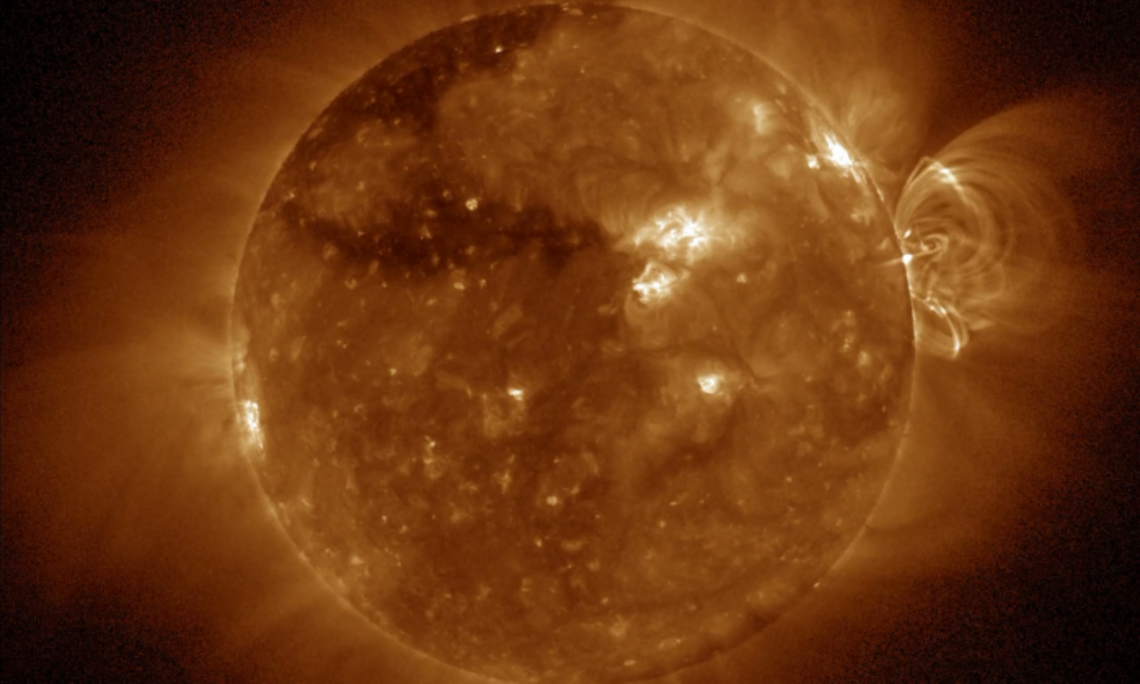
Gibt es Leben abseits der Erde? PhysikerInnen der Universität Graz halten das für wahrscheinlich. Foto: Pixabay

Gibt es Leben abseits der Erde? PhysikerInnen der Universität Graz halten das für wahrscheinlich. Foto: Pixabay

PhysikerInnen der Universität Graz weisen günstige Bedingungen auf Exoplanet nach

Bekommen wir einmal Besuch von Aliens? Das können die ForscherInnen der Universität Graz nicht vorhersagen. Aber das Team rund um Arnold Hanslmeier vom Institut für Physik wies nach, dass Leben außerhalb unseres Sonnensystems möglich ist. Zumindest der erdnächste Exoplanet Proxima Centauri b, der den Stern Proxima Centauri als „Sonne“ umkreist, ist für Mikroorganismen bewohnbar. Ausschlaggebend dafür ist ein ausreichender Schutz vor schädlicher UV-Strahlung.
„Diese Strahlung ist ein wesentlicher Faktor, der Leben, wie wir es kennen, auf der Oberfläche von Planeten beeinflusst“, fasst Hanslmeier zusammen. Unterschiedliche Wellenlängen des ultravioletten Lichts werden von der Atmosphäre eines Himmelskörpers verschieden stark absorbiert. Die Grazer PhysikerInnen haben die Auswirkungen der Strahlung unter mehreren Bedingungen für den Planeten Proxima Centauri b berechnet. Selbst in einem Worst-Case-Szenario – ohne UV-Schutz durch eine Atmosphäre und während einer starken Strahleneruption des zentralen Sterns – könnte ein Teil der Mikroorganismen weiterhin existieren. „Unsere Studie zeigt, dass bestimmte Organismen mit wesentlich extremeren Bedingungen zurechtkommen können, als wir sie auf der Erde finden“, beschreibt Hanslmeier. Das bedeutet auch, dass Leben auf anderen Exoplaneten wahrscheinlicher ist, als bisher angenommen. Die Chance für uns Menschen, mit Aliens Kontakt aufzunehmen, bleibt allerdings gering: „Die Reise zu Proxima Centauri b würde mit modernster Raumflugtechnik etwa 6000 Jahre dauern“, rechnet der Astrophysiker vor.

Die Forschungsergebnisse wurden kürzlich in den Monthly Notices of the Royal Academy of Sciences veröffentlicht.

 

created by Dagmar Eklaude

Related news

Future Education Talk with Angelika Bernsteiner and Lilith Rüschenpöhler

How Young People Can Help Shape Research

Nano but Mighty: Innovations in confined spaces

At the University of Graz, Peter Banzer and his team (OpNaQ group) are controlling light in extremely confined spaces, enabling entirely new applications in physics, biology, and medicine. By precisely tailoring light fields at the nanometer scale, they can exert forces, extract information, and make hidden features visible.

Gold Medal of Honour for Willibald Plessas

On 11 June 2026, Willibald Plessas was awarded the Golden Medal of Honour for Services to the Republic of Austria in the auditorium of the Old University of Graz.

A quantum black hole?

First hints for a bound state of gravitons, which could be a primordial black hole

Begin of page section:
Additional information:

University of Graz
Universitaetsplatz 3
8010 Graz
Austria
  • Contact
  • Web Editors
  • Moodle
  • UNIGRAZonline
  • Imprint
  • Data Protection Declaration
  • Accessibility Declaration
Weatherstation
Uni Graz

End of this page section. Go to overview of page sections

End of this page section. Go to overview of page sections

Begin of page section:

End of this page section. Go to overview of page sections