Begin of page section:
Page sections:

  • Go to contents (Accesskey 1)
  • Go to position marker (Accesskey 2)
  • Go to main navigation (Accesskey 3)
  • Go to sub navigation (Accesskey 4)
  • Go to additional information (Accesskey 5)
  • Go to page settings (user/language) (Accesskey 8)
  • Go to search (Accesskey 9)

End of this page section. Go to overview of page sections

Begin of page section:
Page settings:

English en
Deutsch de
Search
Login

End of this page section. Go to overview of page sections

Begin of page section:
Search:

Search for details about Uni Graz
Close

End of this page section. Go to overview of page sections


Search

Begin of page section:
Main navigation:

Page navigation:

  • University

    University
    • About the University
    • Organisation
    • Faculties
    • Library
    • Working at University of Graz
    • Campus
    Developing solutions for the world of tomorrow - that is our mission. Our students and our researchers take on the great challenges of society and carry the knowledge out.
  • Research Profile

    Research Profile
    • Our Expertise
    • Research Questions
    • Research Portal
    • Promoting Research
    • Research Transfer
    • Ethics in Research
    • Commission for Scientific Integrity
    Scientific excellence and the courage to break new ground. Research at the University of Graz creates the foundations for making the future worth living.
  • Studies

    Studies
    • Prospective Students
    • Students
  • Community

    Community
    • International
    • Location
    • Research and Business
    • Alumni
    The University of Graz is a hub for international research and brings together scientists and business experts. Moreover, it fosters the exchange and cooperation in study and teaching.
Topics
  • Sustainable University
  • Researchers answer
  • Work for us
Close menu

End of this page section. Go to overview of page sections

Begin of page section:
You are here:

University of Graz Natural sciences Institute of Physics News How does light become electricity on the nanoscale?
  • About the institute
  • Our research
  • Personalities
  • Student Services
  • News
  • Events

End of this page section. Go to overview of page sections

Tuesday, 06 September 2022

How does light become electricity on the nanoscale?

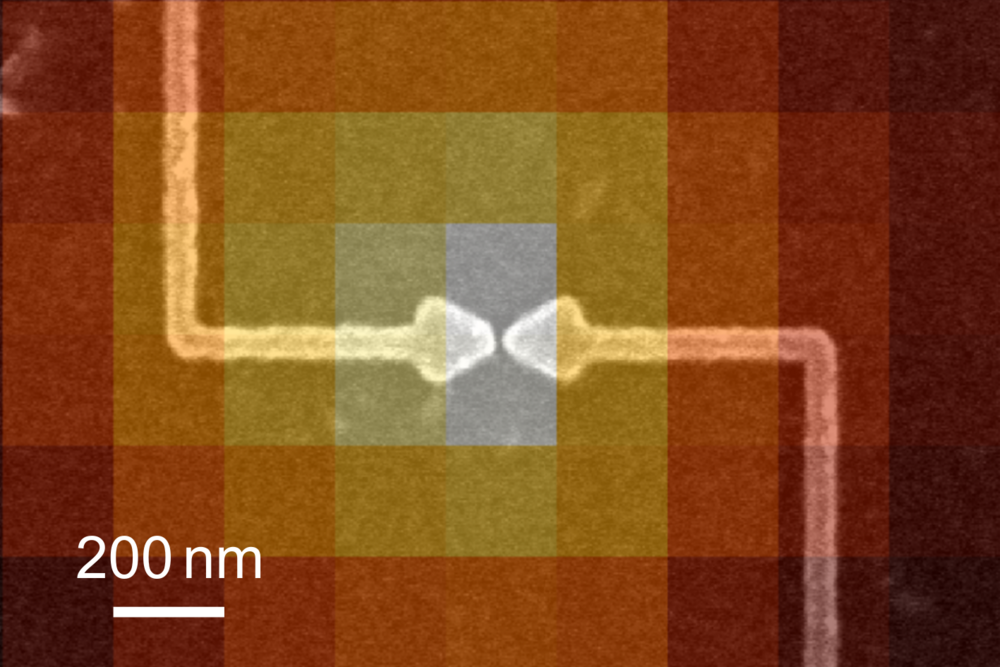
Photocurrent (colored) generated by a laser beam focused on quantum dots between nanoelectrodes (grey). Image: Uni Graz / Grimaldi

Photocurrent (colored) generated by a laser beam focused on quantum dots between nanoelectrodes (grey). Image: Uni Graz / Grimaldi

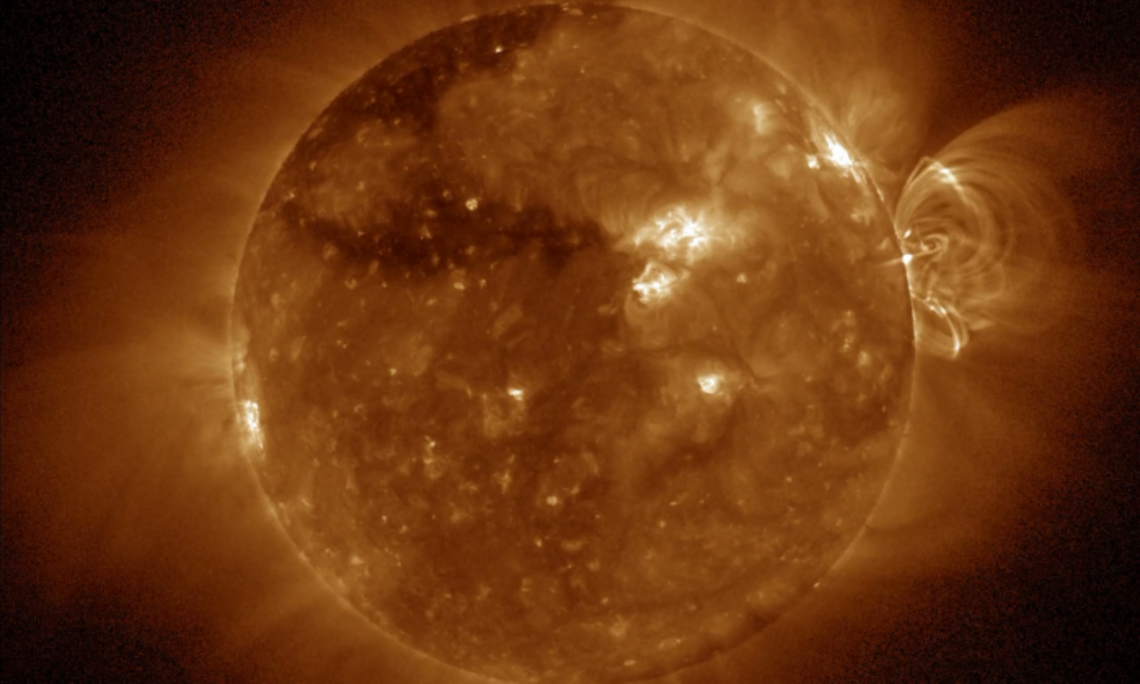
Today's ecological and political crises are increasingly focusing on the production and use of clean forms of energy. Photovoltaics in particular stands out here, relying on the by human standards endless energy hitting the earth in the form of sun light. In photovoltaic semiconductor components, light quanta generate charge carriers that are subsequently available as electrical energy. The underlying process, the photoelectric effect, was successfully interpreted almost 120 years ago by Albert Einstein, for which he received the 1921 Nobel Prize in Physics.

However, while experiments at that time only took place with macroscopic objects, the undelying effects can nowadays be observed on the smallest scales. For this purpose, the Nanooptics group has used modern electron beam lithography to fabricate nanoscale structures that serve as electrodes with tiny gaps as small as 10 nanometers. In cooperation with the ETH Zurich, these gaps were filled with several small, so-called quantum dots, which are only 4-5 nm in size and can convert absorbed light into electricity due to their semiconducting nature.

During the experiments on this system, an unexpected regularity was observed over several orders of magnitude of the incident light intensity: The current generated by the light – but also the noise of the current – ​​do not depend linearly on the light intensity, but follow a power law. These results provide insight into the elementary processes of the interaction of light with matter and could help to increase the efficiency of future photovoltaic components or sensors.

The results were published in Nanoscale Advances, supported by the Open Access Publication Fund of the University of Graz.

D. Grimaldi, E. Kelderer, D. N. Dirin, M. V. Kovalenko, A. Hohenau, H. Ditlbacher, J. R. Krenn, Photoconductivity of PbS/perovskite quantum dots in gold nanogaps, Nanoscale Adv. 4, 3566-3572 (2022), https://pubs.rsc.org/en/content/articlelanding/2022/na/d2na00284a.

created by Dario Grimaldi

Related news

Teaching vignettes for working with Arduino in teacher education

The field of physics education focuses, among other things, on how pre-service teachers can be supported in using digital media effectively in science education. One area of research specifically addresses digital data acquisition using Arduino microcontrollers.

Flawlessness defying imperfection

Researchers from the OpNaQ group (Banzer) at the University of Graz and international partners have demonstrated a miniaturized silicon‑nitride photonic chip that can precisely measure the polarization of visible light, even though some of its own components are imperfect. The work, published recently in Advanced Photonics Nexus, demonstrates a new class of passive, compact, and high‑speed on‑chip polarimeters designed for applications ranging from biomedical imaging to quantum communication.

How Do Adolescents Evaluate the Credibility of Instagram Posts?

A new article has been published in the Journal of Baltic Science Education.

Shaping the Future of Sensing, Together

The Christian Doppler Laboratory for Structured Matter Based Sensing (CDL-SMBS) is entering a new phase following its successful first evaluation at the end of 2024, and two expansions in 2024 and more recently in 2026.

Begin of page section:
Additional information:

University of Graz
Universitaetsplatz 3
8010 Graz
Austria
  • Contact
  • Web Editors
  • Moodle
  • UNIGRAZonline
  • Imprint
  • Data Protection Declaration
  • Accessibility Declaration
Weatherstation
Uni Graz

End of this page section. Go to overview of page sections

End of this page section. Go to overview of page sections

Begin of page section:

End of this page section. Go to overview of page sections