Begin of page section:
Page sections:

  • Go to contents (Accesskey 1)
  • Go to position marker (Accesskey 2)
  • Go to main navigation (Accesskey 3)
  • Go to sub navigation (Accesskey 4)
  • Go to additional information (Accesskey 5)
  • Go to page settings (user/language) (Accesskey 8)
  • Go to search (Accesskey 9)

End of this page section. Go to overview of page sections

Begin of page section:
Page settings:

English en
Deutsch de
Search
Login

End of this page section. Go to overview of page sections

Begin of page section:
Search:

Search for details about Uni Graz
Close

End of this page section. Go to overview of page sections


Search

Begin of page section:
Main navigation:

Page navigation:

  • University

    University
    • About the University
    • Organisation
    • Faculties
    • Library
    • Working at University of Graz
    • Campus
    Developing solutions for the world of tomorrow - that is our mission. Our students and our researchers take on the great challenges of society and carry the knowledge out.
  • Research Profile

    Research Profile
    • Our Expertise
    • Research Questions
    • Research Portal
    • Promoting Research
    • Research Transfer
    • Ethics in Research
    • Commission for Scientific Integrity
    Scientific excellence and the courage to break new ground. Research at the University of Graz creates the foundations for making the future worth living.
  • Studies

    Studies
    • Prospective Students
    • Students
  • Community

    Community
    • International
    • Location
    • Research and Business
    • Alumni
    The University of Graz is a hub for international research and brings together scientists and business experts. Moreover, it fosters the exchange and cooperation in study and teaching.
Topics
  • Sustainable University
  • Researchers answer
  • Work for us
Close menu

End of this page section. Go to overview of page sections

Begin of page section:
You are here:

University of Graz Natural sciences Institute of Physics News Flawlessness defying imperfection
  • About the institute
  • Our research
  • Personalities
  • Student Services
  • News
  • Events

End of this page section. Go to overview of page sections

Monday, 01 June 2026

Flawlessness defying imperfection

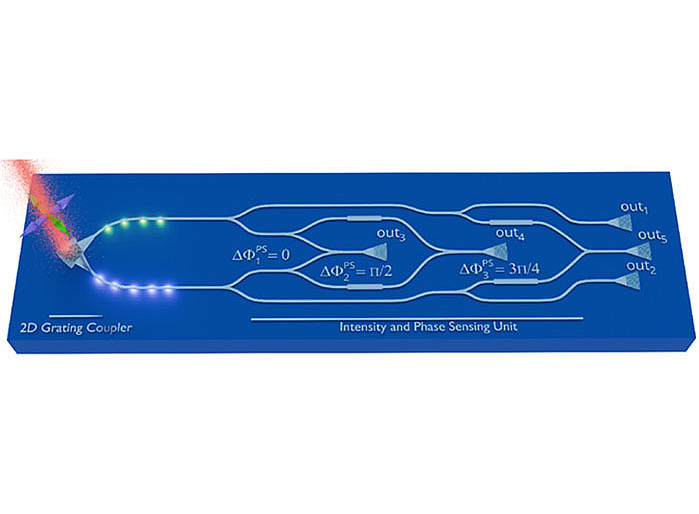
Schematic view of the photonic integrated circuit for polarization metrology. Christoph Stockinger, University of Graz ©University of Graz / Stockinger

Schematic view of the photonic integrated circuit for polarization metrology. - Image: University of Graz / Stockinger

Researchers from the OpNaQ group (Banzer) at the University of Graz and international partners have demonstrated a miniaturized silicon‑nitride photonic chip that can precisely measure the polarization of visible light, even though some of its own components are imperfect. The work, published recently in Advanced Photonics Nexus, demonstrates a new class of passive, compact, and high‑speed on‑chip polarimeters designed for applications ranging from biomedical imaging to quantum communication.

At the heart of the on-chip polarimeter is a compact polarization‑splitting grating coupler that directs two linear polarization components into separate waveguides on the chip. These signals are then analyzed by a network of passive interferometers, allowing the full polarization state to be reconstructed using only intensity measurements; no moving parts, modulators, or active tuning required.

Because extreme miniaturization can make such components less performant and sensitive to deviations, the researchers introduced a robust calibration method that compensates for imperfections in the polarization splitting capabilities of grating couplers, and fabrication tolerances of waveguides and phase shifters. Using a programmable polarization state generator, the chip can be fully calibrated, enabling highly accurate polarization measurements of arbitrary input states.

This advance paves the way for scalable, low‑cost, and fast polarimetric sensors, including future 2D detector arrays for imaging polarimetry in the visible spectrum.

Link to publication: 
https://www.spiedigitallibrary.org/90f072ad-89a6-4d76-94a6-16ce92843e04

Contact:
Peter Banzer, peter.banzer(at)uni-graz.at

Additional links: 
https://structured-matter.com/
https://opnaq.uni-graz.at/en/research/

Related news

How Do Adolescents Evaluate the Credibility of Instagram Posts?

A new article has been published in the Journal of Baltic Science Education.

Shaping the Future of Sensing, Together

The Christian Doppler Laboratory for Structured Matter Based Sensing (CDL-SMBS) is entering a new phase following its successful first evaluation at the end of 2024, and two expansions in 2024 and more recently in 2026.

Under Current

High-Resolution Imaging with Quantum Dots and Atomic Force Microscopy

The Josef Krainer „Förderungspreis“ goes to Stefan Purkhart

Stefan Purkhart from the Institute of Physics at the University of Graz has been awarded the Josef Krainer „Förderungspreis“ 2026 for his dissertation.

Begin of page section:
Additional information:

University of Graz
Universitaetsplatz 3
8010 Graz
Austria
  • Contact
  • Web Editors
  • Moodle
  • UNIGRAZonline
  • Imprint
  • Data Protection Declaration
  • Accessibility Declaration
Weatherstation
Uni Graz

End of this page section. Go to overview of page sections

End of this page section. Go to overview of page sections

Begin of page section:

End of this page section. Go to overview of page sections