Quantum gravity remains an elusive and challenging subject. Using numerical simulations of a candidate theory based on general relativity, known as causal dynamical triangulations, a major step has been taken.
Any quantum theory of gravity needs to describe the quantum version of pure gravity black holes, so-called Schwarzschild black holes. However, as gravity becomes quantized in terms of gravitons, and such black hole needs to be made up by such gravitons, a bound state.
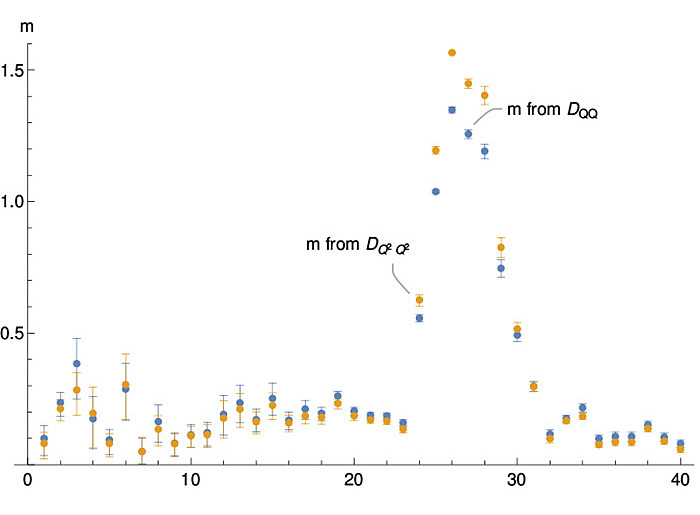
Using these simulations, a team around Axel Maas has provided first hints of the existence of such bound states of gravitons, also called geons. It exhibits a significant mass, which is sensitive to the extension of the universe during its evolution. While further work is required to determine whether this is indeed a quantum version of a black hole, this has been a major proof of principle in this direction.
Eventually, this quantum nature of black holes should also be testable in the pattern of gravitational waves emitted by colliding black holes.
Such calculation are necessary first steps to predict such patterns, e.g. at the future Einstein telescope, in which Austria currently plans to become a member.
Contact person: Axel Maas
Link to the article: dx.doi.org/10.1016/j.physletb.2026.140600
Referenz: Phys. Lett. B 879 (2026) 140600