Begin of page section:
Page sections:

  • Go to contents (Accesskey 1)
  • Go to position marker (Accesskey 2)
  • Go to main navigation (Accesskey 3)
  • Go to sub navigation (Accesskey 4)
  • Go to additional information (Accesskey 5)
  • Go to page settings (user/language) (Accesskey 8)
  • Go to search (Accesskey 9)

End of this page section. Go to overview of page sections

Begin of page section:
Page settings:

English en
Deutsch de
Search
Login

End of this page section. Go to overview of page sections

Begin of page section:
Search:

Search for details about Uni Graz
Close

End of this page section. Go to overview of page sections


Search

Begin of page section:
Main navigation:

Page navigation:

  • University

    University
    • About the University
    • Organisation
    • Faculties
    • Library
    • Working at University of Graz
    • Campus
    Developing solutions for the world of tomorrow - that is our mission. Our students and our researchers take on the great challenges of society and carry the knowledge out.
  • Research Profile

    Research Profile
    • Our Expertise
    • Research Questions
    • Research Portal
    • Promoting Research
    • Research Transfer
    • Ethics in Research
    • Commission for Scientific Integrity
    Scientific excellence and the courage to break new ground. Research at the University of Graz creates the foundations for making the future worth living.
  • Studies

    Studies
    • Prospective Students
    • Students
    • Registration for Study Programme (Winter semester 2026/27)
    • Study Days 22-26 June 2026
  • Community

    Community
    • International
    • Location
    • Research and Business
    • Alumni
    The University of Graz is a hub for international research and brings together scientists and business experts. Moreover, it fosters the exchange and cooperation in study and teaching.
Topics
  • Sustainable University
  • Researchers answer
  • Work for us
Close menu

End of this page section. Go to overview of page sections

Begin of page section:
You are here:

University of Graz Natural sciences Institute of Physics News Gold Medal of Honour for Willibald Plessas
  • About the institute
  • Our research
  • Personalities
  • Student Services
  • News
  • Events

End of this page section. Go to overview of page sections

Wednesday, 24 June 2026

Gold Medal of Honour for Willibald Plessas

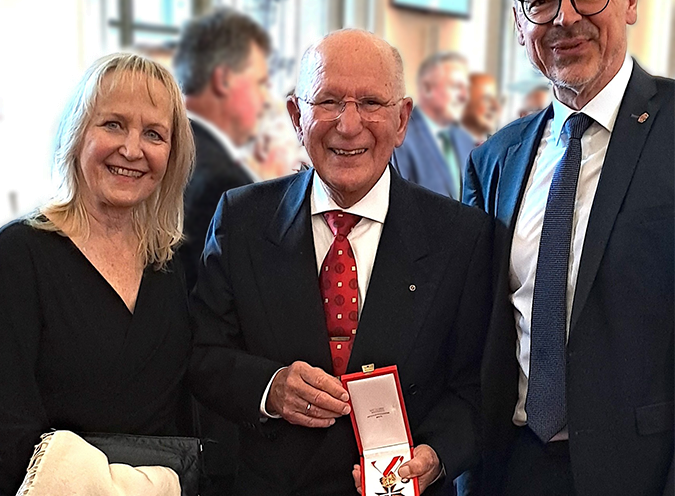
(von rechts nach links) Rektor der Kunstuniversität Graz, ao. Univ.-Prof. MMag. Dr. Georg Schulz, Ao.Univ.-Prof.i.R. Dr. Willibald Plessas und Frau Dr. Ulrike Erhart-Sauseng, Vizepräsidentin bei der Gesellschaft der Freunde der KUG. - Foto: Uni Graz / Weiss ©Uni Graz / Weiss

(from right to left) Rector of the University of Music and Performing Arts Graz, Associate Professor MMag. Dr. Georg Schulz, Retired Associate Professor Dr. Willibald Plessas, and Dr. Ulrike Erhart-Sauseng, Vice President of the Society of Friends of the KUG. — Photo: University of Graz / Weiss

On 11 June 2026, Willibald Plessas was awarded the Golden Medal of Honour for Services

to the Republic of Austria in the auditorium of the Old University of Graz.

Willibad Plessas is an Associate Professor Emeritus at the University of Graz, an elected member of the European Academy of Sciences and Arts (EASA), and a long-standing President of the Society of Friends of the University of Music and Performing Arts Graz. From 2003 to 2008, he also served as Chair of the University Council of the KUG. In all his roles, Willibald Plessas has earned numerous and exceptional merits to the advancement of young people in the university sector. 

As a professor at the Karl-Franzens University of Graz, Plessas gained international recognition for his research into the structure of matter, particularly protons and neutrons. His work in the field of hadron physics brought the ‘Graz School’ to worldwide prominence. Equally influential was his work as a university lecturer and mentor, inspiring and supporting generations of students and young researchers in their scientific pursuits. His commitment to international scientific collaboration was also of great significance. He helped organize the Schladming University Weeks for Theoretical Physics, initiated the Oberwölz Symposia and, together with Heinrich Mitter, founded the journal *Few-Body Systems*, which developed into a prestigious international publication. 

Particular mention should be made of his work at the University of Music and Performing Arts Graz. As President of the Society of Friends of the University of Music and Performing Arts Graz, he has, since 2012, supported numerous students with great dedication by allocating available funds for scholarships and project grants according to transparent criteria, and by securing significant additional funding. This financial support has thus served, not least, as a recognition of the students’ academic achievements. 

The Institute of Physics and the Department of Theoretical Physics extend their warmest congratulations to Willibald Plessas on being awarded the Golden Medal of Honour

Related news

Nano but Mighty: Innovations in confined spaces

At the University of Graz, Peter Banzer and his team (OpNaQ group) are controlling light in extremely confined spaces, enabling entirely new applications in physics, biology, and medicine. By precisely tailoring light fields at the nanometer scale, they can exert forces, extract information, and make hidden features visible.

A quantum black hole?

First hints for a bound state of gravitons, which could be a primordial black hole

Teaching vignettes for working with Arduino in teacher education

The field of physics education focuses, among other things, on how pre-service teachers can be supported in using digital media effectively in science education. One area of research specifically addresses digital data acquisition using Arduino microcontrollers.

Flawlessness defying imperfection

Researchers from the OpNaQ group (Banzer) at the University of Graz and international partners have demonstrated a miniaturized silicon‑nitride photonic chip that can precisely measure the polarization of visible light, even though some of its own components are imperfect. The work, published recently in Advanced Photonics Nexus, demonstrates a new class of passive, compact, and high‑speed on‑chip polarimeters designed for applications ranging from biomedical imaging to quantum communication.

Begin of page section:
Additional information:

University of Graz
Universitaetsplatz 3
8010 Graz
Austria
  • Contact
  • Web Editors
  • Moodle
  • UNIGRAZonline
  • Imprint
  • Data Protection Declaration
  • Accessibility Declaration
Weatherstation
Uni Graz

End of this page section. Go to overview of page sections

End of this page section. Go to overview of page sections

Begin of page section:

End of this page section. Go to overview of page sections